✎ Indian semiconductor startups raised $206M since 2022, with DLI-backed firms attracting $100.8M in VC funding amid investor focus on mature ventures.
Relevance for Banking, SSC & RBI Grade B exams: Economy/Governance
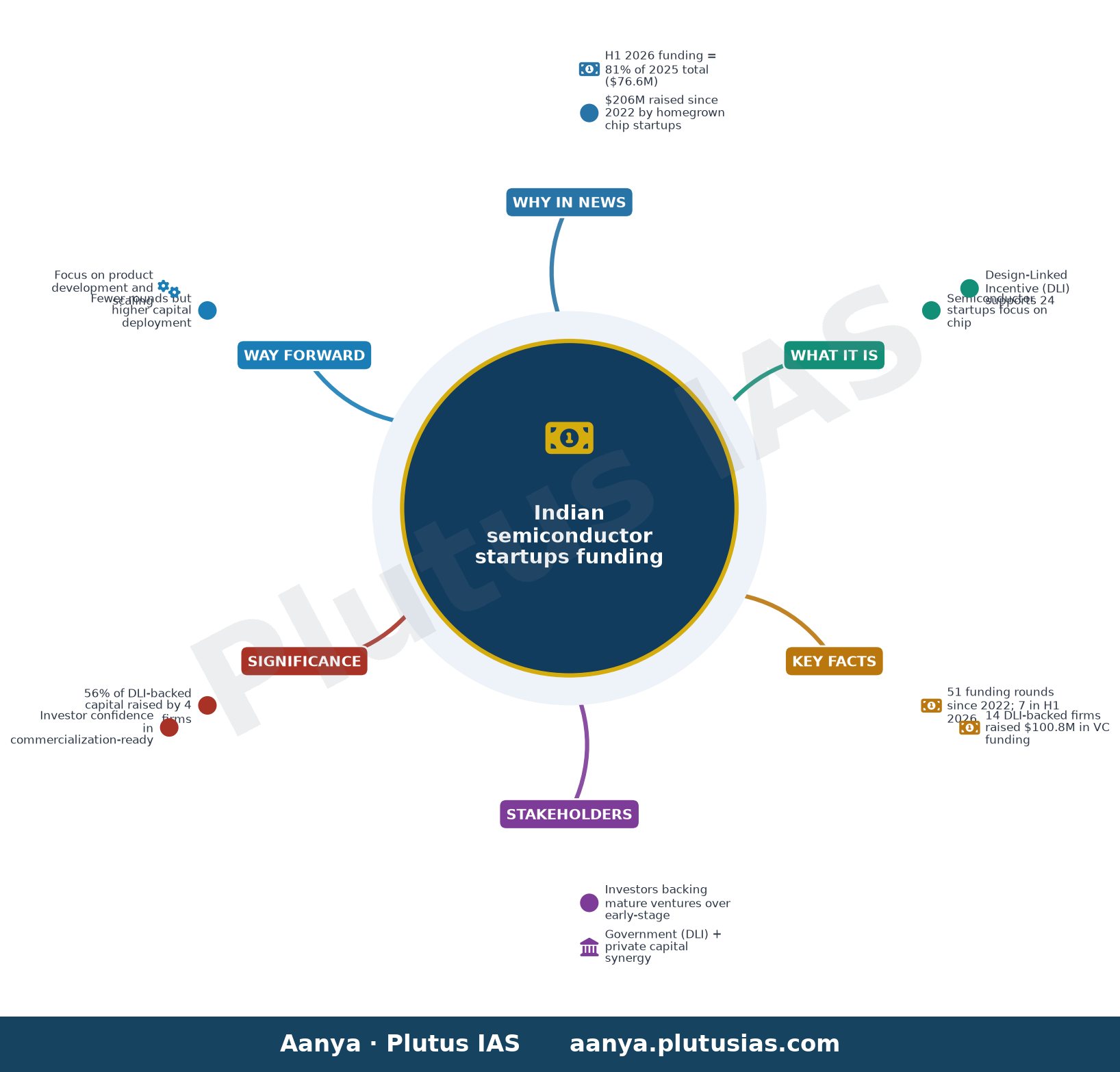
A recent report by Speciale Invest and Startup Policy Forum highlights that homegrown semiconductor startups have raised $206 million across 51 funding rounds since 2022, with $61.9 million secured in the first half of 2026 alone—81% of the $76.6 million raised in the entirety of 2025. The trend indicates a shift toward concentrated investments in mature ventures, particularly those supported by government initiatives like the Design-Linked Incentive (DLI) programme, which has enabled 14 chip-design projects to attract $100.8 million in venture capital. This aligns with broader economic priorities, as India aims to bolster its semiconductor ecosystem amid global supply chain shifts, making it relevant for banking and SSC exams where questions on government schemes, startup funding, and economic policies are common.
For RBI Grade B aspirants, the focus on strategic investors—such as Zoho and TDK Ventures—and the increasing role of global semiconductor firms in India’s startup ecosystem underscores the intersection of technology, governance, and capital flows. The diversification into photonics, power semiconductors, and AI-driven chip design reflects India’s evolving industrial strategy, a key theme in governance-related questions. Banking exams may test awareness of how such investments impact financial inclusion, credit growth, or sectoral policies, while SSC aspirants could encounter questions on the role of startups in economic development or the impact of government incentives on innovation.
Source: Business Standard
Generated by AanyaAi for educational purpose.
