✎ Jal Jeevan Mission 2.0 aims to provide safe drinking water to all rural households by Dec 2028 with ₹8.69 lakh cr outlay.
Relevance for Banking, SSC & RBI Grade B exams: Polity & Governance
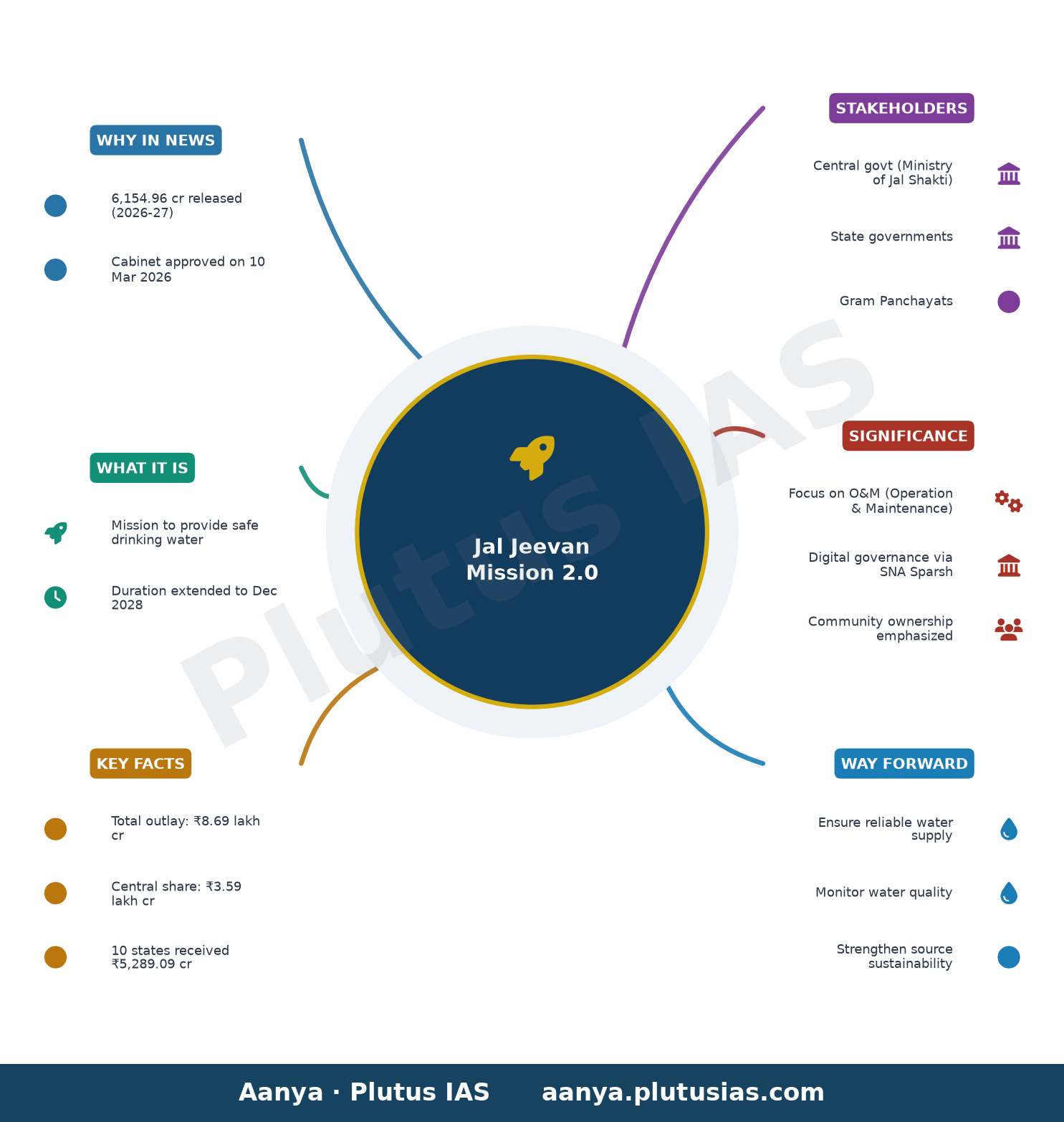
The Union Government has accelerated the implementation of Jal Jeevan Mission (JJM) 2.0 by releasing ₹6,154.96 crore to states during 2026-27, including ₹5,289.09 crore as central share to 10 states and ₹865.87 crore via the SNA-Sparsh platform to 13 states. Approved by the Union Cabinet in March 2026 under the expanded framework of JJM 2.0, the mission now runs until December 2028 with a total outlay of ₹8.69 lakh crore, including ₹3.59 lakh crore central assistance, to ensure reliable, adequate and safe piped water supply to every rural household. The shift from infrastructure creation to operation, maintenance and community-led governance—backed by digital monitoring through SNA-Sparsh—reflects a transformative governance model that prioritises source sustainability, water quality surveillance and transparent fund flow, making it a key case study in Centre-state fiscal federalism for aspirants preparing for Banking, SSC and RBI Grade B examinations.
For banking and SSC aspirants, JJM 2.0 offers insights into flagship schemes, fund flow mechanisms and digital governance tools like SNA-Sparsh that enhance transparency and accountability—critical themes in economic and governance sections of these exams. RBI Grade B candidates can draw parallels with fiscal federalism, resource allocation and monitoring frameworks, while noting how such centrally sponsored schemes integrate with broader developmental goals like sustainable water security, which often appear in descriptive and analytical questions.
Source: PIB (Press Information Bureau)
Generated by AanyaAi for educational purpose.
