
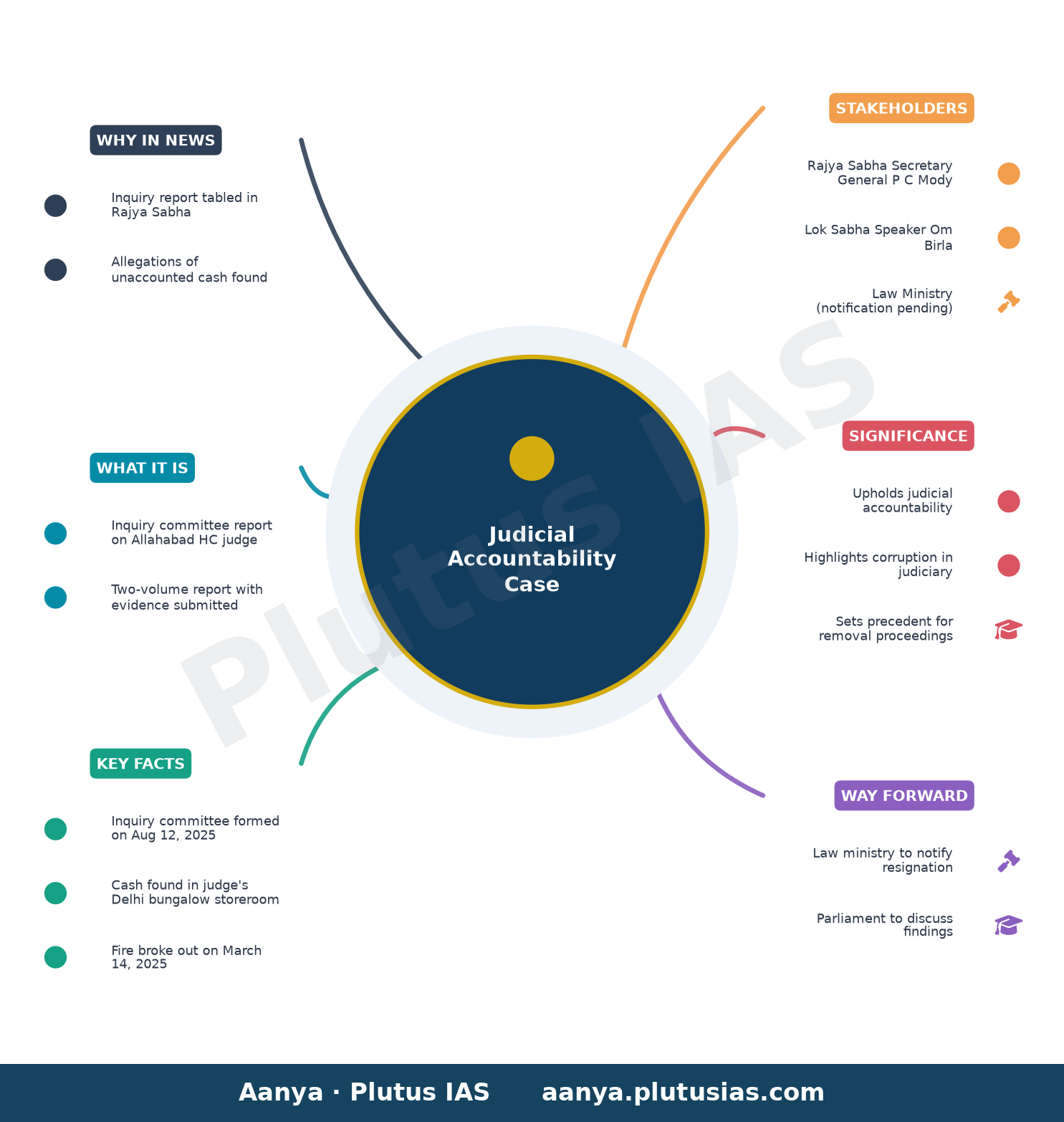
✎ Judicial accountability ensures transparency and integrity in the judiciary, as seen in the case of Justice Varma's resignation following unaccounted cash allegations.
Relevance for Banking, SSC & RBI Grade B exams: Economy/Governance
The inquiry report on former Allahabad High Court Judge Justice Yashwant Varma, tabled in the Rajya Sabha on August 12, 2026, highlights serious allegations of financial misconduct, including the discovery of unaccounted cash from his official residence during a fire incident in March 2025. The three-member probe panel, constituted by Lok Sabha Speaker Om Birla, found that Justice Varma had “active or tacit control” over the storeroom where the cash was hidden, as per an in-house committee report by then Chief Justice of India Sanjiv Khanna. Though Justice Varma resigned before impeachment proceedings could conclude, his resignation has not yet been formally notified by the Law Ministry, leaving the matter pending. This case underscores the importance of transparency and accountability in the judiciary, a key governance issue relevant for banking and administrative exams, as it reflects on ethical standards and institutional integrity.
For Banking PO, SSC, and RBI Grade B aspirants, this incident is significant as it touches upon governance, ethics, and the legal framework governing judicial appointments and removals. Questions on judicial accountability, the process of impeachment of judges under Article 124(4) of the Constitution, and the role of parliamentary committees may appear in exams. Additionally, the case highlights the need for strict adherence to financial disclosures and anti-corruption measures, which are often tested in banking and civil services examinations. Understanding such high-profile cases helps aspirants grasp the interplay between constitutional provisions, parliamentary procedures, and ethical governance.
Source: Hindustan Times
Generated by AanyaAi for educational purpose.
