
✎ Ken-Betwa Link Project requires strict adherence to tribal rehabilitation policies under FRA 2006 and national norms.
Relevance for Banking, SSC & RBI Grade B exams: Polity & Governance
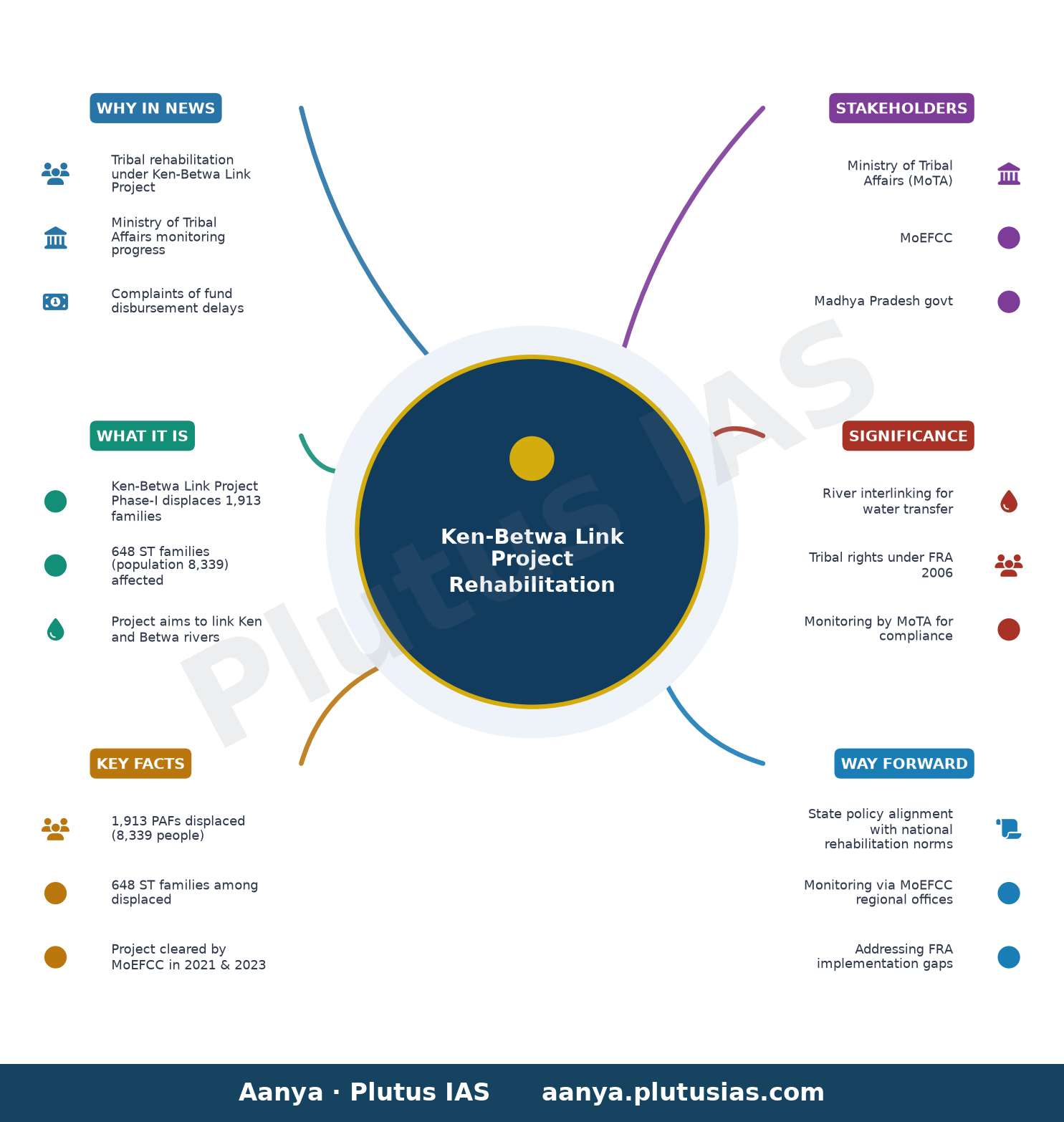
The Ken-Betwa Link Project (KBLP), a major interlinking river initiative under the National Perspective Plan, aims to address water scarcity in drought-prone regions of Uttar Pradesh and Madhya Pradesh. However, its implementation has raised concerns regarding the displacement and rehabilitation of tribal communities, particularly those dependent on forest and riverine ecosystems. According to a PIB release dated August 6, 2026, the Tribal Affairs Ministry has clarified that while land acquisition and rehabilitation activities are being carried out by state governments, the monitoring of resettlement plans for Scheduled Tribe (ST) Project-Affected Families (PAFs) remains a critical focus. The Ministry highlighted that out of 1,913 displaced families (8,339 individuals) in Phase-I, 648 belong to ST communities, necessitating strict adherence to the Forest Rights Act (FRA), 2006, and the National Rehabilitation and Resettlement Policy to ensure fair compensation and alternative livelihoods. The Ministry also noted that while no complaints regarding fund disbursement were recorded, issues related to delayed or incomplete rehabilitation have been raised, prompting investigations by state authorities.
For banking and SSC aspirants, this issue underscores the intersection of governance, environmental policy, and socio-economic justice, which are frequently tested in exams like RBI Grade B and UPSC Prelims. Questions may probe the role of the Tribal Affairs Ministry in monitoring resettlement, the legal framework governing tribal rights (e.g., FRA, 2006), or the procedural steps for land acquisition under the Right to Fair Compensation and Transparency in Land Acquisition, Rehabilitation and Resettlement (RFCTLARR) Act, 2013. Similarly, SSC CGL candidates might encounter questions on the ecological impact of river-linking projects or the constitutional provisions safeguarding tribal interests (e.g., Fifth and Sixth Schedules). The KBLP case exemplifies how infrastructure projects must balance developmental goals with constitutional and statutory obligations, a recurring theme in governance-related current affairs.
Source: PIB (Press Information Bureau)
Generated by AanyaAi for educational purpose.
