
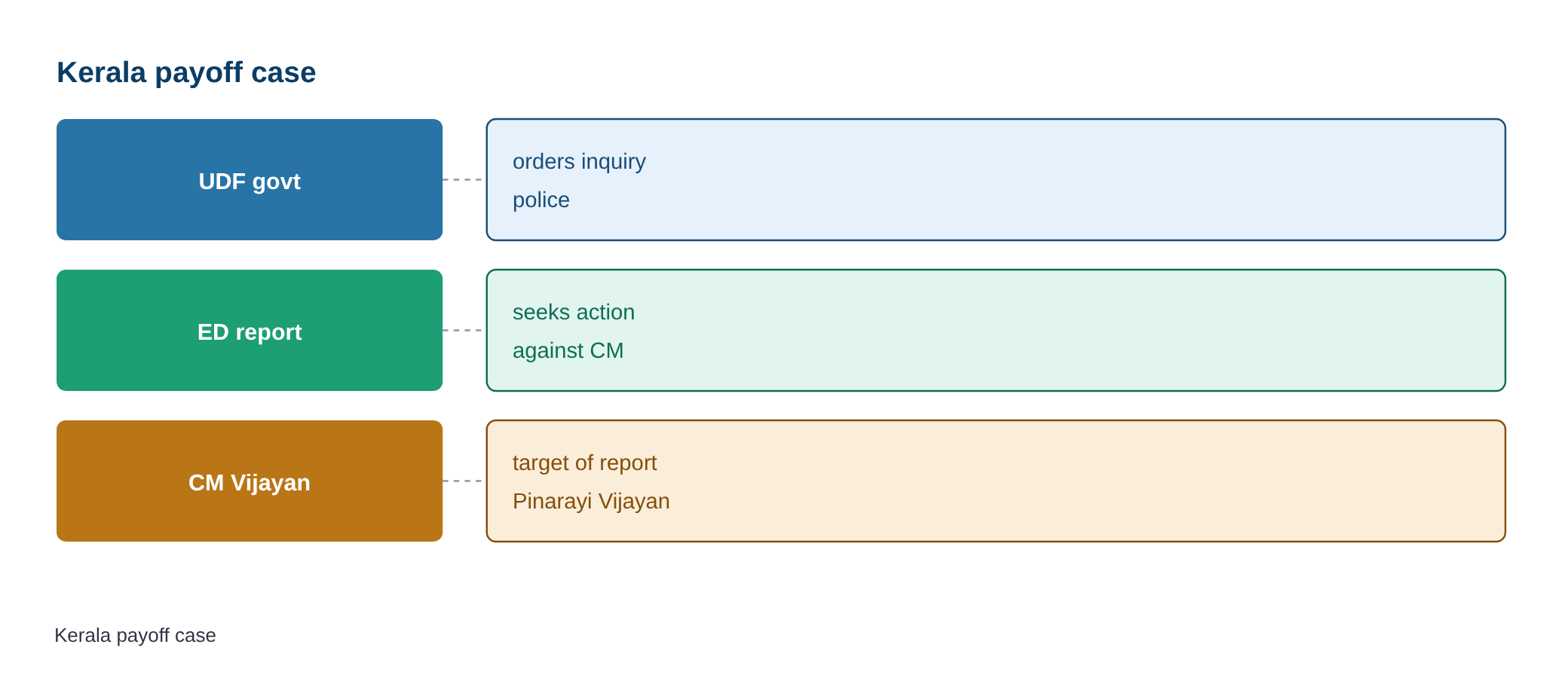
✎ Kerala’s UDF govt ordered a police inquiry into the Exalogic-CMRL payoff case based on legal prerequisites and Supreme Court rulings, highlighting the interplay between law and politics in corruption probes.
Relevance for Banking, SSC & RBI Grade B exams: Economy/Governance
The Kerala government’s UDF administration has ordered a police inquiry into the Exalogic-CMRL payoff case, following the Enforcement Directorate’s (ED) report that sought action against former Chief Minister Pinarayi Vijayan, his daughter T. Veena, and son-in-law P.A. Mohamed Riyas. Home Minister Ramesh Chennithala clarified that the decision was based on legal prerequisites, citing Supreme Court rulings in *Vijay Madanlal Choudhary vs Union of India* and *Lalita Kumari vs State of Uttar Pradesh*, which mandate law enforcement agencies to act on ED’s shared information under PMLA while allowing preliminary inquiries before FIR registration. The ED’s 25-page report alleges that CMRL, a state-owned chemical company, camouflaged bribes as consultancy payments to Veena’s firm, Exalogic Solutions, during Vijayan’s tenure (2017-2021), with a diary allegedly detailing these transactions seized during a raid on Vijayan’s residence. While Vijayan and Riyas have denied the allegations, the case underscores the intersection of financial irregularities, political accountability, and legal scrutiny, making it a critical governance issue for competitive exam aspirants.
For banking and SSC examinations, this case highlights the role of investigative agencies like the ED in tackling financial crimes, the legal framework governing money laundering (PMLA), and the procedural nuances of preliminary inquiries versus FIRs. RBI Grade B aspirants should note how such high-profile cases impact governance, public trust, and regulatory oversight in state-owned enterprises, while also testing their understanding of Supreme Court judgments on investigative agencies’ powers. The controversy also serves as a case study for SSC aspirants on corruption, transparency, and the balance between political accountability and legal processes, reflecting broader themes in governance and administrative ethics.
Source: The Hindu
Generated by AanyaAi for educational purpose.

1 comment on “Kerala UDF Orders Police Probe into CMRL-Exalogic Payoff Case Against Pinarayi Vijayan”