
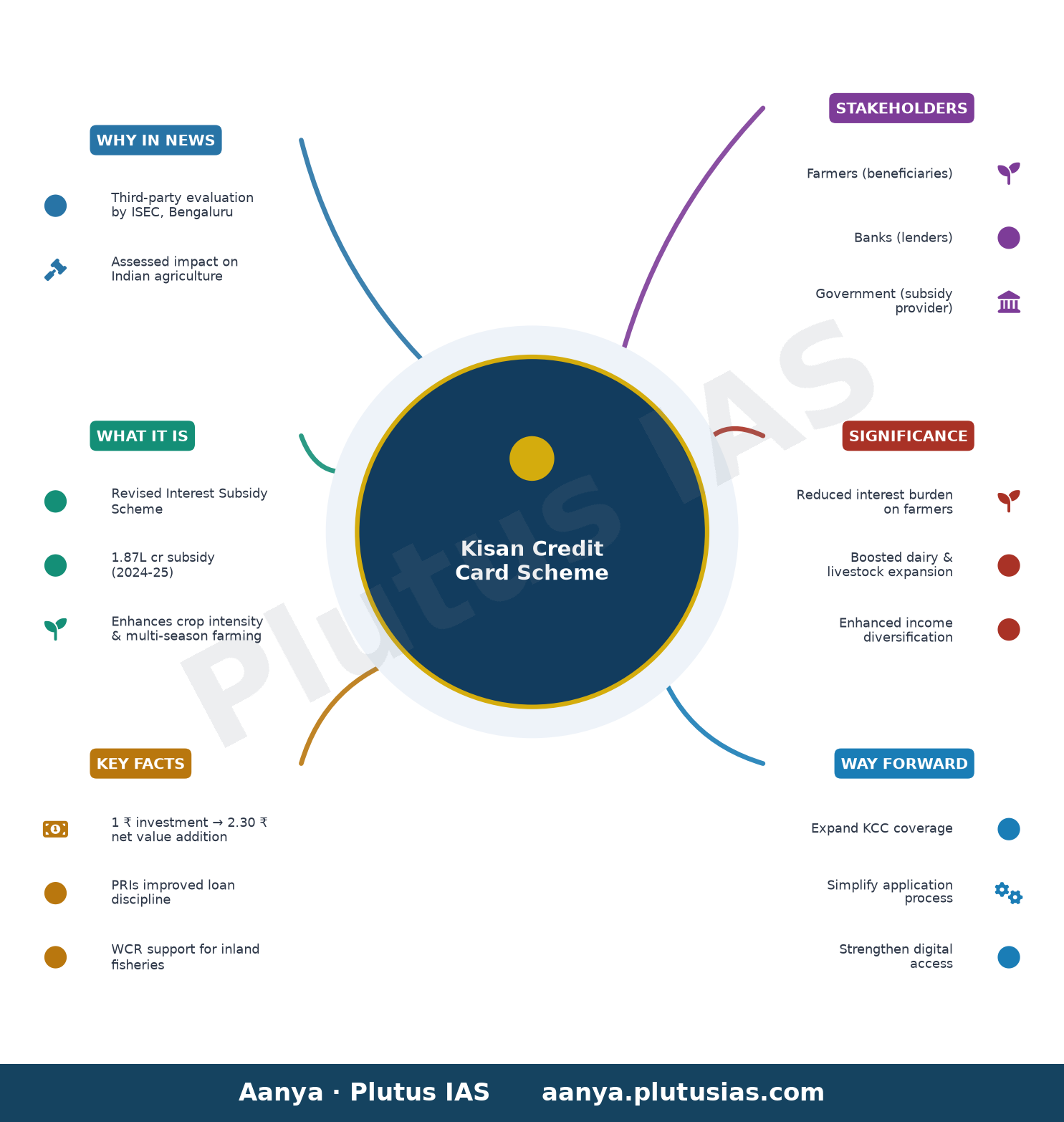
✎ Kisan Credit Card Scheme boosts agri GDP via 2.30x value addition per ₹1 investment, reducing interest burden and enhancing multi-season farming.
Relevance for Banking, SSC & RBI Grade B exams: Polity & Governance
The third-party evaluation by the Institute for Social and Economic Change (ISEC), Bengaluru, has highlighted the significant economic impact of the Kisan Credit Card (KCC) – Modified Interest Subsidy Scheme, revealing that every ₹1 invested in the scheme generates ₹2.30 in net value addition in agriculture and allied sectors. This multiplier effect underscores the scheme’s role in enhancing agricultural productivity and rural income. The Modified Interest Subsidy Scheme has also played a pivotal role in reducing the financial burden on farmers, with an estimated subsidy outlay of ₹1.87 lakh crore from its inception until 2024-25. Additionally, the scheme has positively influenced crop intensity and multi-season farming, enabling farmers to cultivate larger areas, adopt diversified crop portfolios, and improve input utilization through timely access to working capital. Early repayment incentives have further strengthened credit discipline, boosting lenders’ confidence in agricultural financing.
For banking aspirants preparing for exams like IBPS PO, SBI Clerk, or RBI Grade B, this scheme is highly relevant as it reflects the government’s efforts to streamline agricultural credit delivery through digital initiatives like the Kisan Credit Card Portal, Jan Samarth Portal, and e-KCC. The expansion of collateral-free loan limits to ₹2 lakh and the focus on digital inclusion highlight the evolving role of banks in rural financial inclusion. For SSC aspirants, particularly those appearing for exams like CGL or CHSL, understanding the KCC scheme’s socio-economic impact and its integration with digital governance models can be crucial for questions related to government welfare schemes and financial inclusion policies. The scheme also aligns with broader themes of rural development and sustainable agriculture, which are frequently tested in competitive examinations.
Source: PIB (Press Information Bureau)
Generated by AanyaAi for educational purpose.
