
✎ Kerala’s KSEB seeks 500 MW RTC power for 25 years under SHAKTI policy to address power crisis via long-term coal linkage.
Relevance for Banking, SSC & RBI Grade B exams: Polity & Governance
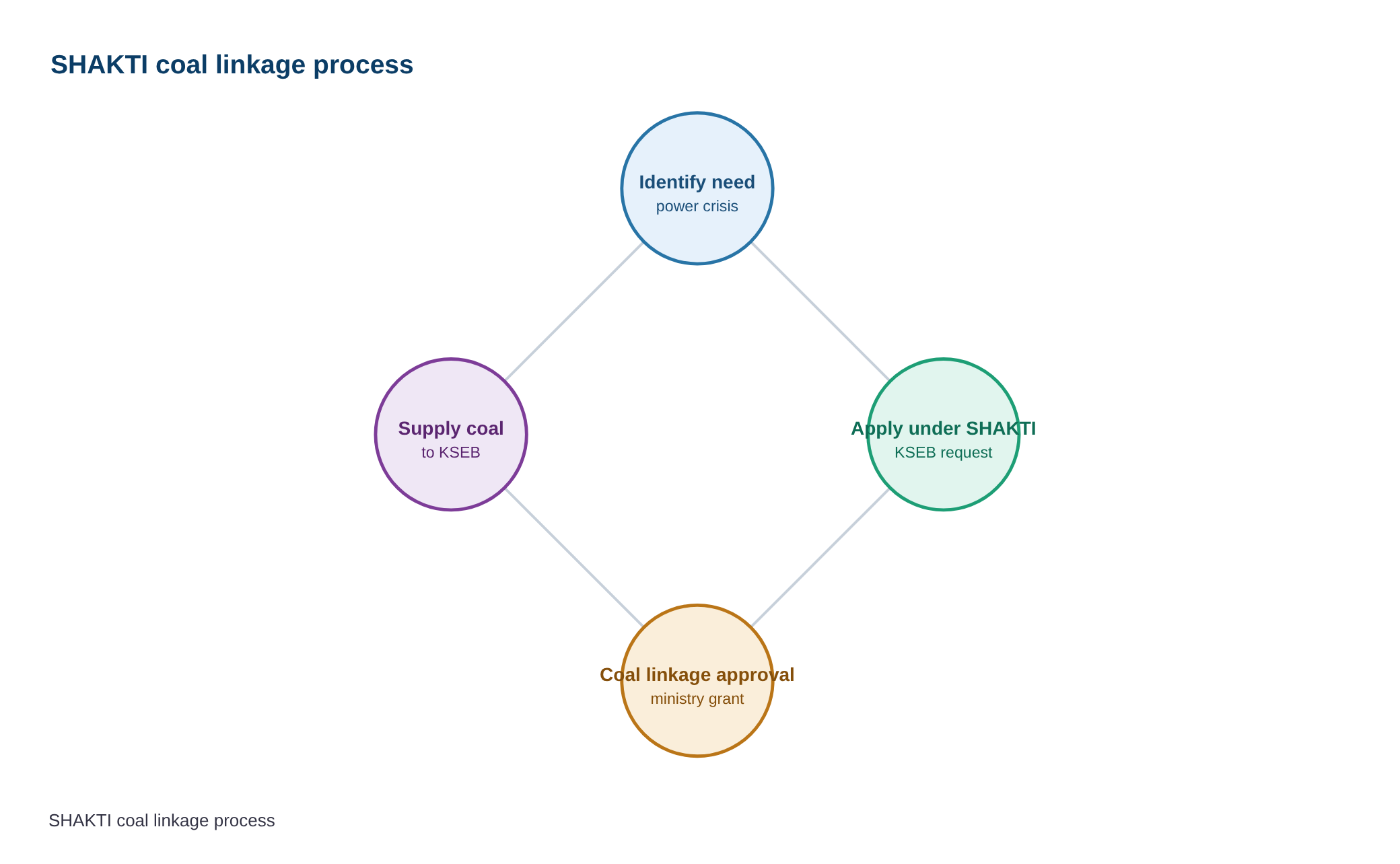
The Kerala State Electricity Board (KSEB) has initiated a fresh attempt to secure a long-term coal-based power supply under the SHAKTI policy, a scheme aimed at transparent allocation of coal linkages to states and distribution companies. The KSEB has issued a Request for Qualification (RfQ) to procure 500 MW of round-the-clock power for 25 years, with supply expected to commence from June 2, 2027. This move comes amid Kerala’s ongoing power crisis, exacerbated by its heavy reliance on imported electricity, which has led to evening power curbs due to supply shortages. The procurement will follow a Design, Build, Finance, Own, and Operate (DBFOO) model, allowing private players to participate in a public-private partnership framework. The SHAKTI policy, introduced by the Union Coal Ministry, enables states to bid for coal linkages under competitive tariff-based procurement, aligning with norms set by the Union Power Ministry.
For banking and government exam aspirants, this development highlights the intersection of energy policy, governance, and economic planning. The SHAKTI policy exemplifies how central schemes are implemented at the state level, reflecting the Centre-State coordination essential for infrastructure and resource allocation. The DBFOO model underscores the growing role of public-private partnerships in critical sectors like power generation, a concept frequently tested in exams such as RBI Grade B and SSC CGL. Additionally, the power crisis in Kerala serves as a case study for understanding energy security, pricing mechanisms, and regulatory challenges, all of which are relevant for aspirants preparing for polity and governance segments.
Source: The Hindu
Generated by AanyaAi for educational purpose.

1 comment on “KSEB’s SHAKTI Policy Move to Resolve Kerala’s Power Crisis with 500 MW Coal Linkage”