✎ Government can now levy MDR on UPI/RuPay transactions to fund fintech and banking infrastructure.
Relevance for Banking, SSC & RBI Grade B exams: Polity
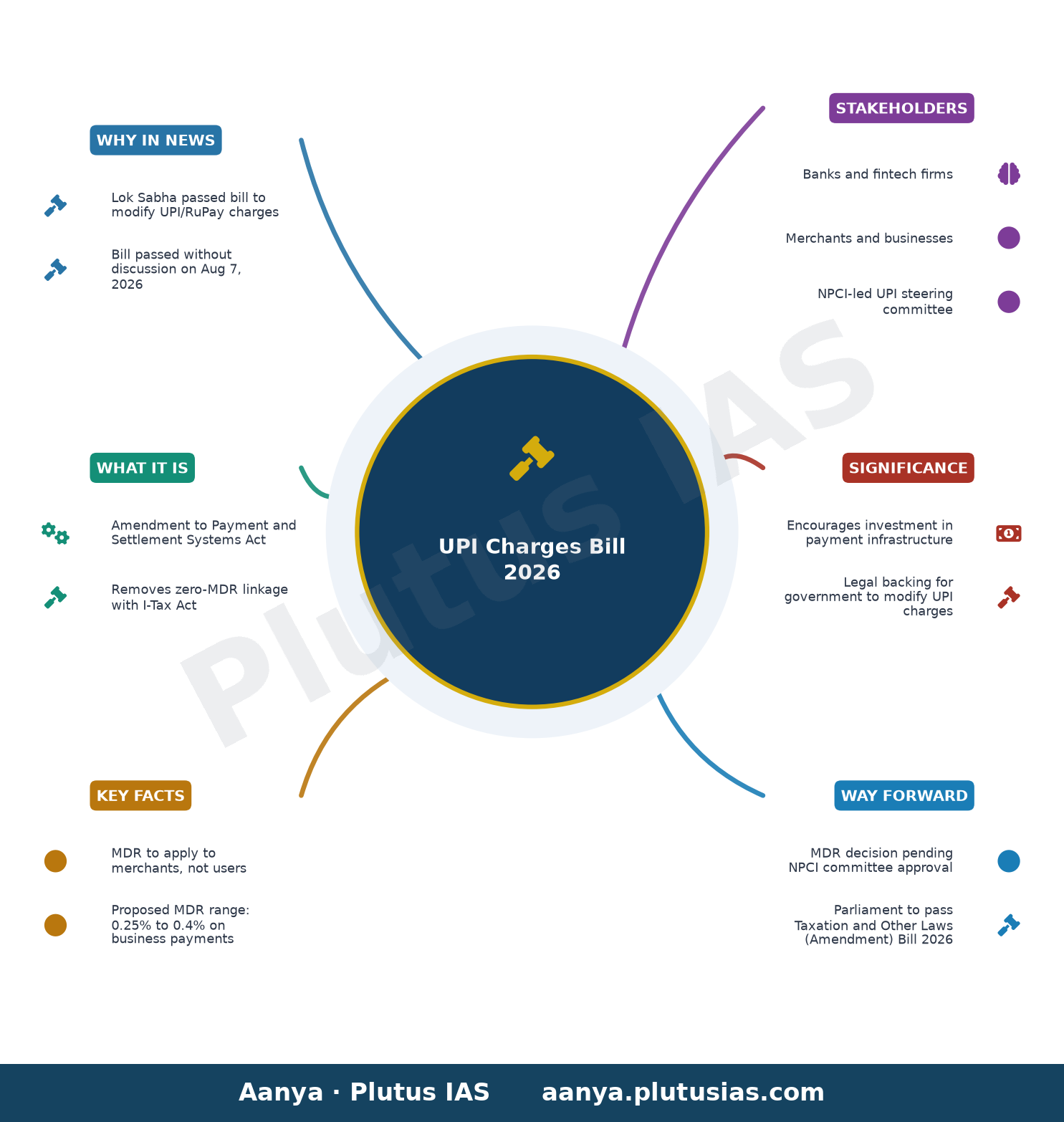
The Lok Sabha recently passed the *Taxation and Other Laws (Amendment) Bill, 2026*, which grants the government the authority to modify the zero-MDR (Merchant Discount Rate) framework on UPI and RuPay card transactions. The bill removes the existing legal restriction that prevents banks and fintech firms from charging MDR on electronic payments, though the Finance Minister clarified that these charges would apply only to merchants and not to end-users. The move aims to facilitate investments in digital payment infrastructure by allowing banks and fintech companies to earn revenue from merchant transactions, which could exceed ₹2,000. However, the final decision on MDR implementation will be determined by the UPI and Services Steering Committee, led by the NPCI, after parliamentary approval. The bill also decouples the Payment and Settlement Systems Act from the Income Tax Act, providing greater flexibility in regulating digital payment systems.
For banking and SSC aspirants, this development is crucial as it highlights the evolving regulatory landscape of digital payments, a key area in both competitive exams and professional banking roles. The bill’s provisions on MDR and UPI transactions directly impact the operational dynamics of banks, fintech firms, and payment service providers, making it a relevant topic for understanding policy changes in the financial sector. For RBI Grade B candidates, the discussion on MDR and its potential impact on transaction costs, financial inclusion, and innovation in digital payments is particularly significant, as it aligns with the central bank’s focus on sustainable and inclusive growth in the payments ecosystem. The debate between the Finance Minister and opposition MPs also underscores the importance of parliamentary discussions on economic policies, a topic frequently tested in exams.
Source: Times of India
Generated by AanyaAi for educational purpose.
