
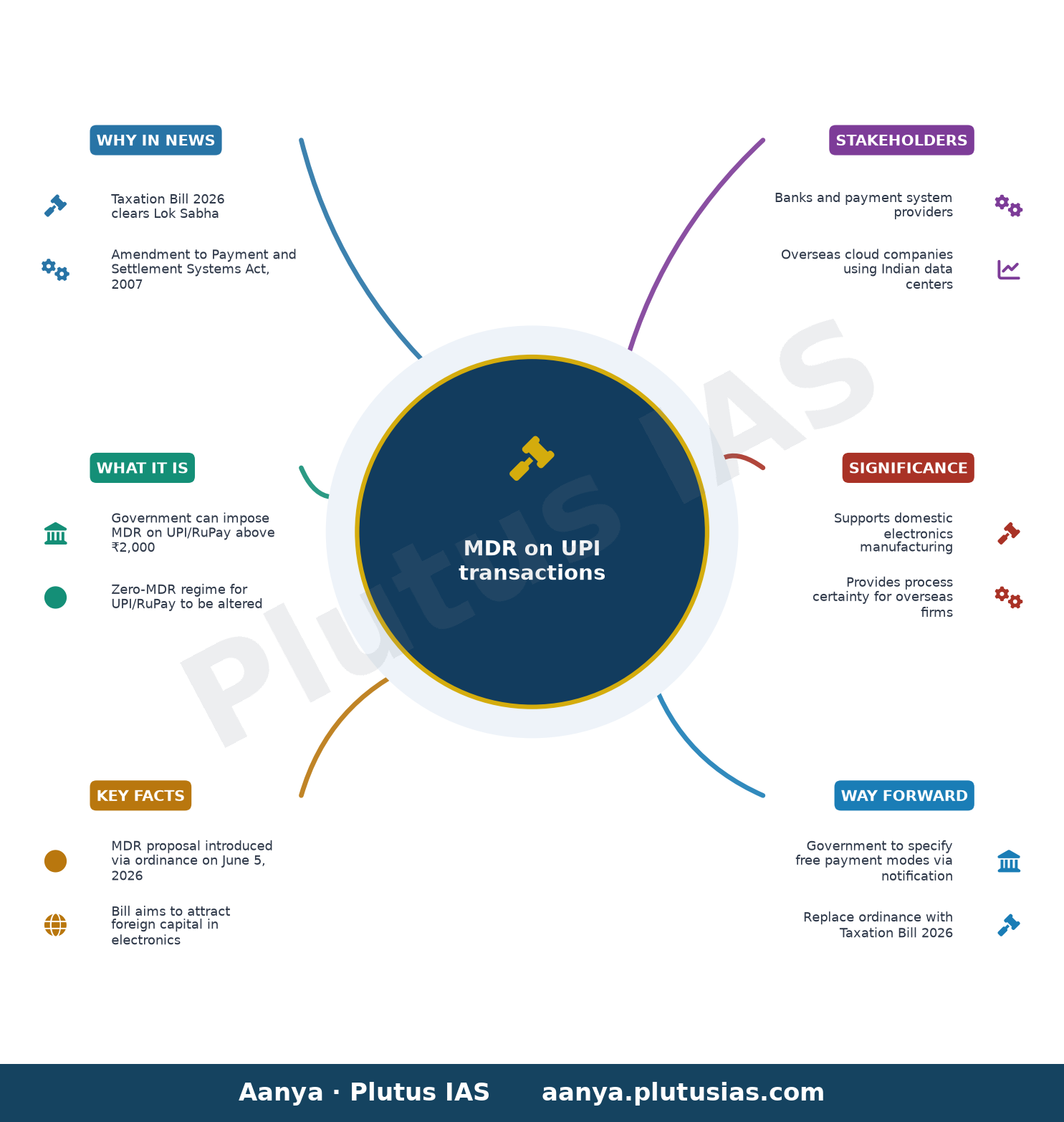
✎ MDR on UPI/RuPay above ₹2,000 may be introduced via Taxation Bill 2026 to boost electronics manufacturing and foreign investments.
Relevance for Banking, SSC & RBI Grade B exams: Polity
The Lok Sabha recently passed the Taxation and Other Laws (Amendment) Bill, 2026, which includes a provision allowing the government to levy Merchant Discount Rate (MDR) on UPI transactions. This move aims to address the financial burden on banks and payment service providers, which currently operate under a zero-MDR regime for UPI and RuPay card payments. The bill amends the Payment and Settlement Systems Act, 2007, to delink it from the Income Tax Act and empowers the Centre to specify which electronic payment modes or transactions must remain free of charges through a notification. This provision is significant for banking aspirants as it reflects the government’s evolving approach to digital payment infrastructure, a key area in RBI Grade B and banking exams.
The bill also extends income-tax exemptions for foreign companies engaged in domestic electronics manufacturing until 2040-41, promoting India’s ‘Make in India’ initiative. This aligns with the government’s broader goal of attracting foreign investment and strengthening the electronics supply chain. For SSC and RBI Grade B aspirants, this highlights the intersection of taxation policy, economic reforms, and digital payments—topics frequently tested in exams. Understanding such amendments is crucial for grasping India’s fiscal and regulatory framework, especially in the context of digital economy and foreign direct investment.
Source: Times of India
Generated by AanyaAi for educational purpose.
