
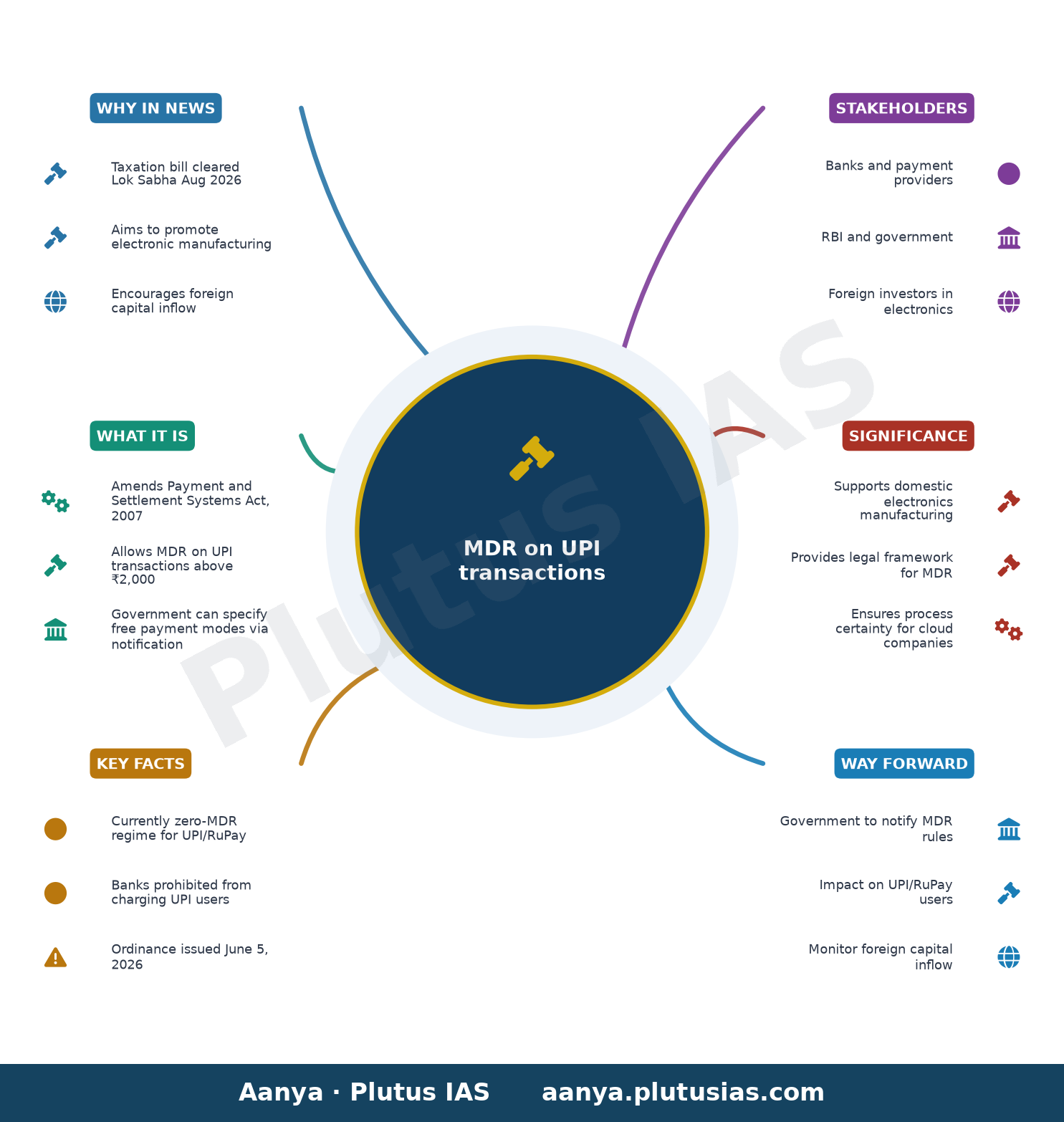
✎ MDR on UPI transactions introduced to boost electronics manufacturing and foreign investment, with government empowered to specify free payment modes.
Relevance for Banking, SSC & RBI Grade B exams: Polity
The Lok Sabha recently passed the **Taxation and Other Laws (Amendment) Bill, 2026**, which includes provisions to allow the government to impose **Merchant Discount Rate (MDR) on UPI transactions** above ₹2,000, marking a significant shift from the current zero-MDR regime. The bill amends the **Payment and Settlement Systems Act, 2007**, enabling the Centre to notify which electronic payment modes will remain free of charges. This move aligns with the government’s broader push for **digital payments** while addressing concerns over the cost burden on banks and payment service providers. The amendment also seeks to **promote electronic manufacturing** by extending tax exemptions for foreign companies producing goods like mobile phones and laptops in India until 2040-41, fostering domestic production and supply chain resilience.
For **banking and SSC aspirants**, this bill is crucial as it impacts **digital payment ecosystems**, a key area in financial literacy and economic policies. The **RBI Grade B exam** may test knowledge of how MDR adjustments influence **UPI adoption, banking costs, and financial inclusion**. The bill’s focus on **foreign investments, tax exemptions, and data centre regulations** also ties into broader economic governance, making it relevant for **polity and economic policy questions** in competitive exams. Understanding these amendments helps aspirants grasp India’s evolving **taxation and digital economy framework**, a recurring theme in such assessments.
Source: Times of India
Generated by AanyaAi for educational purpose.
