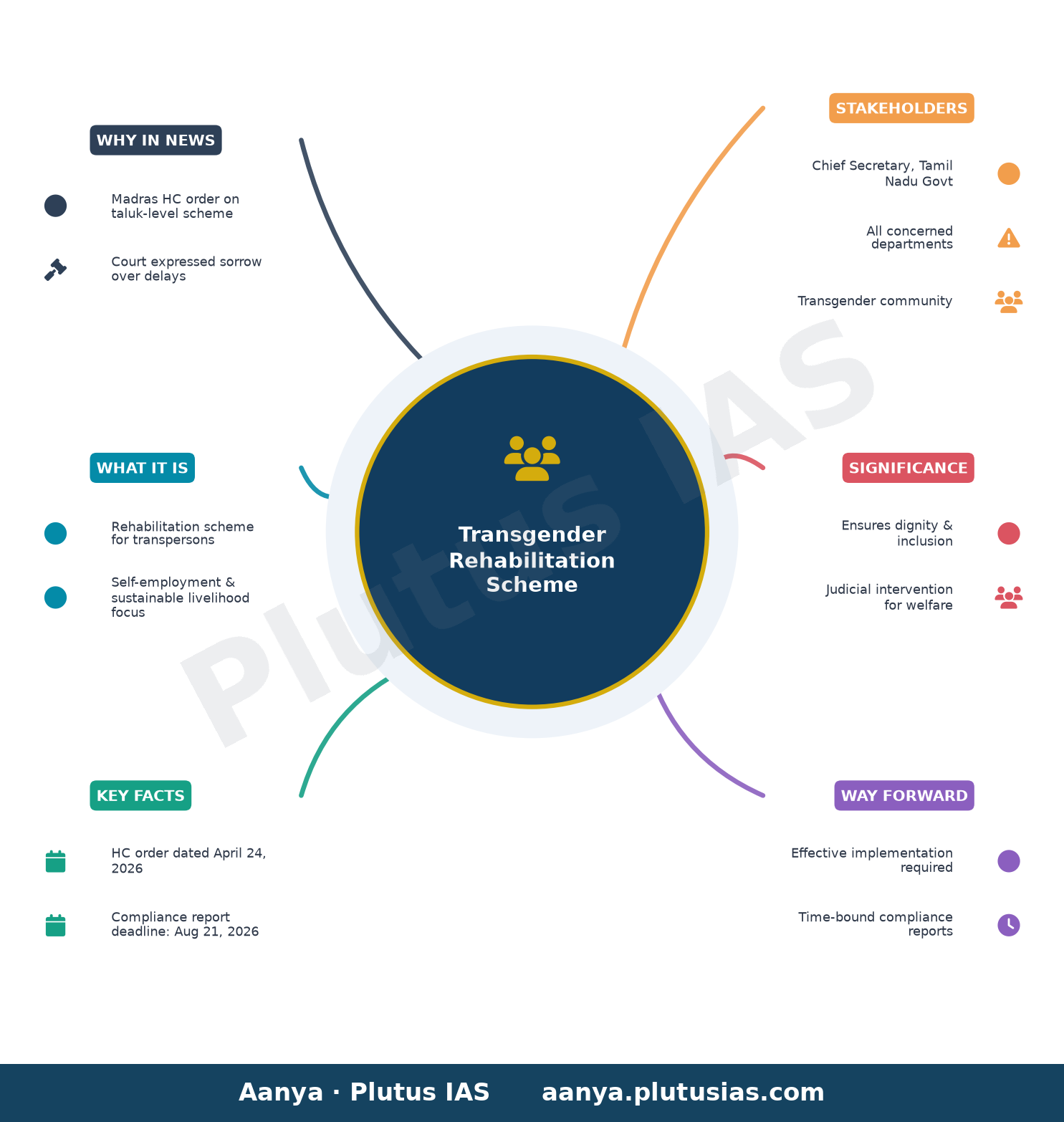
✎ Madras HC directs Tamil Nadu to implement taluk-level rehabilitation scheme for transpersons to ensure dignity and sustainable livelihood.
Relevance for Banking, SSC & RBI Grade B exams: Polity & Governance
The Madras High Court’s directive to the Tamil Nadu Chief Secretary to file a compliance report on a rehabilitation scheme for transgender persons at the taluk level underscores the judiciary’s role in ensuring inclusive governance. The court’s order, issued by Justice K.K. Ramakrishnan on April 24, 2026, mandates the formulation of a comprehensive scheme to provide self-employment opportunities, sustainable livelihoods, and dignified living conditions for transgender individuals. This move highlights the intersection of social justice and governance, emphasizing the need for tailored welfare measures, including access to education, healthcare, and economic opportunities. The court’s intervention reflects a broader commitment to rectify historical injustices and integrate marginalized communities into mainstream society, a principle that resonates with the constitutional ethos of equality and non-discrimination.
For aspirants preparing for competitive exams like Bank PO, IBPS, SBI, RBI Grade B, and SSC, this development is highly relevant as it touches upon key governance themes such as judicial activism, social welfare policies, and inclusive development. Questions in these exams often assess candidates’ understanding of constitutional provisions, government schemes, and the role of the judiciary in enforcing rights. The case also aligns with current affairs topics on LGBTQ+ rights, affirmative action, and the implementation of welfare programs, which are frequently tested in descriptive and objective sections. Additionally, the emphasis on taluk-level implementation reflects the importance of decentralized governance, a concept that may appear in questions related to local administration or public policy.
Source: The Hindu
Generated by AanyaAi for educational purpose.
