✎ Madras HC restored temple rights to acquire elephants by striking down a 2023 order for violating natural justice.
Relevance for Banking, SSC & RBI Grade B exams: Polity
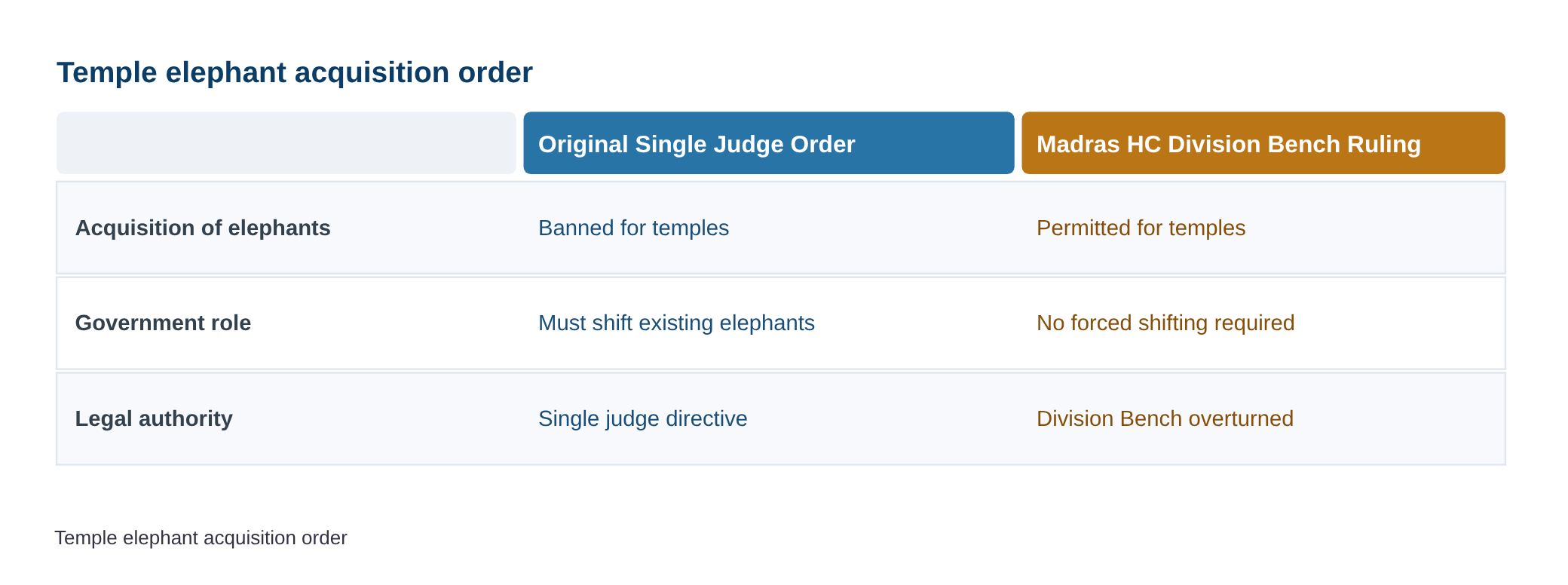
The Madras High Court on September 2, 2026, set aside a single judge’s order that had barred Tamil Nadu temples from acquiring elephants and directed the State government to consider shifting all captive elephants to rehabilitation homes. The Division Bench, comprising Chief Justice Sushrut Arvind Dharmadhikari and Justice G. Arul Murugan, ruled that the order was unsustainable as it was passed without hearing the State or the temples concerned. The judges emphasized that courts cannot issue general directions overriding existing laws, such as the Tamil Nadu Captive Elephants (Management and Maintenance) Rules, 2011, framed under the Wildlife (Protection) Act, 1972, which already regulate the possession and care of elephants in captivity.
This judgment holds relevance for Banking, SSC, and RBI Grade B exams as it underscores the importance of judicial review, separation of powers, and adherence to statutory frameworks. For aspirants, it highlights constitutional principles like natural justice (audi alteram partem) and the supremacy of law, which are often tested in exams. Additionally, questions on wildlife laws, administrative discretion, and judicial activism may arise, making this a pertinent case study for Polity and Governance sections.
Source: The Hindu
Generated by AanyaAi for educational purpose.
