✎ Minority Ministry’s strategic collaborations with top institutions aim to boost infrastructure, entrepreneurship, and monitoring for minority communities via PM VIKAS scheme.
Relevance for Banking, SSC & RBI Grade B exams: Polity & Governance
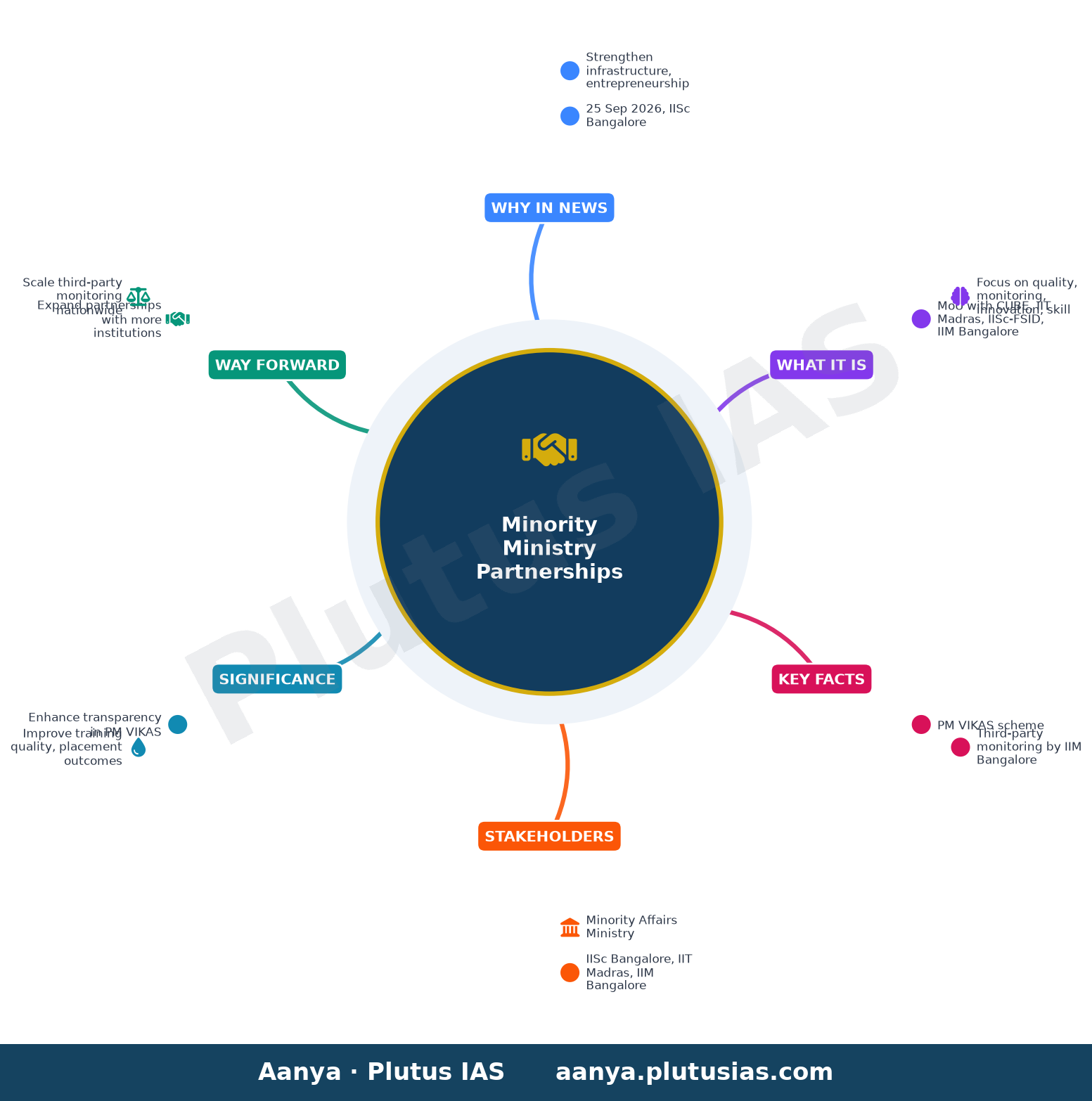
The Ministry of Minority Affairs, Government of India, signed multiple MoUs on 25 September 2026 at IISc Bengaluru with leading academic and research institutions—CUBE (IIT Madras), IISc-FSID, IIM Bengaluru, and IIMB Innovations—to strengthen its infrastructure, entrepreneurship, and monitoring initiatives for minority communities. These partnerships aim to enhance quality assessment, independent monitoring, skill development, and sustainable economic opportunities by leveraging technical and academic expertise, improving evidence-based decision-making, and fostering innovation and entrepreneurship. For banking and SSC aspirants, this initiative highlights the government’s focus on inclusive growth through institutional collaborations, which may be relevant for questions on governance, public-private partnerships, and socio-economic development schemes like PM VIKAS and PMJVK. RBI Grade B candidates should note how such initiatives integrate with broader economic policies, particularly in skill enhancement and infrastructure development, which are key to financial inclusion and sustainable growth.
The agreements also emphasize independent third-party monitoring of PM VIKAS training programs (via IIM Bengaluru) and PMJVK infrastructure projects (via CUBE, IIT Madras), ensuring transparency and accountability. This aligns with current affairs themes on governance reforms and monitoring mechanisms in public welfare schemes, often tested in competitive exams. The collaborations further strengthen the entrepreneurship ecosystem for minorities through PM-MVF, focusing on startups, innovation, and market access—topics that may appear in SSC and banking exams under sections like economic policies, government schemes, or social justice. Aspirants should connect these developments with broader themes of digital transformation, data governance, and sustainable development, which are increasingly relevant in contemporary governance discussions.
Source: PIB (Press Information Bureau)
Generated by AanyaAi for educational purpose.

1 comment on “Minority Affairs Ministry Partners with IISc, IITs for Skill & Infrastructure Boost”