
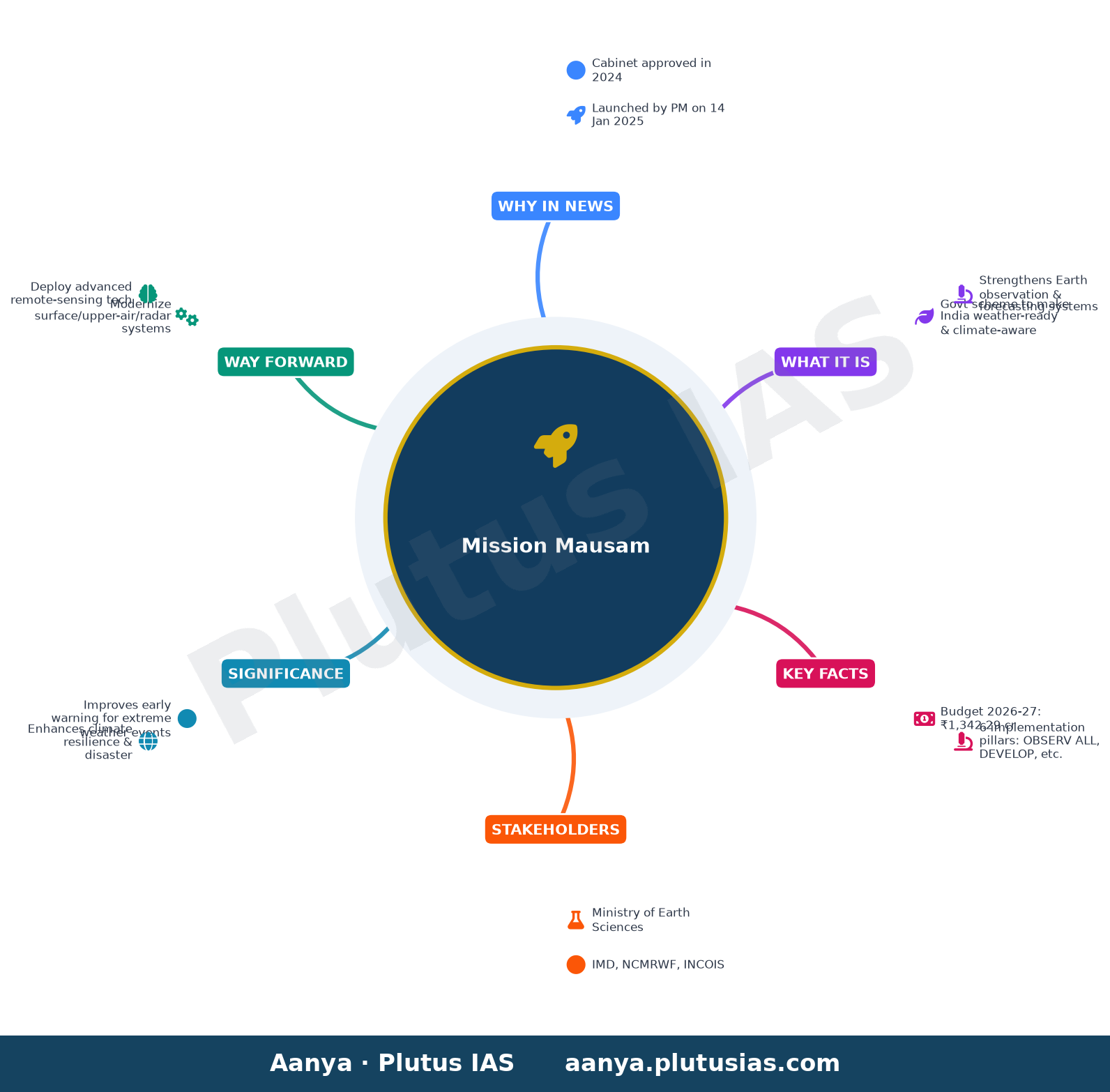
✎ Mission Mausam aims to revolutionize India's weather forecasting and climate resilience through advanced tech and global collaboration.
Relevance for Banking, SSC & RBI Grade B exams: Polity & Governance
The Government of India’s **Mission Mausam**, launched by the Prime Minister on 14 January 2025 under the Ministry of Earth Sciences, aims to transform India into a “weather-ready and climate-conscious nation.” With a ₹2,000 crore outlay for 2024-26, the mission seeks to modernise Earth system observations, enhance early warning systems for high-impact weather events, and deliver seamless weather and climate services to bolster climate resilience and disaster preparedness. By deploying next-generation Doppler radars, advanced satellites, high-performance computing, and AI/ML-driven forecasting models, the initiative will improve the accuracy, spatial resolution, and lead time of weather predictions—critical for sectors like agriculture, aviation, and disaster management. For banking and SSC aspirants, this policy reflects the government’s push for data-driven governance and infrastructure modernisation, themes often tested in exams through questions on budgetary allocations, technological adoption in governance, and inter-ministerial schemes.
For RBI Grade B and other competitive exams, **Mission Mausam** underscores the intersection of climate policy with economic stability. Enhanced weather forecasting directly impacts agricultural productivity, supply chains, and insurance sectors—key areas monitored by central banks for systemic risks. The mission’s focus on AI/ML and high-performance computing also highlights India’s push toward digital public infrastructure, a topic relevant for questions on fintech, governance reforms, and sustainable development. Aspirants should note the mission’s six thematic pillars—*ObservAll*, *Develop*, *Weather MOD*, *AtComp*, *Frontier*, and *NEAT*—as they encapsulate India’s strategy for climate adaptation, which may appear in descriptive or analytical questions on governance and policy frameworks.
Source: PIB (Press Information Bureau)
Generated by AanyaAi for educational purpose.
