
Relevance for Banking, SSC & RBI Grade B exams: Polity & Governance
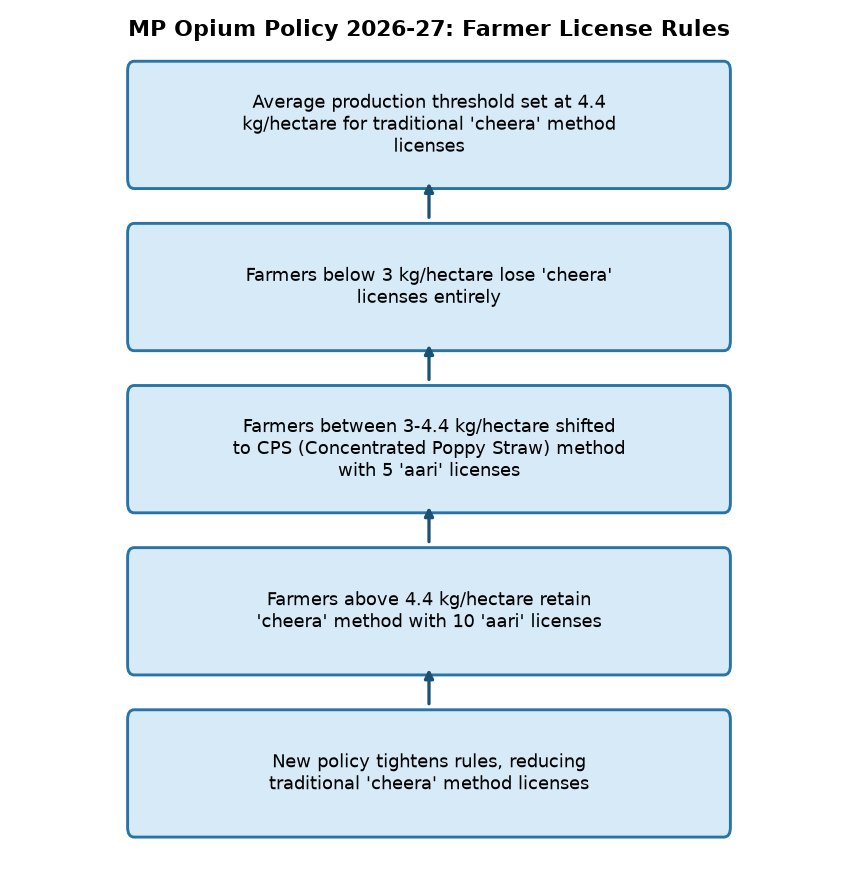
The Centre’s Opium Policy 2026-27 has dashed the hopes of opium growers in Madhya Pradesh and Rajasthan, as it failed to raise the procurement price despite their long-standing demand. Instead, the government tightened licensing norms, reducing the average yield threshold for traditional *cheera* (incision) method from 4.2 kg/hectare to 4.4 kg/hectare, while mandating a shift to the Concentrated Poppy Straw (CPS) method for lower-yielding farmers. Those producing below 3 kg/hectare will lose their *cheera* licences entirely, exacerbating farmer distress in opium belts like Mandsaur and Neemuch. The policy also introduces stricter production caps for *doda* poppy, with licences revoked for yields below 800 kg/hectare, further squeezing smallholders’ livelihoods.
For Banking, SSC, and RBI Grade B aspirants, this policy highlights critical governance and economic themes. It underscores the Centre’s regulatory role in agricultural commodities with dual-use potential, balancing farmer incomes with national security concerns. The shift to CPS, while aimed at improving yield efficiency, risks marginalising small farmers—a socio-economic challenge that aligns with broader rural distress narratives tested in exams. Additionally, the policy’s impact on licencing and revenue streams reflects the interplay between fiscal policy, trade controls, and rural welfare, making it a relevant case study for governance and economic awareness sections.
Source: amarujala.com
Generated by AanyaAi for educational purpose.
