
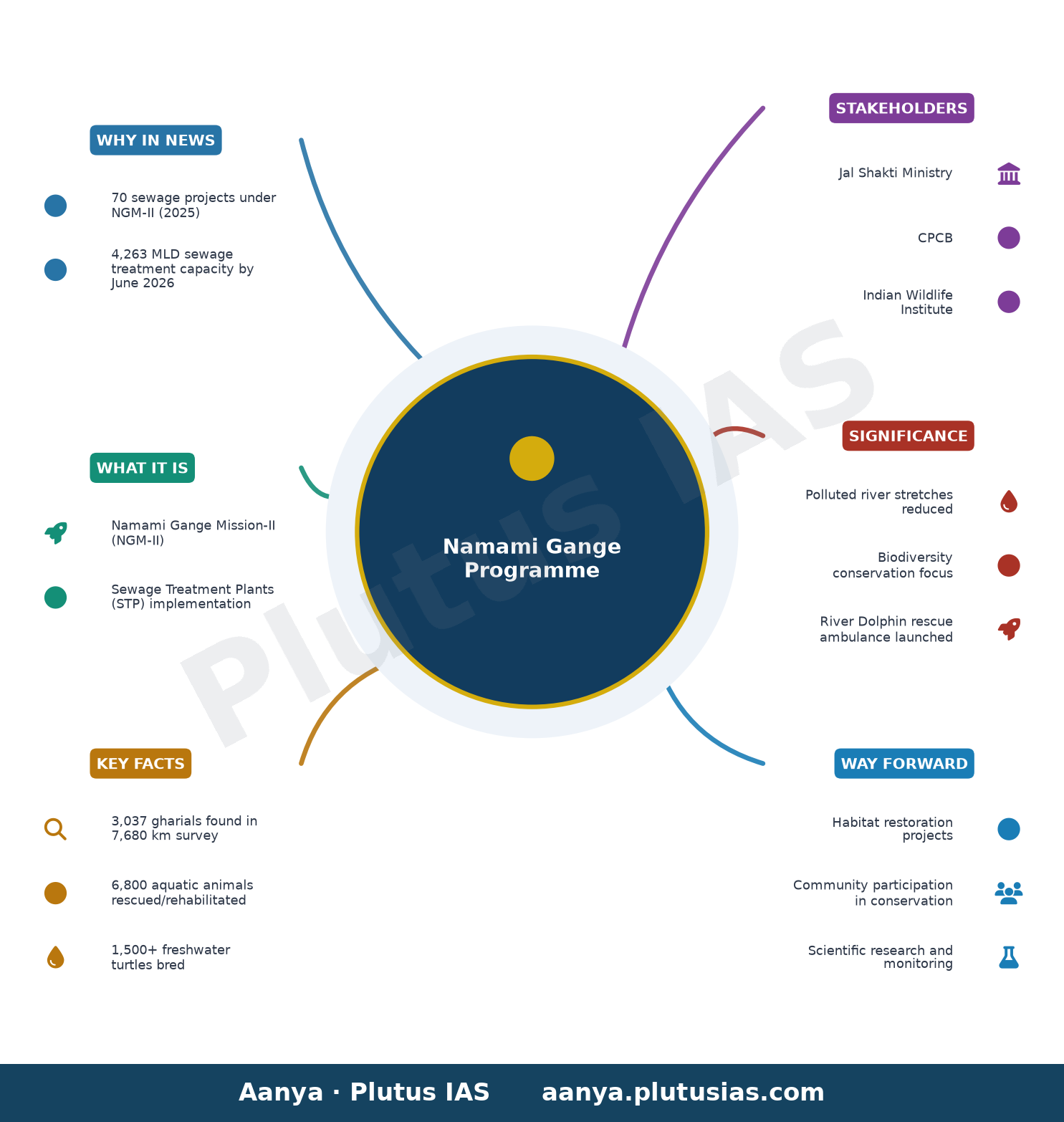
✎ Namami Gange integrates sewage treatment, biodiversity conservation, and community engagement to rejuvenate the Ganga ecosystem.
Relevance for Banking, SSC & RBI Grade B exams: Polity & Governance
The *Namami Gange* initiative, launched under the *National Mission for Clean Ganga (NMCG)*, has achieved significant milestones in reviving the Ganga and its tributaries through sewage infrastructure projects and biodiversity conservation. By August 2026, 70 sewage treatment projects, including 25 newly commissioned plants, were implemented under *Namami Gange Phase-II*, adding 4,263 MLD of sewage treatment capacity. The Central Pollution Control Board (CPCB) reported partial improvements in polluted stretches of the Ganga in states like Uttar Pradesh and Bihar, with some segments like Haridwar-Sultanpur and Bijnor-Tarighat showing signs of recovery. However, challenges persist in segments like Buxar-Bhagalpur (Bihar) and Baharampur-Diamond Harbour (West Bengal), where pollution levels remain high. The initiative also focuses on industrial pollution control, with three Common Effluent Treatment Plants (CETPs) approved to mitigate industrial discharge, two of which—Mathura CETP (6.25 MLD) and Jajmau CETP (20 MLD)—have been completed. The enforcement of minimum ecological flow norms by the Central Water Commission ensures sustainable water availability in the river.
For banking and government exam aspirants, the *Namami Gange* program holds relevance in governance, environmental policy, and economic sustainability. The ₹35,970 crore investment in 219 sewage projects highlights the government’s commitment to infrastructure development, a key topic in *RBI Grade B* and *Bank PO* exams, where questions on public expenditure and policy implementation are common. The program’s emphasis on biodiversity conservation—such as the rescue of 6,800 aquatic animals, including 1,899 gharials and 1,500 freshwater turtles—aligns with *SSC* and *IBPS* syllabi on environmental governance and conservation efforts. Additionally, the initiative’s collaboration with institutions like the Wildlife Institute of India (WII) and ICAR-CIFRI underscores the role of scientific research in policy-making, a theme often tested in *RBI Grade B* descriptive papers on sustainable development. Understanding such flagship programs helps aspirants grasp India’s approach to balancing economic growth with ecological preservation, a critical aspect for exams focusing on governance and current affairs.
Source: PIB (Press Information Bureau)
Generated by AanyaAi for educational purpose.
