
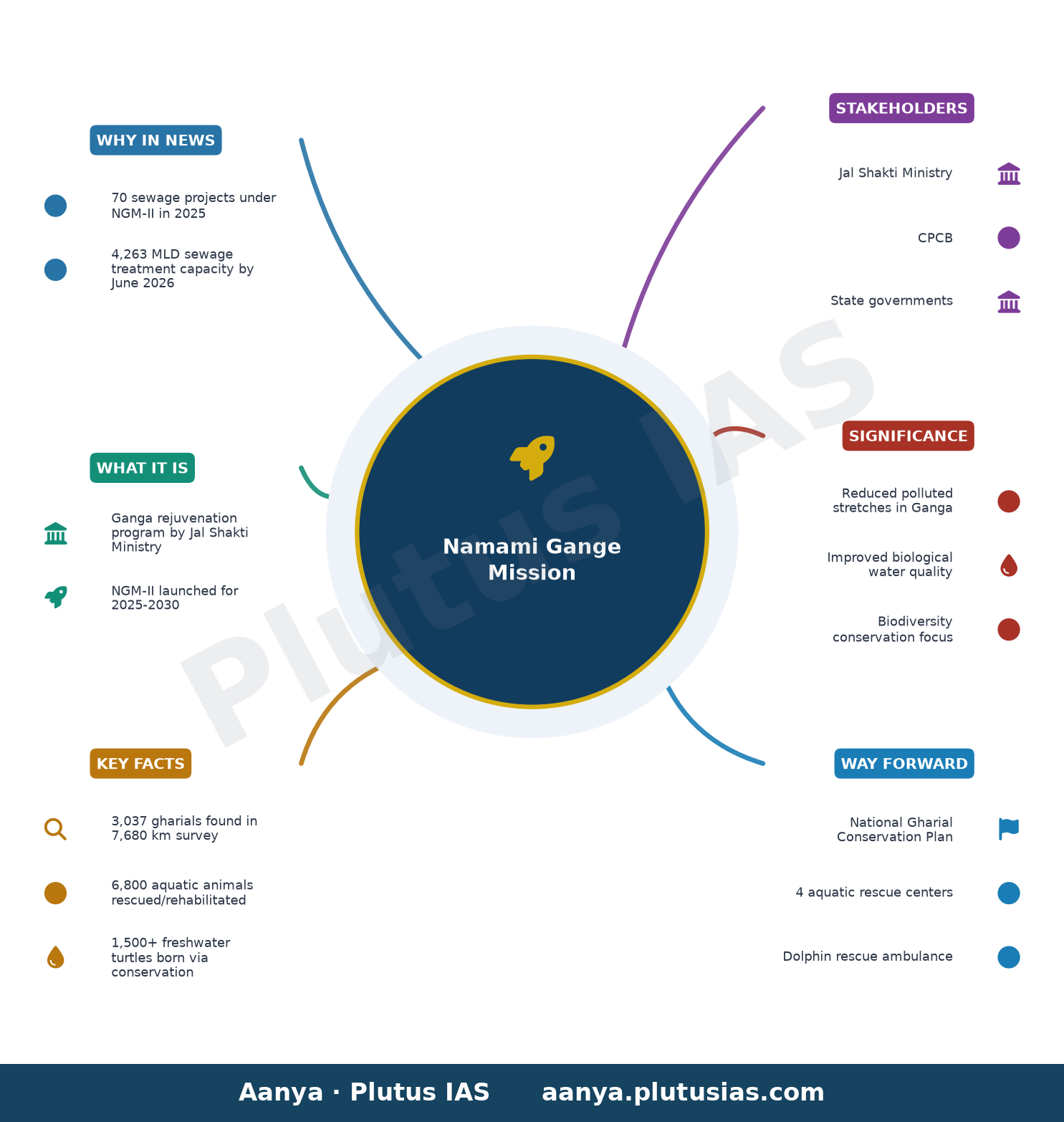
✎ Namami Gange integrates sewage treatment, biodiversity conservation, and community participation for Ganga rejuvenation.
Relevance for Banking, SSC & RBI Grade B exams: Polity & Governance
The Namami Gange Mission-II (NGM-II), launched under the ‘Namami Gange’ program, has significantly advanced sewage infrastructure in 2025, with 70 sewage treatment projects (STPs) completed, including 25 new operational plants. By June 2026, the initiative has created a cumulative sewage treatment capacity of 4,263 million liters per day (MLD) along the Ganga basin, addressing pollution hotspots identified by the Central Pollution Control Board (CPCB). For banking and SSC aspirants, this underscores the government’s emphasis on infrastructure development and environmental governance, a recurring theme in exams like IBPS PO and RBI Grade B, where questions on flagship schemes and their economic impact are common. The mission’s focus on reducing industrial and domestic pollution aligns with broader themes of sustainable development and public expenditure management, critical for policy-based questions in these exams.
The program’s biodiversity conservation efforts, including the rescue of 6,800 aquatic species, the release of 1,500 freshwater turtles, and the establishment of India’s first dolphin rescue ambulance, highlight its ecological impact. For SSC and RBI Grade B candidates, such initiatives reflect the intersection of environmental science and governance, often tested in General Awareness sections. The mission’s collaboration with institutions like the Wildlife Institute of India (WII) and ICAR-CIFRI, along with its ₹35,970 crore investment in 219 STPs, demonstrates multi-sectoral coordination—a key governance principle frequently examined in civil services and banking recruitment tests.
Source: PIB (Press Information Bureau)
Generated by AanyaAi for educational purpose.
