✎ NEP 2020-driven NCERT curriculum reforms emphasize inclusive, competency-based education with multi-level stakeholder participation.
Relevance for Banking, SSC & RBI Grade B exams: Polity & Governance
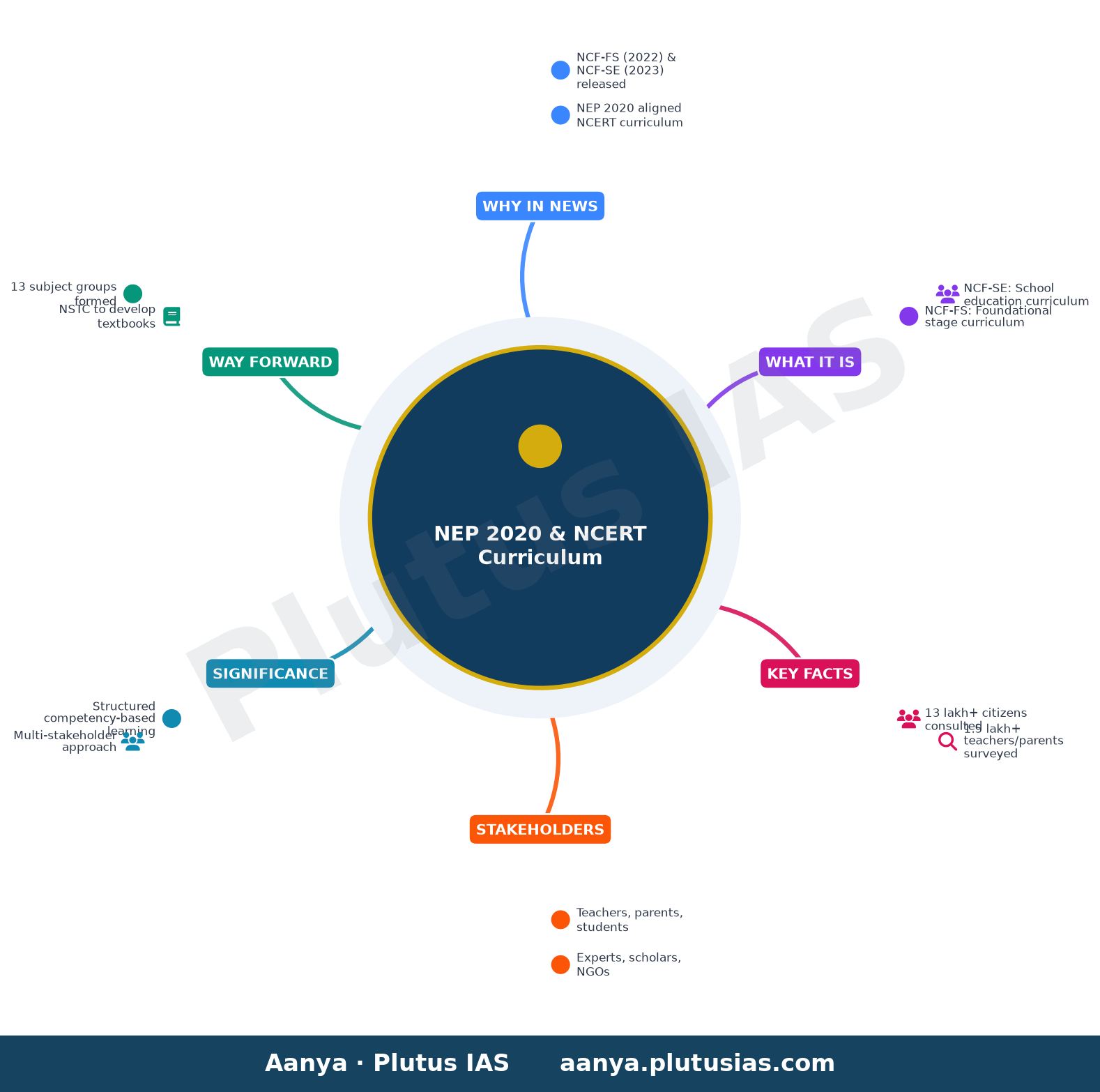
The National Education Policy (NEP) 2020, a landmark reform in India’s education sector, has led to significant updates in the school curriculum through the National Council of Educational Research and Training (NCERT). In alignment with NEP 2020, NCERT released the National Curriculum Framework for Foundational Stage (NCF-FS) in 2022 and the National Curriculum Framework for School Education (NCF-SE) in 2023. These frameworks provide a structured approach to defining curriculum goals, competencies, learning outcomes, teaching methods, and assessment across different subjects and grade levels. The development process involved extensive consultations with stakeholders, including teachers, parents, students, and experts, ensuring inclusivity and relevance. Over 13 lakh citizens participated in national-level surveys, while 1.5 lakh educators and stakeholders contributed at the state level, reflecting a bottom-up approach to curriculum design. This participatory model underscores the policy’s emphasis on democratic engagement in educational reforms.
For aspirants preparing for exams like Bank PO, IBPS, SBI, RBI Grade B, and SSC, understanding NEP 2020 and its implementation through NCERT’s revised curriculum is crucial. The policy’s focus on multidisciplinary learning, skill development, and inclusive education aligns with the evolving demands of the job market and governance. Questions in these exams may test knowledge of NEP’s objectives, such as foundational literacy, critical thinking, and digital literacy, which are now embedded in school curricula. Additionally, the emphasis on constitutional values, gender sensitivity, and cultural relevance in the new frameworks reflects broader governance principles, making it relevant for exams assessing awareness of national policies and their societal impact.
Source: PIB (Press Information Bureau)
Generated by AanyaAi for educational purpose.
