
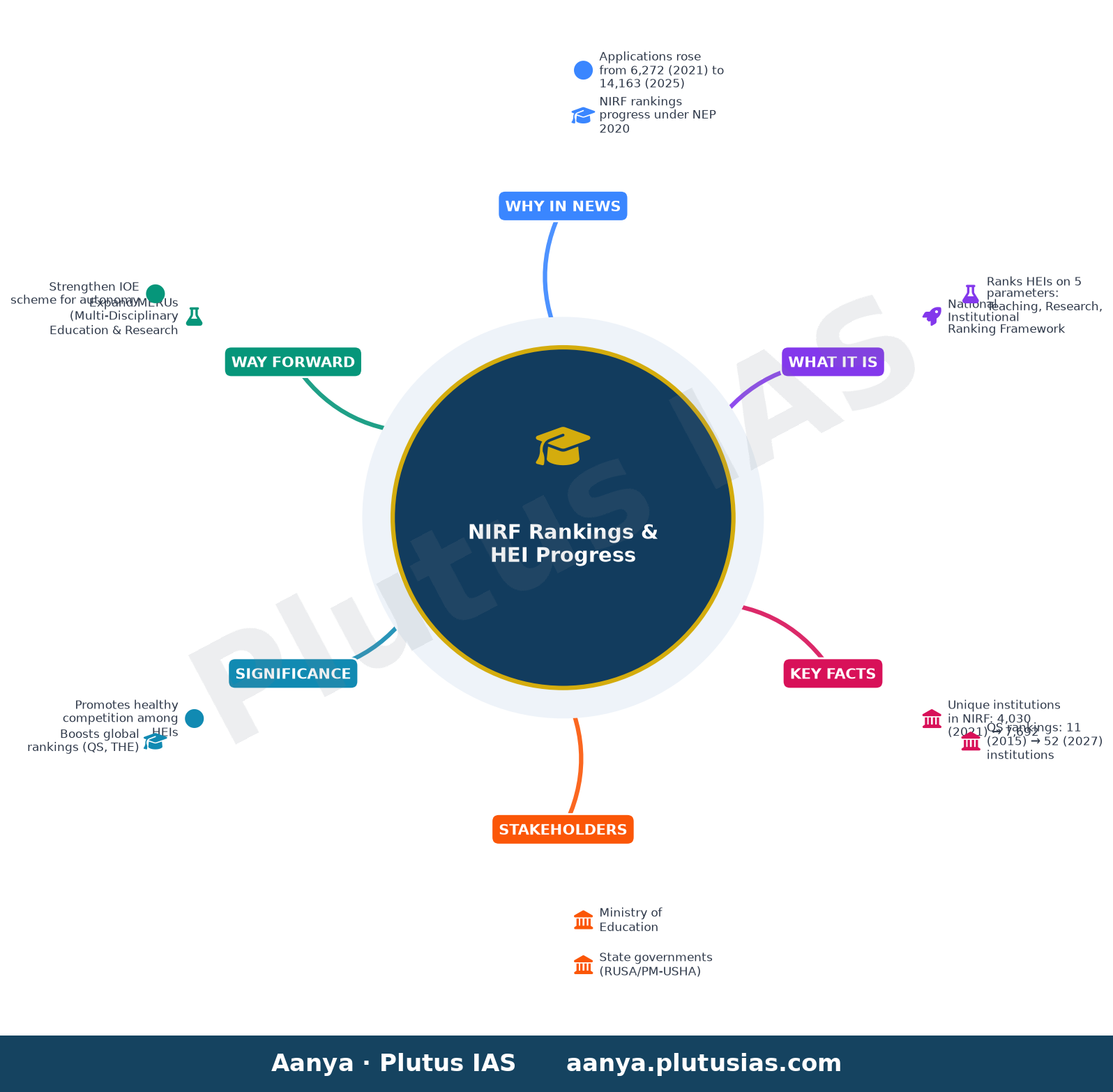
✎ NIRF rankings drive HEI quality improvement under NEP 2020, expanding participation and global visibility.
Relevance for Banking, SSC & RBI Grade B exams: Economy/Governance
The **National Institutional Ranking Framework (NIRF)** has emerged as a pivotal tool in driving the progress of Higher Education Institutions (HEIs) in India, aligning with the **National Education Policy (NEP) 2020**’s vision of enhancing educational quality through multidisciplinary learning, research, and innovation. Since its launch in 2015, NIRF has fostered healthy competition among institutions by ranking them across five key parameters—teaching, learning, resources, research, outcome-based performance, outreach, inclusivity, and perception. The framework’s growing adoption, with applications surging from **6,272 in 2021 to 14,163 in 2025**, reflects its increasing credibility and impact. Notably, the number of Indian institutions featured in global rankings like the **QS World University Rankings** has risen from **11 in 2015 to 52 in 2027**, underscoring the tangible improvements in India’s higher education landscape. For aspirants of **Bank PO, IBPS, SBI, RBI Grade B, and SSC exams**, understanding NIRF’s role is crucial as it highlights the government’s focus on **institutional accountability, skill development, and industry-academia collaboration**, themes often tested in exams through questions on **governance reforms, education policies, and economic growth drivers**.
The **NIRF rankings** also serve as a barometer for the government’s initiatives like the **Institutions of Eminence (IoE) scheme**, **RUSA/PM-USHA**, and **National Apprenticeship Training Scheme (NATS)**, which aim to elevate India’s educational infrastructure and employability. For instance, the establishment of **43 new premier institutions**—including seven IITs and nine IIMs—since 2014, along with investments in research parks and skill-integrated programs, demonstrates a concerted effort to bridge the gap between academia and industry demands. This aligns with current-affairs questions in **RBI Grade B and SSC exams**, where candidates are tested on **policy interventions, budget allocations, and their socio-economic implications**. Additionally, the emphasis on **AI, data science, and emerging technologies** in curricula, as mandated by bodies like **AICTE and UGC**, reflects the evolving job market, making it a relevant topic for **Banking exams**, where questions on **digital literacy, skilling, and economic reforms** are common. Aspirants should note how such rankings and policies are instrumental in shaping India’s **human capital development**, a critical factor for sustainable economic growth.
Source: PIB (Press Information Bureau)
Generated by AanyaAi for educational purpose.
