
Relevance for Banking, SSC & RBI Grade B exams: Polity & Governance
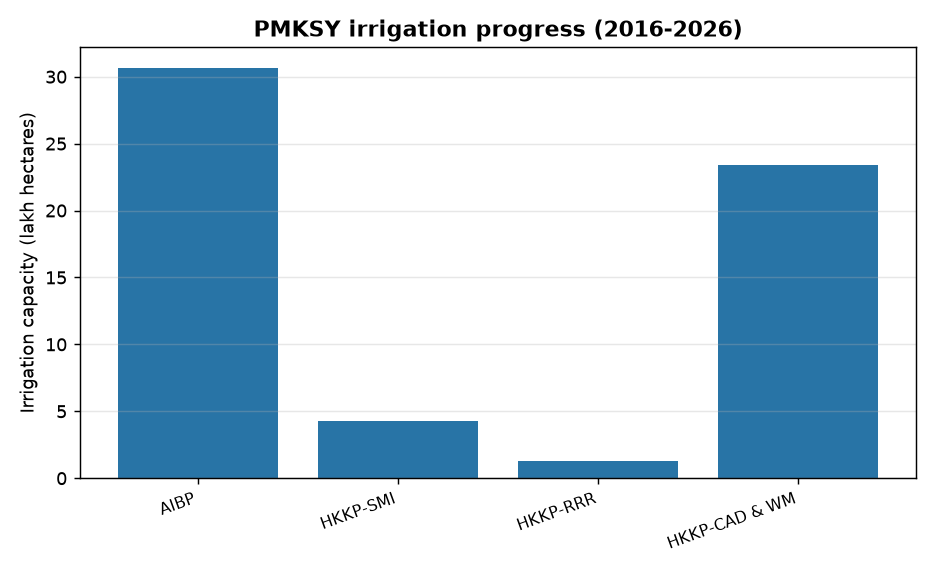
The **Pradhan Mantri Krishi Sinchayee Yojana (PMKSY)**, launched in 2015-16 as a flagship scheme under the Ministry of Jal Shakti, aims to enhance irrigation coverage, water-use efficiency, and agricultural productivity across India. Under PMKSY, key components like the **Accelerated Irrigation Benefits Programme (AIBP)** and **Har Khet Ko Pani (HKKP)**—comprising Command Area Development & Water Management (CAD&WM), Surface Minor Irrigation (SMI), and Repair, Renovation & Restoration (RRR) of water bodies—have significantly expanded irrigation capacity. Between April 2016 and 2025-26, AIBP alone created 30.66 lakh hectares of irrigation potential, while CAD&WM added 23.42 lakh hectares, with notable progress in states like Telangana. The scheme prioritizes drought-prone regions, such as Bundelkhand, where special provisions under AIBP—like relaxed funding norms and higher central assistance (60:40 ratio)—have accelerated project implementation, creating 16.65 lakh hectares of irrigation capacity since 2016. These initiatives not only improve farm-level water access but also reduce wastage, boost crop yields, and promote sustainable water management, aligning with broader goals of doubling farmer incomes and ensuring food security.
For aspirants preparing for **Bank PO, SSC, or RBI Grade B exams**, PMKSY holds relevance as a **governance and economic policy initiative** that intersects with rural development, agricultural finance, and infrastructure financing. Questions may test knowledge of its components (AIBP, HKKP, PDMC), funding mechanisms, or impact on irrigation efficiency and farmer welfare. For instance, understanding how PMKSY integrates with schemes like **PM-KISAN** or **Micro Irrigation Fund (MIF)** can help address questions on agricultural credit, subsidy disbursal, or NABARD’s role in financing irrigation projects. Additionally, the scheme’s focus on **drought mitigation** and **watershed development** ties into broader themes of **climate-resilient agriculture** and **sustainable resource management**, which are increasingly featured in exam syllabi. Aspirants should also note the **state-wise progress** (e.g., Telangana’s RRR projects or Bundelkhand’s special provisions) as potential data-based questions in descriptive or MCQ formats.
Source: PIB (Press Information Bureau)
Generated by AanyaAi for educational purpose.
