Relevance for Banking, SSC & RBI Grade B exams: Economy
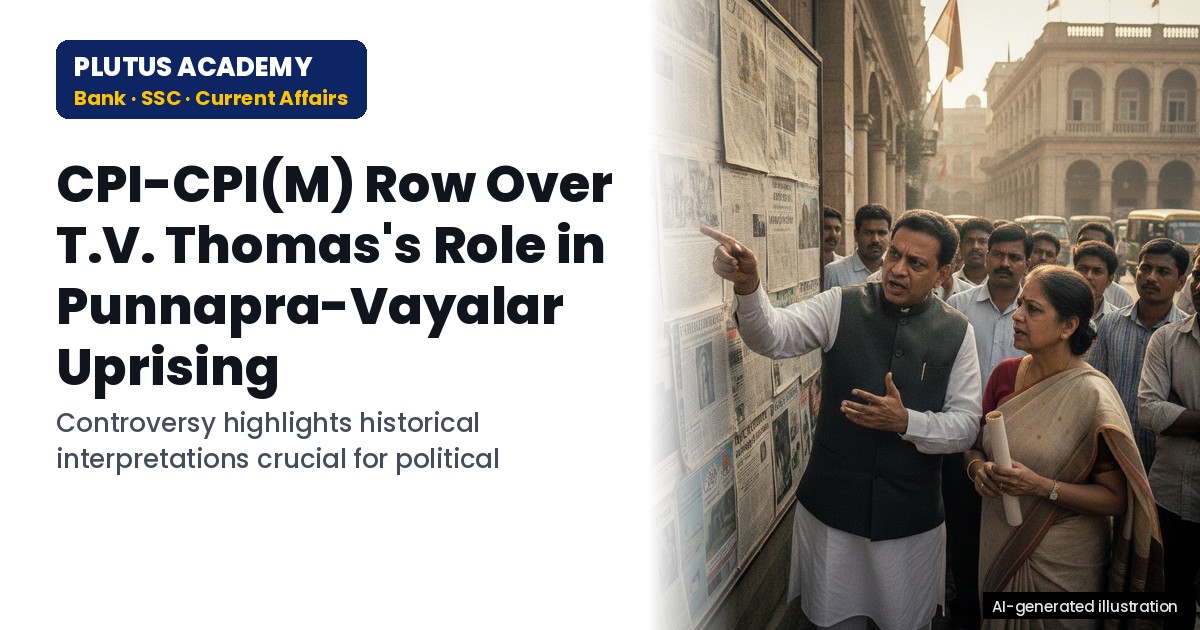
The recent controversy surrounding the late Communist leader T.V. Thomas’s role in the Punnapra-Vayalar uprising, sparking a CPI-CPI(M) row, highlights the enduring significance of historical narratives and their interpretation within political discourse. This dispute, largely playing out on social media and centered on a special edition of Chintha, the CPI(M)’s ideological publication, concerns the documentation of the struggle and the prominence given to leaders like T.V. Thomas, who was president of the All Travancore Trade Union Council (ATTUC) that initiated the workers’ strike. CPI leaders, like T.J. Angelos, have strongly objected to what they perceive as an understatement of Thomas’s contribution, while Dr. T.M. Thomas Isaac, editor of Chintha, dismisses these allegations, asserting that the publication adequately acknowledged Thomas’s role and that the arrangement of photographs was alphabetical, not hierarchical.
For aspirants of Banking, SSC, and RBI Grade B exams, understanding such current affairs is crucial for General Awareness sections, particularly those focusing on socio-political developments and historical contexts that influence contemporary policy and economic decisions. While this specific dispute doesn’t directly address economic policy, it underscores the importance of historical accuracy and political stability, which are indirect factors affecting investor confidence, labor relations, and overall economic sentiment in a region. Furthermore, the debate over historical contributions to labor movements like the Punnapra-Vayalar uprising can inform questions related to India’s economic history, the evolution of labor laws, and the role of trade unions, all of which are relevant for understanding the broader economic landscape.
Source: The Hindu
Generated by AanyaAi for educational purpose.

2 comments on “Punnapra-Vayalar Uprising: CPI-CPI(M) Row over T.V. Thomas’s Role”