
✎ Demand for a special policy to address systemic hardships faced by DNTs, NTs, and SNTs despite constitutional provisions.
Relevance for Banking, SSC & RBI Grade B exams: Polity & Governance
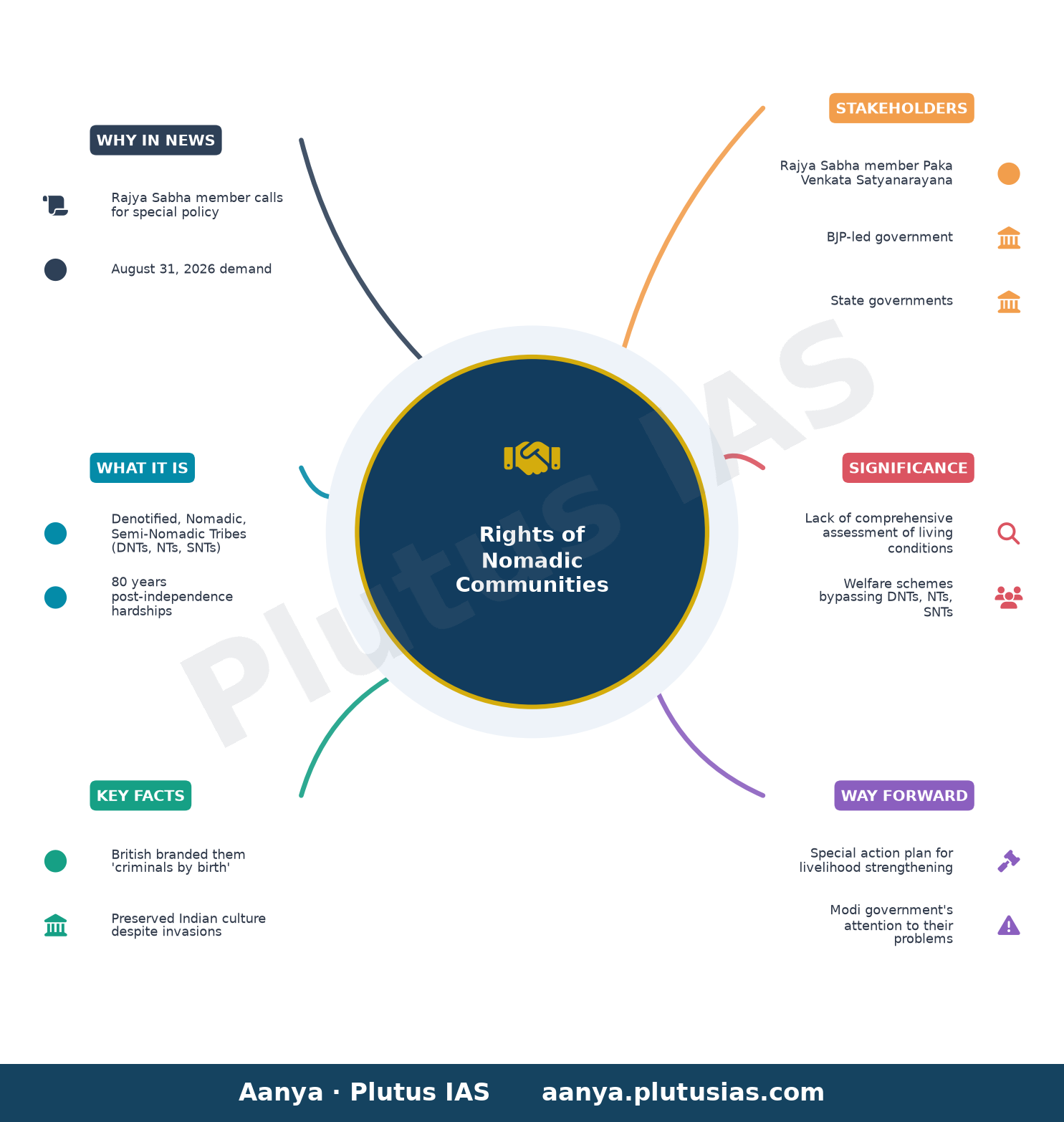
A Rajya Sabha member recently highlighted the urgent need for a dedicated policy to address the systemic neglect faced by Denotified, Nomadic, and Semi-Nomadic Tribes (DNTs, NTs, and SNTs) in India. Speaking at an event marking Denotified, Nomadic, and Semi-Nomadic Tribes Day in Vijayawada, Paka Venkata Satyanarayana emphasized that despite constitutional guarantees, these communities continue to suffer from socio-economic marginalization, with many deprived of welfare benefits due to a lack of comprehensive data on their living conditions. He pointed out that while Scheduled Castes, Scheduled Tribes, and other backward classes have access to various schemes, nomadic tribes remain excluded, despite their significant contributions to preserving Indian culture and traditions. The British colonial administration’s discriminatory policies, which branded them as ‘criminals by birth,’ further exacerbated their plight, pushing them to the fringes of society.
This issue holds relevance for aspirants preparing for banking, SSC, and RBI Grade B exams, particularly in the Polity & Governance segment. Understanding the challenges faced by marginalized communities, including DNTs, NTs, and SNTs, is crucial for framing policies related to social justice, inclusive growth, and welfare schemes—key topics in competitive exams. Additionally, questions on constitutional provisions, government initiatives for vulnerable sections, and historical injustices often feature in these examinations, making this a pertinent case study for aspirants to analyze the intersection of history, governance, and socio-economic development.
Source: The Hindu
Generated by AanyaAi for educational purpose.
