
✎ India must balance liberalisation with self-reliance in critical sectors amid global conflicts and tariffs.
Relevance for Banking, SSC & RBI Grade B exams: Polity & Governance
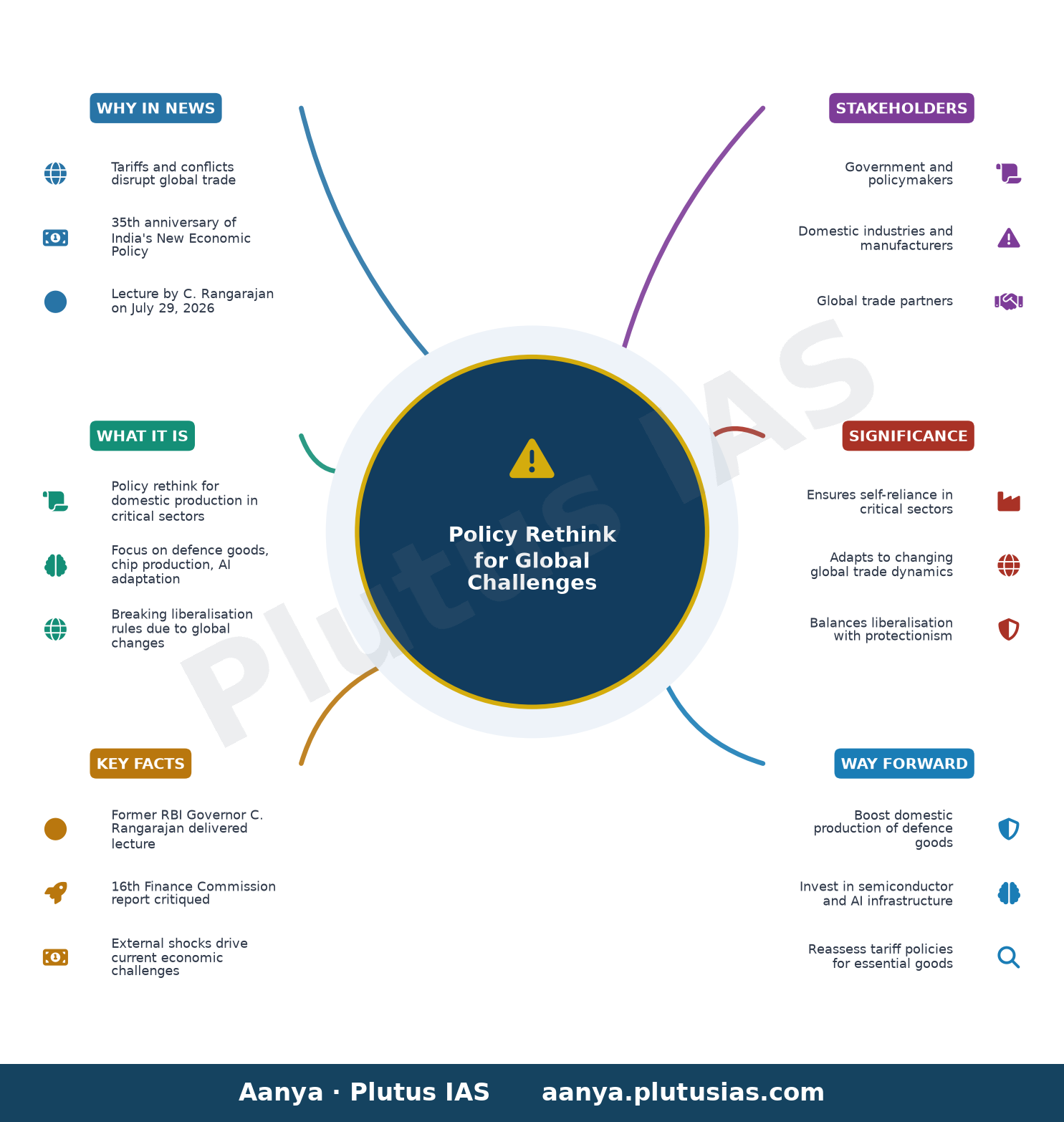
Former RBI Governor C. Rangarajan has emphasized the need for a policy rethink amid rising global conflicts and tariff imposition, highlighting how geopolitical tensions are disrupting economic stability. Speaking at a lecture commemorating 35 years of India’s New Economic Policy, he noted that countries are increasingly resorting to tariffs and trade barriers, forcing nations like India to reconsider their approach to liberalization. Rangarajan pointed out that India must prioritize domestic production in critical sectors such as defence, semiconductors, and AI adaptation, even if it means deviating from traditional liberalization principles. This shift is necessary to mitigate the impact of external shocks and ensure self-reliance in strategic areas, a lesson particularly relevant for aspirants preparing for exams like RBI Grade B, where questions on economic policies and global trade dynamics are common.
For banking and SSC aspirants, Rangarajan’s remarks underscore the importance of understanding how geopolitical factors influence economic policies, including tariffs and trade agreements. The discussion on domestic production versus liberalization aligns with topics frequently tested in exams like IBPS PO and SBI Clerk, where candidates are expected to analyze the trade-offs between protectionism and globalization. Additionally, the mention of AI and semiconductor production highlights the growing intersection of technology and economics, a key area for RBI Grade B candidates focusing on monetary policy and technological advancements. Aspirants should note how such policy shifts can impact inflation, fiscal deficits, and overall economic growth, making it essential to stay updated on current affairs related to trade and governance.
Source: The Hindu
Generated by AanyaAi for educational purpose.
