
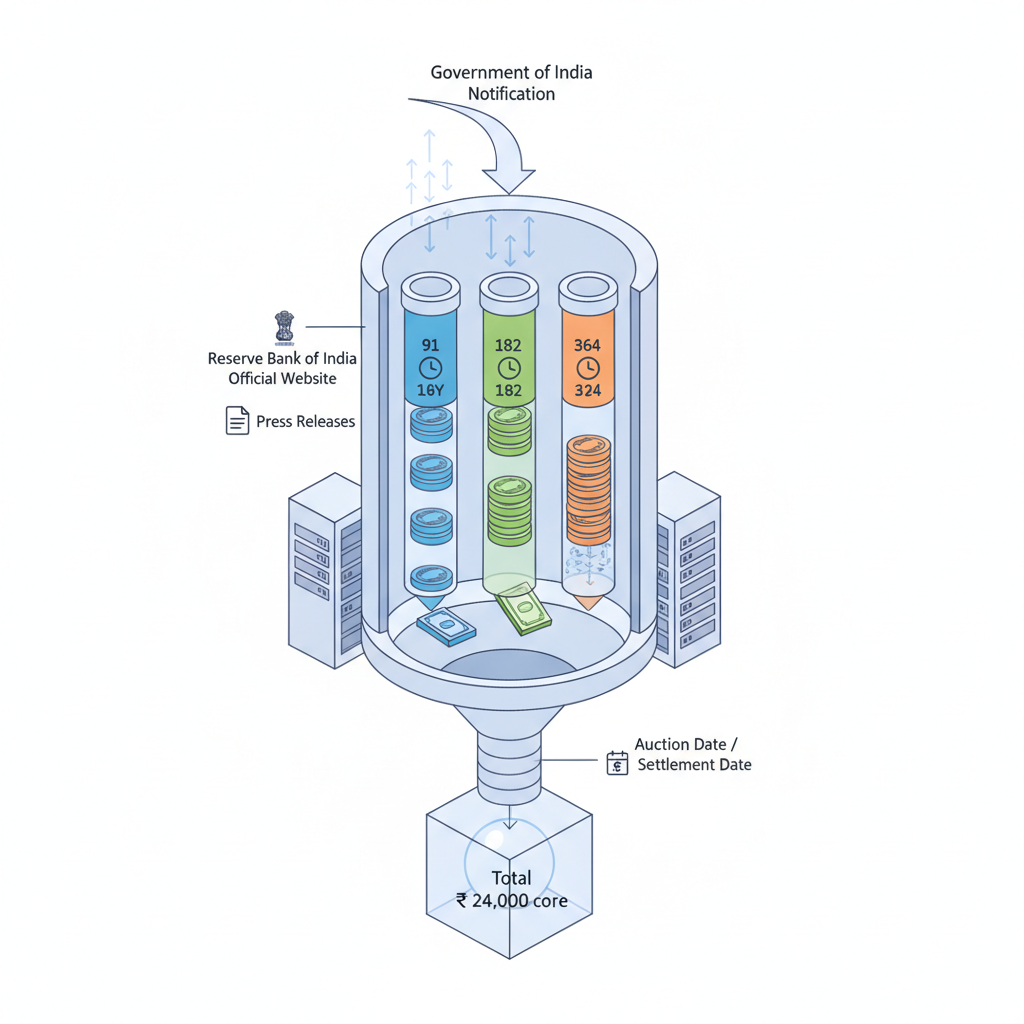
 Treasury BillsNotified AmountAuction DateSettlement DateGovernment Notification
✎ Treasury Bills are short-term government securities auctioned by RBI for GoI's borrowing needs with defined maturity periods and participation rules.
Relevance for Banking, SSC & RBI Grade B exams: Polity
The Reserve Bank of India (RBI) has announced the auction of 91-day, 182-day, and 364-day Treasury Bills (T-Bills) totaling ₹24,000 crore, scheduled for August 19, 2026, with settlement on August 20, 2026. The auction will follow a price-based multiple price method, where competitive bids will be accepted between 10:30 am and 11:30 am, while non-competitive bids—including those from retail investors—can be placed until 11:00 am. Retail investors can participate through the RBI Retail Direct portal, with a cap of 5% of the notified amount for individual allocations. Successful bidders must make payments by August 20, 2026, and results will be declared on the same day. The auction is governed by the General Notification F.No.4(2)-B(W&M)/2018 dated March 26, 2025, as amended, and participation is open to state governments, union territories, eligible provident funds, designated foreign central banks, and other specified entities on a non-competitive basis.
This auction is highly relevant for Banking, SSC, and RBI Grade B exam aspirants as it reflects key concepts in monetary policy, government borrowing, and financial markets. For Banking exams like IBPS PO, SBI Clerk, and RBI Grade B, understanding T-Bill auctions is crucial as they are a primary tool for short-term liquidity management and benchmarking interest rates. SSC aspirants, particularly in the General Awareness section, may encounter questions on government securities, auction mechanisms, or RBI’s role in debt management. The auction’s structure, including competitive and non-competitive bidding, also highlights the RBI’s regulatory framework, making it a potential topic in descriptive papers or interviews for higher-level exams. Additionally, the involvement of retail investors through the RBI Retail Direct portal underscores the government’s push for financial inclusion, a theme often tested in current affairs segments.
Source: RBI
Generated by AanyaAi for educational purpose.
