
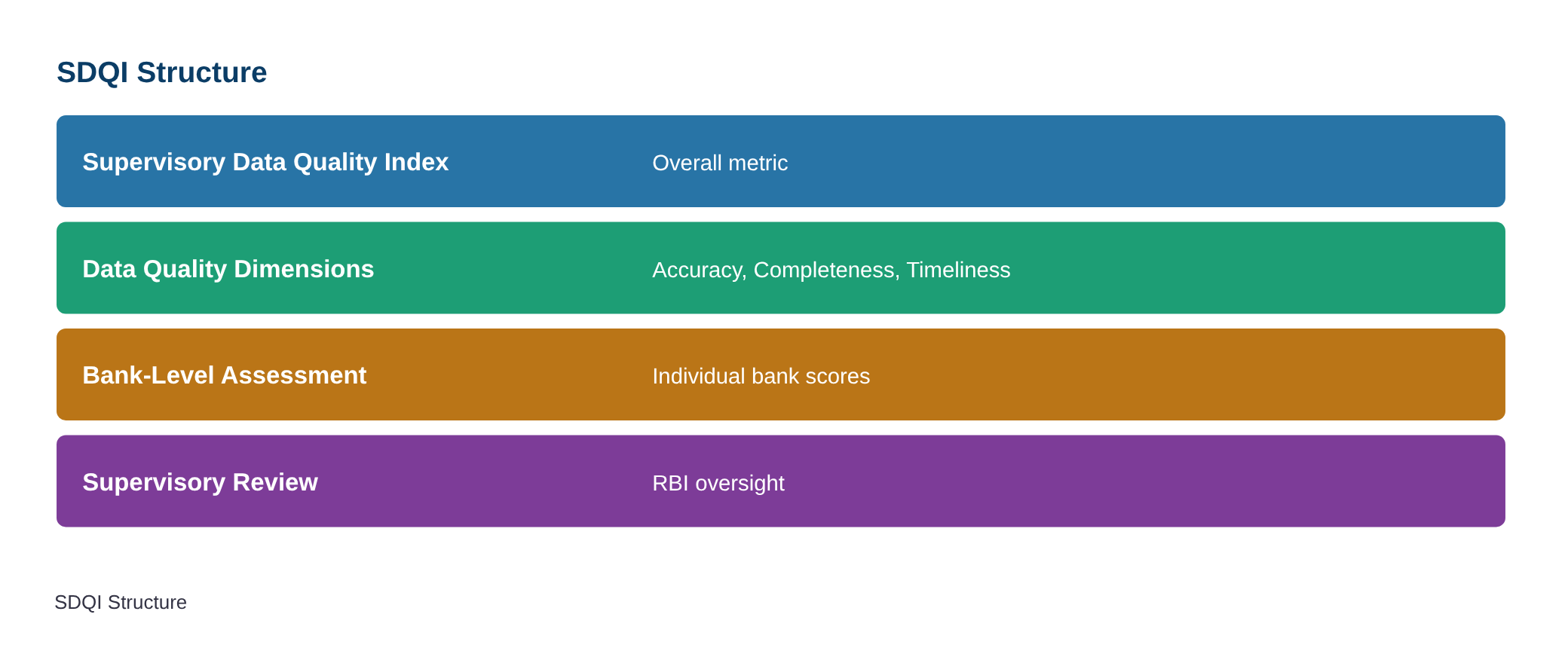
✎ sDQI ensures high-quality, timely, and consistent financial data reporting by banks for RBI’s supervisory assessments.
Relevance for Banking, SSC & RBI Grade B exams: Economy/Governance
The Reserve Bank of India (RBI) recently introduced the Supervisory Data Quality Index (sDQI) for Scheduled Commercial Banks (SCBs) in June 2026, aiming to evaluate the quality of data submitted by banks for supervisory assessments. The sDQI measures four key parameters—Accuracy, Timeliness, Completeness, and Consistency—ensuring that banks adhere to the RBI’s supervisory return guidelines, including the *Reserve Bank of India (Commercial Banks – Supervisory Returns) Directions, 2026* and *Reserve Bank of India (Small Finance Banks – Supervisory Returns) Directions, 2026*. This initiative underscores the RBI’s focus on strengthening the reliability of financial data, which is critical for effective monetary policy, risk assessment, and systemic stability. For banking aspirants preparing for exams like IBPS PO, SBI PO, or RBI Grade B, understanding the sDQI is vital as it highlights the RBI’s emphasis on robust data governance, a key area in banking supervision and regulatory compliance.
For SSC and RBI Grade B candidates, the sDQI serves as a practical example of how regulatory frameworks enhance financial oversight and transparency. The index reflects the RBI’s proactive approach to ensuring high-quality data, which directly impacts banking operations, risk management, and policy decisions. Aspirants should note that questions on data quality, supervisory mechanisms, or RBI’s recent directives may appear in exams, making this topic relevant for both descriptive and objective sections. The introduction of sDQI also aligns with global best practices in financial regulation, reinforcing the importance of accuracy and timeliness in financial reporting—concepts frequently tested in competitive exams.
Source: RBI
Generated by AanyaAi for educational purpose.

1 comment on “RBI Introduces Supervisory Data Quality Index for SCBs in June 2026”