
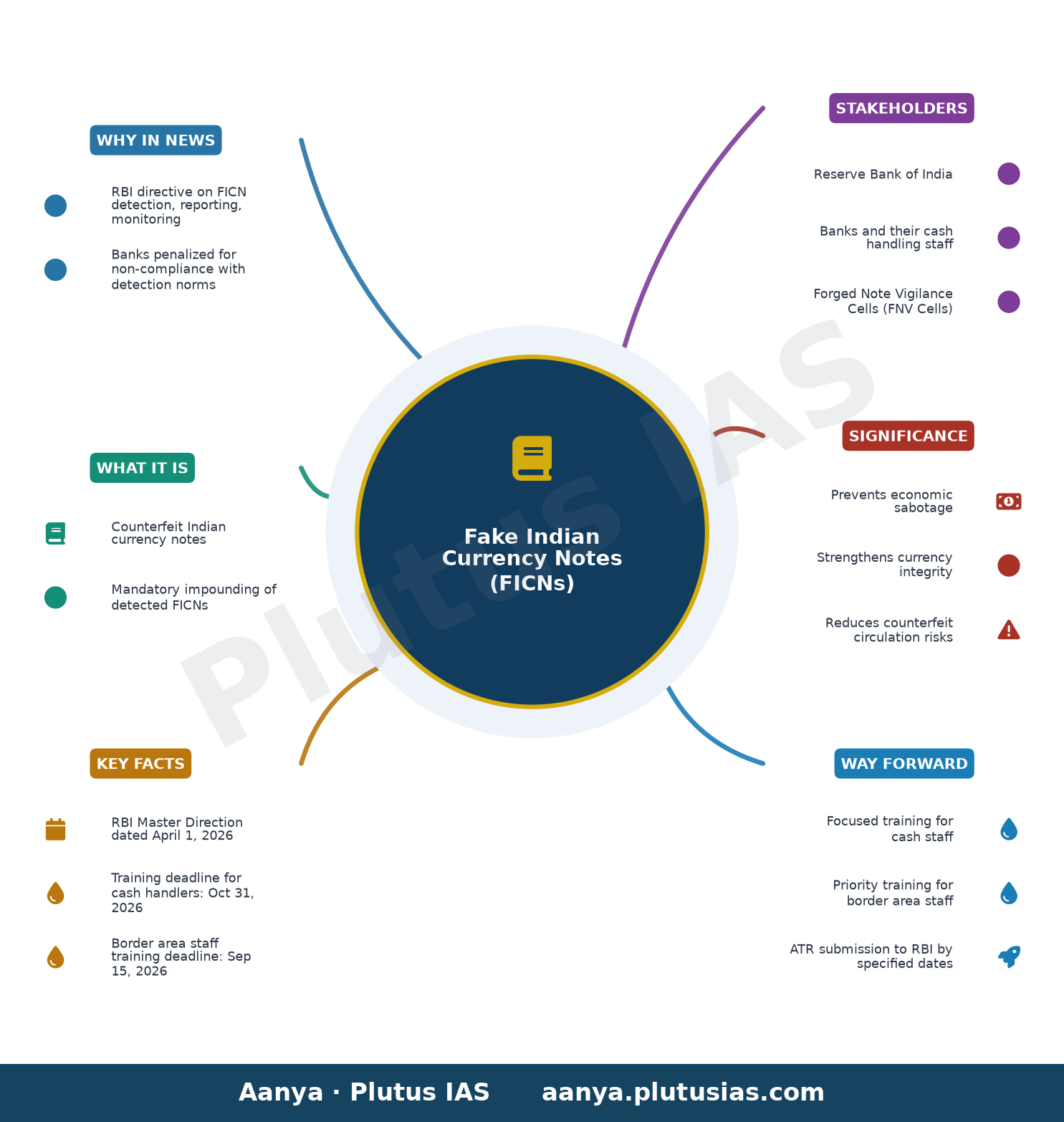
✎ Banks must train staff, detect, impound, and report FICNs per RBI guidelines to avoid penalties and strengthen currency security.
 Security featuresCounterfeit notesCash handlingReporting mechanism
Relevance for Banking, SSC & RBI Grade B exams: Economy/Governance
The Reserve Bank of India (RBI) has issued a directive emphasizing the detection, reporting, and monitoring of Fake Indian Currency Notes (FICNs) through its Master Direction dated April 1, 2026. Banks are mandated to train all cash-handling staff in identifying security features of genuine banknotes and use machines to authenticate notes, ensuring no counterfeit currency is returned or destroyed. Failure to comply with these guidelines can result in penalties, including detection of FICNs in remittances to RBI, ATM dispensations, or over-the-counter payments. The RBI has noted inadequate efforts by some banks and has urged them to strengthen their processes, particularly in border areas where counterfeit activities are more prevalent. Banks must submit Action Taken Reports (ATRs) on training compliance by specified deadlines, with branches in international border districts required to be equipped with Note Authentication/Sorting Machines to enhance detection capabilities.
For aspirants preparing for Bank PO, IBPS, SBI, RBI Grade B, and SSC exams, this directive highlights the importance of currency management and anti-counterfeiting measures in the banking sector. Questions on RBI’s role in maintaining currency integrity, the security features of banknotes, or the penalties for non-compliance with FICN guidelines may appear in examinations. Additionally, understanding the RBI’s monitoring mechanisms and the role of Forged Note Vigilance Cells (FNV Cells) can be crucial for governance-related questions in SSC and RBI Grade B exams. The directive also underscores the need for technological interventions, such as authentication machines, which could be relevant for questions on digital banking and financial technology.
Source: RBI
Generated by AanyaAi for educational purpose.
