
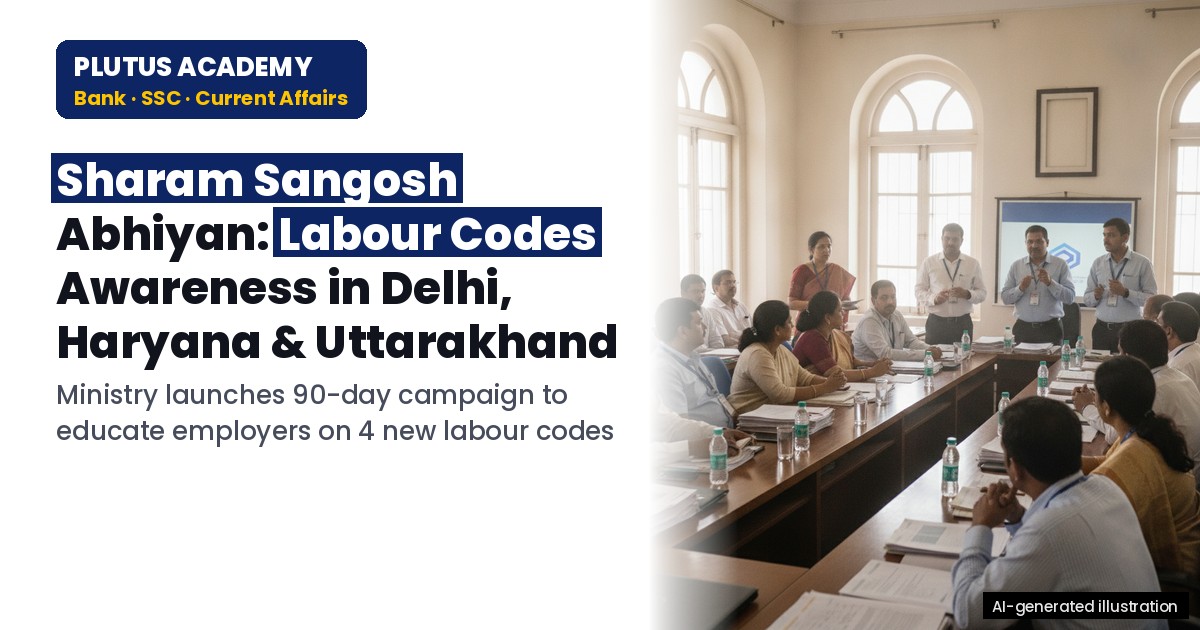
✎ Shri & Employment Ministry's 90-day 'Shram Samvaad' PR campaign (28 Sep 2026–28 Dec 2026) covers all 36 states/UTs, including Delhi, Haryana, and Uttarakhand, to raise awareness on 4 Labour Codes, employer compliance, and social…
Relevance for Banking, SSC & RBI Grade B exams: Polity & Governance
The Labour and Employment Ministry’s nationwide “Sharam Samvaad” outreach campaign, launched on 28 September 2026, reached industrial clusters in Haridwar (Uttarakhand), Naraina (Delhi) and Sonipat (Haryana) on 1 October 2026 through district-level capacity-building and awareness programmes. These events brought together officials, industry bodies, employers, HR and legal professionals, and EPFO, ESIC and Labour Commissioner representatives to clarify the four Labour Codes, employer compliance obligations, and flagship schemes such as PM-Vishwakarma Rozgar Yojana and PM-Shram Yogi Maandhan. The 90-day campaign, covering 316 districts across all States and UTs, aims to remove ambiguities in the new codes’ applicability and ensure smooth on-ground implementation, directly impacting banking operations that finance payroll, social security and industrial lending.
For aspirants of Bank PO, IBPS, SBI, RBI Grade B and SSC exams, this initiative is highly relevant because it underscores the government’s push for formalisation of the workforce through better compliance with social security codes—key for assessing credit risk in MSME lending, monitoring EPFO/ESIC contributions, and evaluating the impact of schemes like PM-SYM on household savings. In governance sections of RBI Grade B Phase-II and SSC CGL Tier-I, questions may test awareness of Labour Code consolidation, PM-Vishwakarma Rozgar Yojana’s role in skilling, or the institutional framework (EPFO, ESIC) that ensures social security—topics now central to India’s formalisation agenda.
Source: PIB (Press Information Bureau)
Generated by AanyaAi for educational purpose.
