
✎ Supreme Court is examining whether Shiv Sena split was a defection under the Anti-Defection Law, impacting Maharashtra politics.
Relevance for Banking, SSC & RBI Grade B exams: Polity
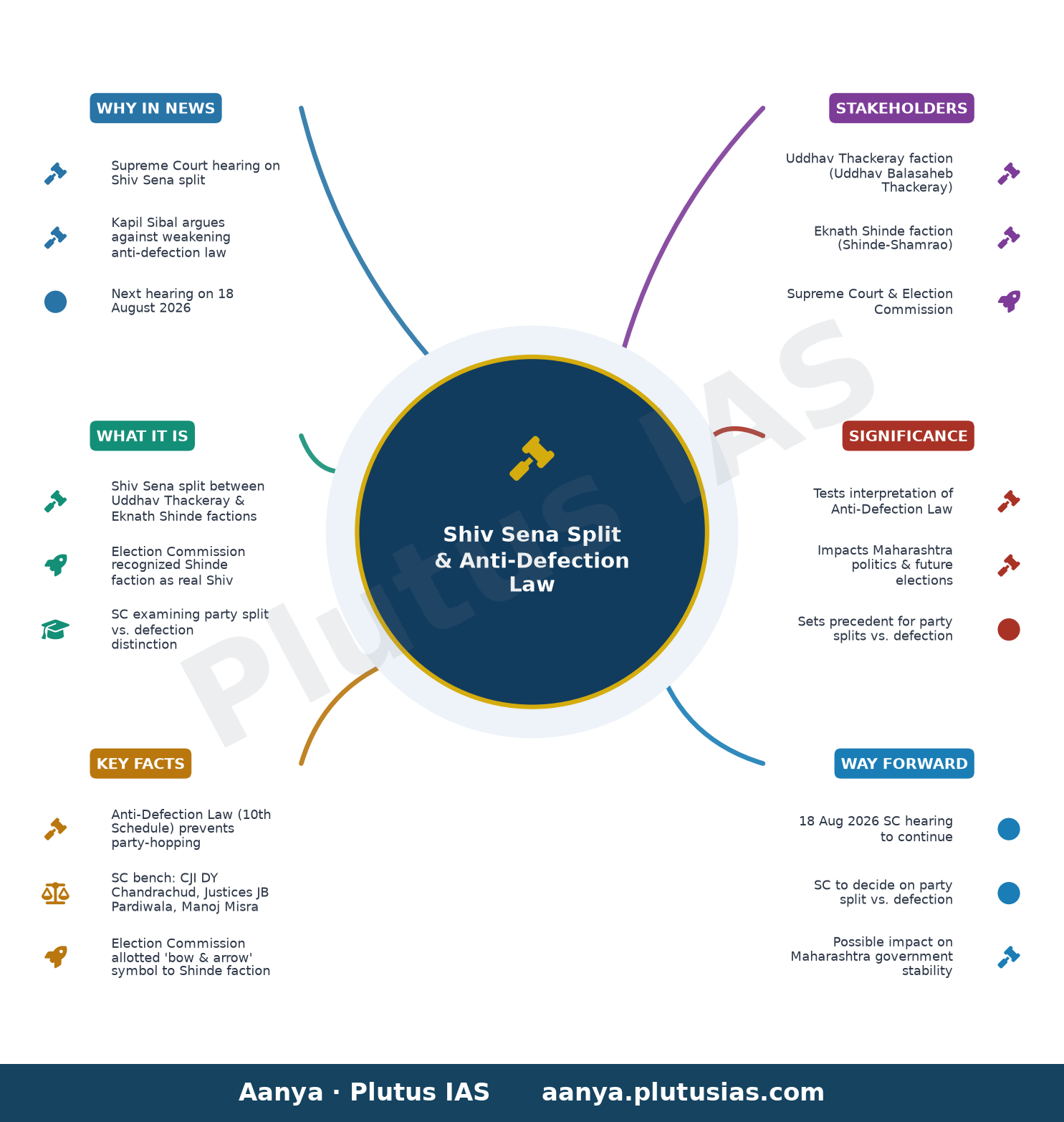
The Supreme Court is currently hearing a critical dispute involving the Shiv Sena, where senior advocate Kapil Sibal argued that the court cannot promote the “sin” of defection by misinterpreting constitutional provisions. The case revolves around whether a split in the legislative party (MLAs) alone constitutes a division in the political party, as claimed by the Election Commission in recognizing the Eknath Shinde faction as the real Shiv Sena. Sibal emphasized that the anti-defection law’s purpose must not be weakened, stressing that disqualification of MLAs and party splits cannot be conflated. The bench, led by Chief Justice Surya Kant, acknowledged its role while asserting that other institutions must also fulfill their responsibilities, highlighting the judiciary’s responsibility in safeguarding democracy.
For banking and SSC aspirants, this case underscores the importance of constitutional provisions like the anti-defection law (Tenth Schedule), which is frequently tested in polity sections. The debate over party splits and MLAs’ disqualification reflects the interplay between legislative, executive, and judicial powers—a recurring theme in competitive exams. RBI Grade B candidates should note how such legal interpretations can impact political stability, governance, and policy implementation, which are often linked to economic stability and fiscal decisions. The 18 August hearing’s outcome may set a precedent for future defection cases, making it a relevant topic for exam preparation.
Source: amarujala.com
Generated by AanyaAi for educational purpose.
