
Relevance for Banking, SSC & RBI Grade B exams: Economy/Governance
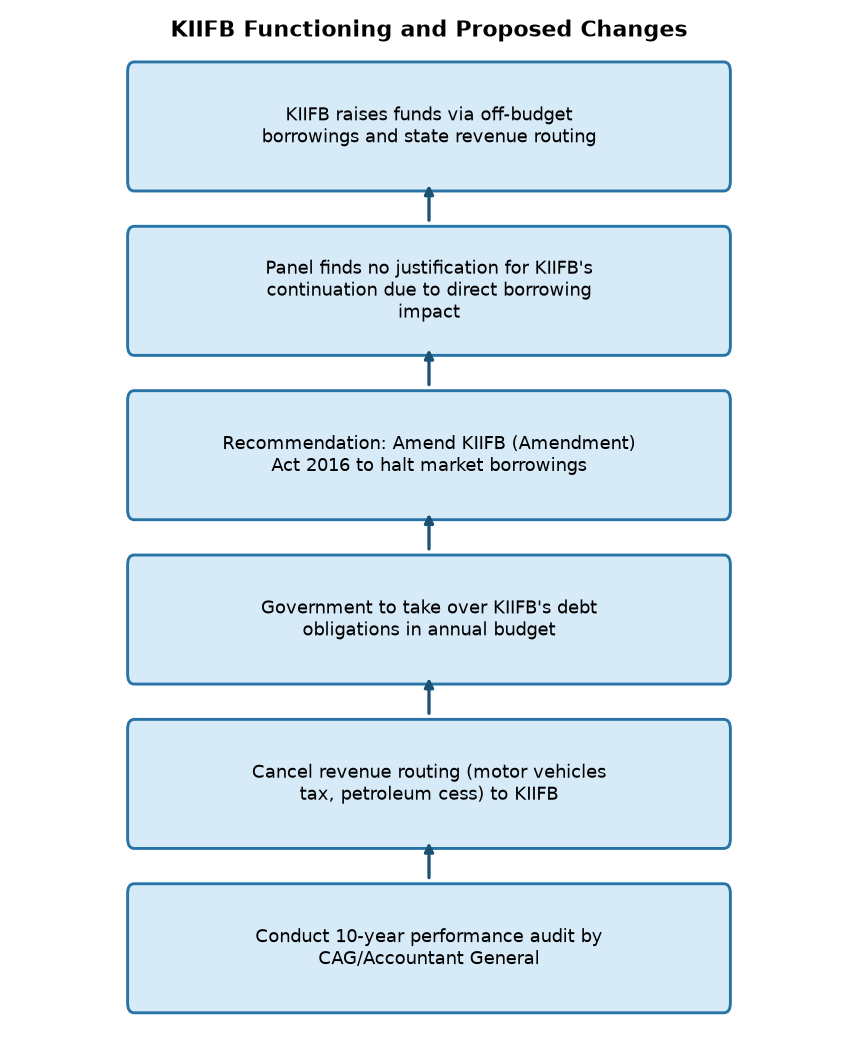
A high-level panel led by former bureaucrat Sudha Pillai has concluded that the Kerala Infrastructure Investment Fund Board (KIIFB) should no longer function as an off-budget vehicle for raising funds and financing projects, citing a “significant detrimental impact on the future fiscal trajectory of the State.” The nine-member committee, which submitted its 96-page report to the Kerala Assembly on October 15, 2026, argues that the original rationale for KIIFB—raising capital without using the State’s borrowing space—has ceased to exist because its borrowings are now treated as direct State debt. The report recommends a CAG performance audit for the decade 2016-2026, an amendment to the KIIFB (Amendment) Act, 2016 to stop market borrowings, and a takeover of KIIFB’s repayment obligations through annual budget provisions. It also flags that only about one-fifth of KIIFB-funded projects are revenue-generating, with the balance dependent on budgetary transfers, and highlights skewed district-wise and department-wise allocations that undermine equitable development.
For banking and SSC aspirants, the report underscores fiscal governance issues such as off-budget borrowings, contingent liabilities, and the distinction between on-budget and off-budget expenditures—concepts frequently tested in exams like IBPS PO, SBI Clerk, and SSC CGL. RBI Grade B candidates should note how the panel’s findings align with Article 293 of the Constitution, the CAG’s role in auditing public accounts, and the fiscal risks posed by special-purpose vehicles, themes that appear in the Economic and Social Issues syllabus. The ₹61,678 crore loss figure cited in the report also illustrates the opportunity cost of sub-optimal resource allocation, a data point useful for essay and descriptive questions on public finance.
Source: The Hindu
Generated by AanyaAi for educational purpose.
