
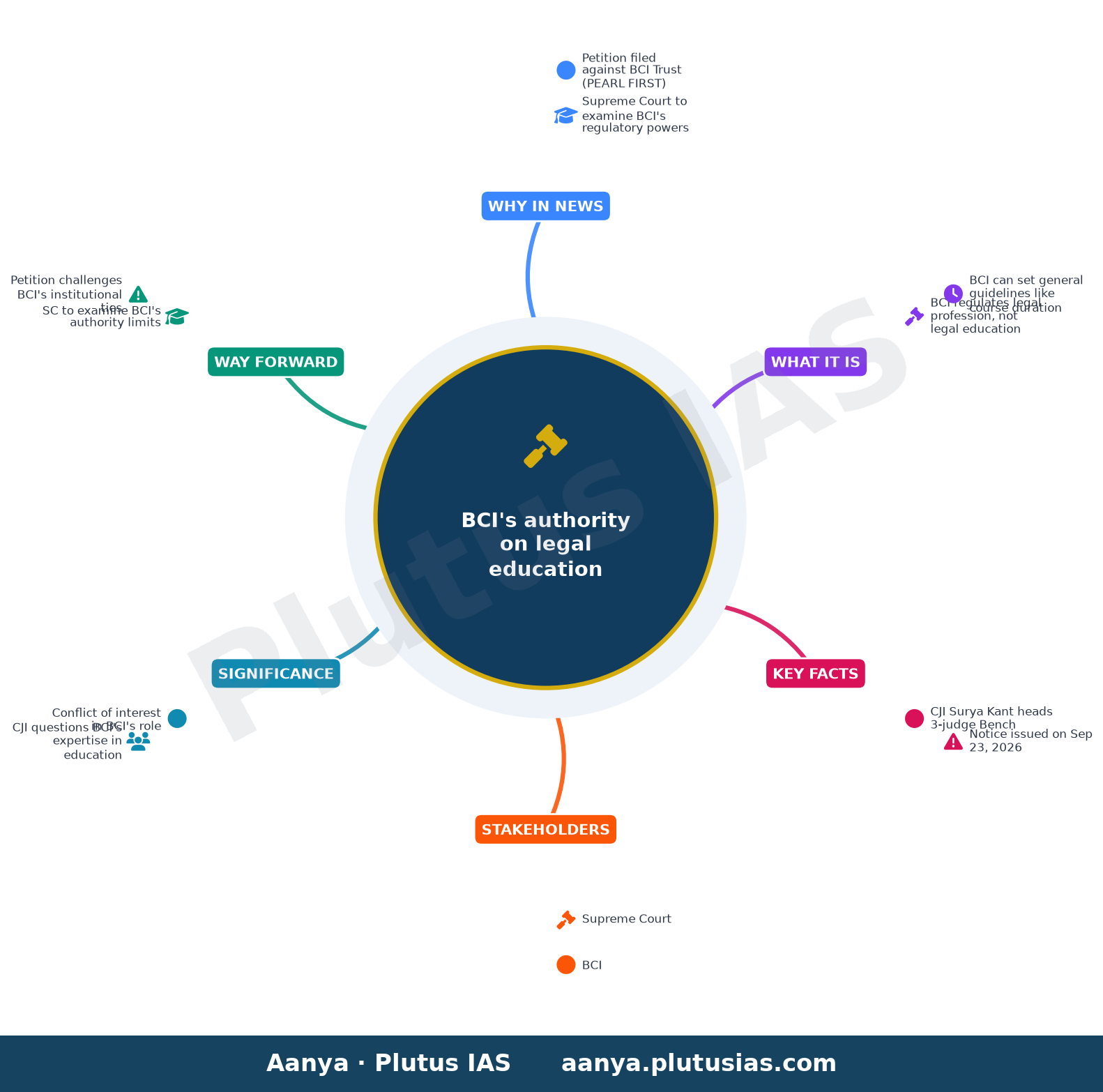
✎ Supreme Court questions BCI's power to regulate legal education, limiting its role to general guidelines.
Relevance for Banking, SSC & RBI Grade B exams: Polity
The Supreme Court’s decision to examine the Bar Council of India’s (BCI) authority over legal education highlights a critical constitutional debate on regulatory powers and conflict of interest. The three-judge Bench, led by Chief Justice Surya Kant, raised concerns over the BCI’s dual role as both a regulator of the legal profession and an entity involved in establishing and managing law universities, such as the India International University of Legal Education and Research (IIULER) in Goa. The Court questioned whether the BCI, primarily tasked with overseeing lawyers, can effectively regulate legal education when domain experts and academicians exist. This scrutiny is particularly relevant for banking and SSC aspirants, as it underscores the importance of institutional autonomy and checks on regulatory overreach, a concept often tested in governance and constitutional law sections of competitive exams.
For RBI Grade B and other government job aspirants, this case serves as a key example of judicial intervention in administrative functions, a recurring theme in public policy and constitutional law. The petition argues that the BCI’s involvement in running law universities conflicts with its regulatory duties, creating a bias that could undermine the integrity of legal education standards. Such cases reflect broader principles of separation of powers and accountability, which are frequently examined in exams like RBI Grade B’s phase-II descriptive papers or SSC’s general awareness sections. Understanding these nuances helps aspirants grasp the interplay between constitutional bodies and their jurisdiction, a vital topic for both prelims and mains preparations.
Source: The Hindu
Generated by AanyaAi for educational purpose.

1 comment on “Supreme Court questions BCI’s power over legal education regulations”