
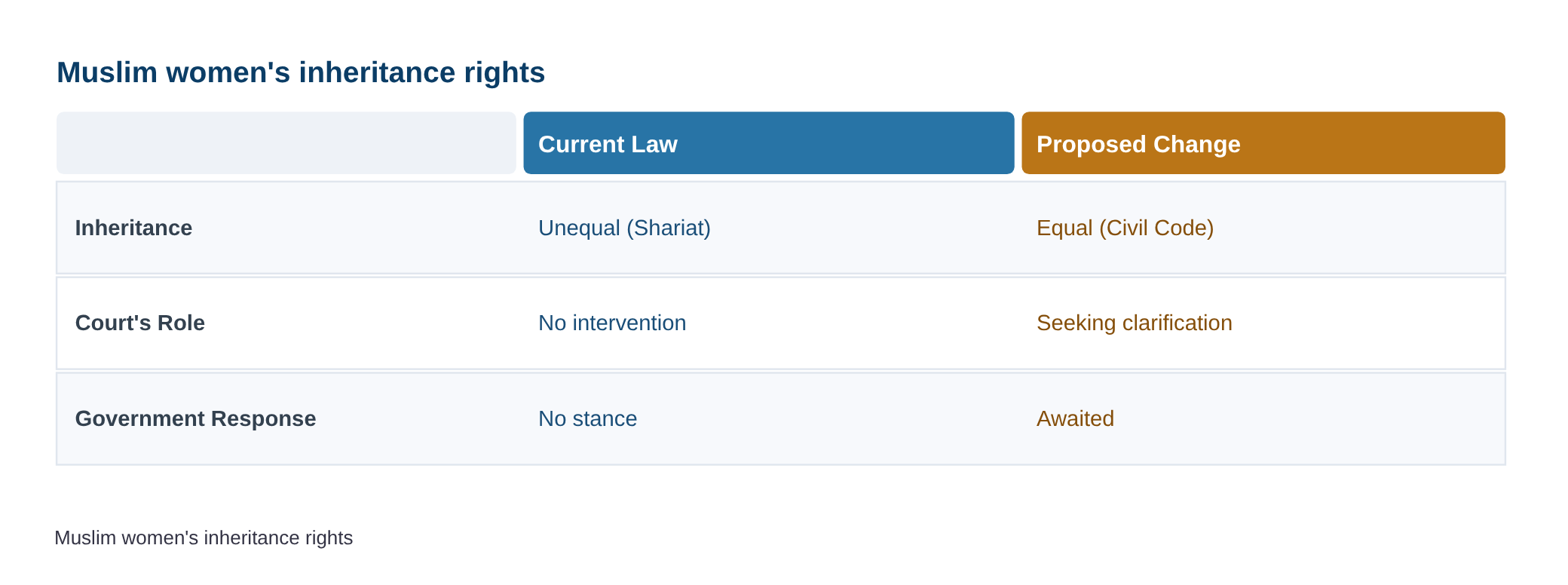
✎ Muslim women's inheritance rights under scrutiny for gender bias in personal laws.
Relevance for Banking, SSC & RBI Grade B exams: Polity
The Supreme Court has sought a response from the Centre on a Public Interest Litigation (PIL) challenging the gender disparity in inheritance rights under Muslim Personal Law, which allegedly denies Muslim women equal property rights compared to men. The PIL argues that these non-codified inheritance rules violate constitutional provisions, including Articles 14 (equality), 15 (prohibition of discrimination), and 21 (right to life and personal liberty), by institutionalizing gender bias. The bench, led by Chief Justice Surya Kant and Justices Joymalya Bagchi and V. Mohana, has issued notices to the Ministries of Law and Justice and Youth Affairs and Sports, highlighting the need for constitutional scrutiny of such personal laws.
This issue is highly relevant for Banking, SSC, and RBI Grade B exam aspirants as it intersects with constitutional law, fundamental rights, and socio-legal debates. Questions on fundamental rights, judicial review, and gender justice are frequently asked in these exams. Additionally, understanding the interplay between personal laws and constitutional morality is crucial for topics like governance, law reforms, and social justice, which are often included in the syllabus for these competitive exams.
Source: amarujala.com
Generated by AanyaAi for educational purpose.

1 comment on “Supreme Court Questions Muslim Inheritance Rights for Women Under Personal Law”