
Relevance for Banking, SSC & RBI Grade B exams: Polity & Governance
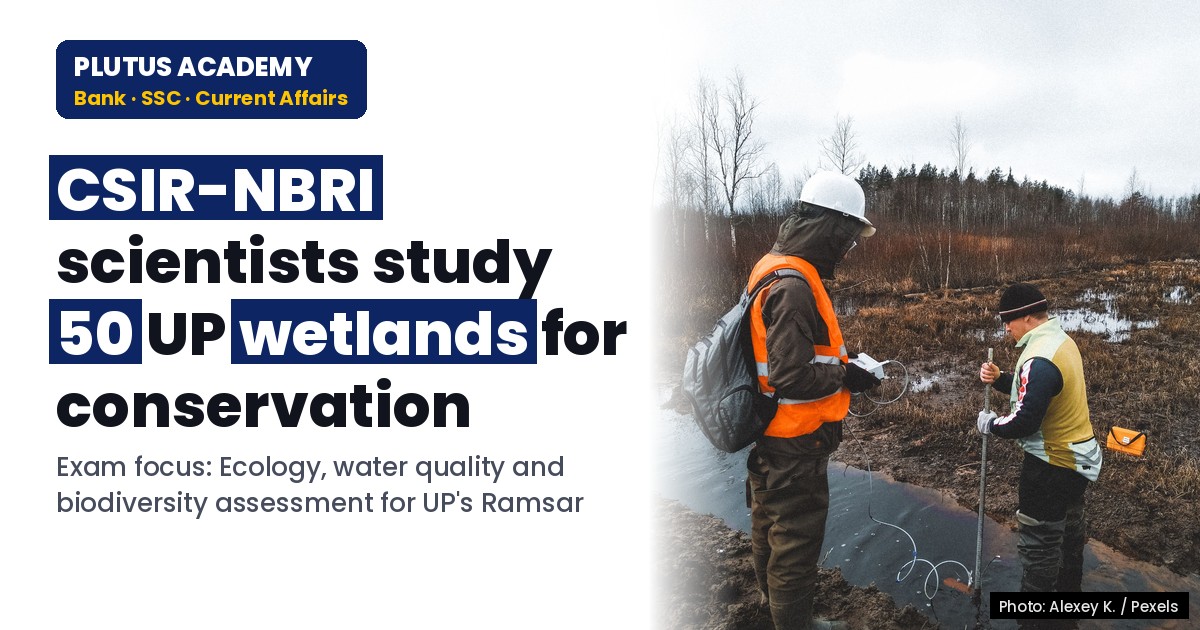
The Uttar Pradesh government, in collaboration with the **CSIR-National Botanical Research Institute (NBRI)**, has launched a scientific survey of **50 wetlands**, including **13 Ramsar sites**, to assess their ecological health, water quality, and biodiversity. The initiative, led by scientists including Dr. Sachitra Kumar Rath, aims to strengthen conservation efforts and restore ecological balance in these critical water bodies. The team recently conducted field visits to wetlands like **Sarai Barai in Barabanki**, collecting samples of water, aquatic vegetation, and conducting terrestrial inspections to analyze human interference, pollution, and agricultural activities impacting these ecosystems.
This campaign holds significant relevance for **Banking, SSC, and RBI Grade B exams**, as it aligns with **sustainable development, environmental governance, and public policy** themes frequently tested in these examinations. The Ramsar Convention, an international treaty for wetland conservation, reflects India’s commitment to global environmental agreements—a topic often asked in **General Awareness sections**. Additionally, the involvement of **CSIR (Council of Scientific and Industrial Research)**, a premier research body, underscores the role of **scientific institutions in policy implementation**, a key area in **RBI Grade B’s Economic and Social Issues (ESI) syllabus**. For SSC aspirants, questions on **wetland conservation, biodiversity, and government schemes** (like the National Mission for Clean Ganga) are common, making this initiative a potential exam topic.
Source: amarujala.com
Generated by AanyaAi for educational purpose.

2 comments on “UP Launches Scientific Study of 50 Wetlands Including Ramsar Sites for Conservation”