✎ India’s space sector reforms boost private participation, enhancing global leadership in space technology and education.
Relevance for Banking, SSC & RBI Grade B exams: Science & Technology
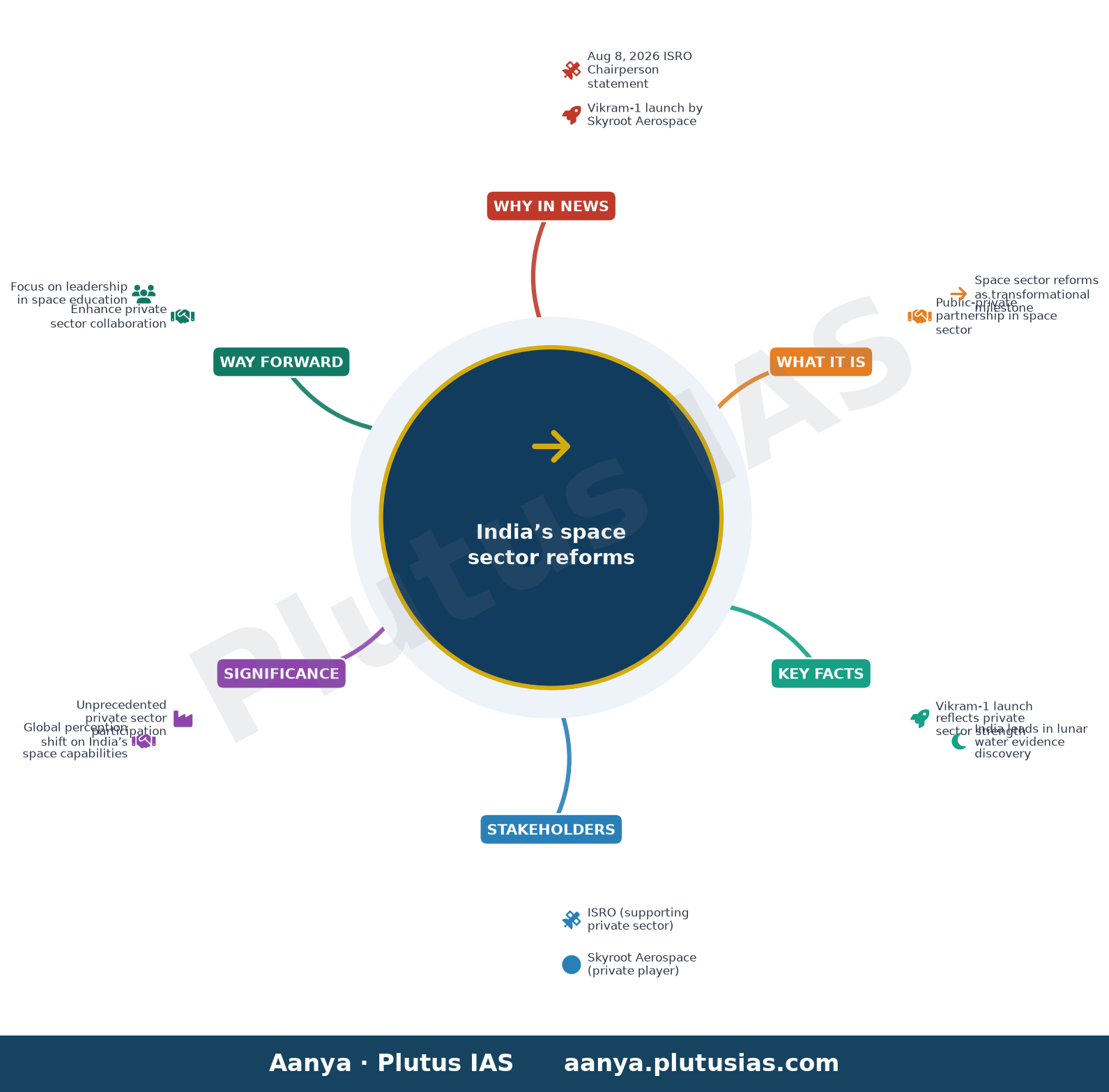
The successful launch of Vikram-1 by Skyroot Aerospace underscores the growing synergy between India’s public and private sectors in the space domain, as highlighted by ISRO Chairperson V. Narayanan. He termed the space sector reforms as a “transformational milestone,” enabling unprecedented private participation and positioning India as a global leader in critical space operations, including lunar discoveries and soft landings. This collaboration not only strengthens India’s technological prowess but also aligns with the government’s vision of a self-reliant and commercially competitive space ecosystem, making it a key topic for banking and SSC exams where questions on India’s strategic sectors and reforms are common.
For RBI Grade B aspirants, the Vikram-1 launch reflects India’s broader economic and technological advancements, which can influence monetary policies, foreign investments, and sectoral growth. The emphasis on public-private partnerships (PPPs) in space mirrors similar models in banking and infrastructure, where efficiency and innovation are critical. SSC candidates may encounter questions on India’s space missions, reforms, or the role of institutions like ISRO and IIST, making this a relevant current-affairs topic for their preparation.
Source: The Hindu
Generated by AanyaAi for educational purpose.
