
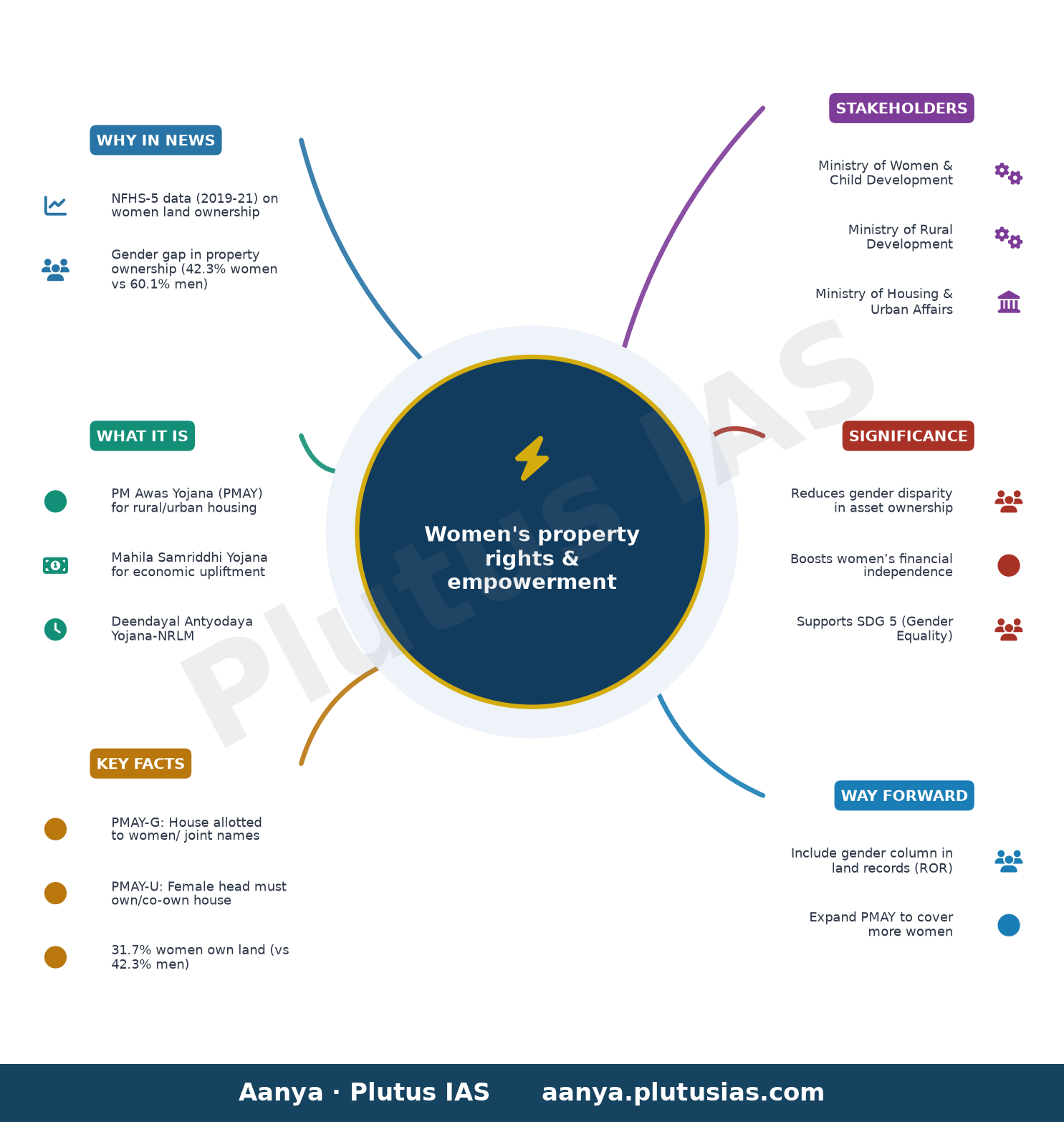
✎ Government schemes like PMAY and Mahila Samriddhi Yojana promote women’s property ownership and economic empowerment.
Relevance for Banking, SSC & RBI Grade B exams: Polity & Governance
The Government of India has implemented several schemes to promote women’s property ownership and economic empowerment, a critical focus area for governance and policy-making. Key initiatives include the Pradhan Mantri Awas Yojana (PMAY) in both rural and urban sectors, which mandates property allocation in women’s names or jointly with their spouses, ensuring financial security. Additionally, the *Mahila Samriddhi Yojana* under the Ministry of Social Justice and Empowerment and the *Deendayal Antyodaya Yojana-National Rural Livelihood Mission* (DAY-NRLM) under the Ministry of Rural Development further support women’s economic independence by facilitating access to housing and livelihood opportunities. These measures align with the National Family Health Survey (NFHS-5) data, which highlights persistent gender disparities in asset ownership—only 42.3% of women aged 15-49 own homes compared to 60.1% of men, and 31.7% own land versus 42.3% of men—underscoring the need for targeted interventions.
For aspirants preparing for Bank PO, IBPS, SBI, RBI Grade B, and SSC exams, this topic is highly relevant as it intersects with governance, social justice, and economic policies. Questions may arise on the objectives and provisions of PMAY, DAY-NRLM, or the role of NFHS in policy formulation, testing candidates’ understanding of welfare schemes and their impact on gender equity. The inclusion of gender-specific columns in land records further reflects the government’s commitment to transparency and women’s rights, a potential area for analytical questions in exams like RBI Grade B’s Economic and Social Issues section or SSC’s General Awareness segment. Understanding these schemes also aids in answering questions on financial inclusion and women-centric developmental policies, which are frequently emphasized in competitive exams.
Source: PIB (Press Information Bureau)
Generated by AanyaAi for educational purpose.
