✎ WPI inflation in August 2026 rose to 9.92% due to fuel, food, and manufacturing price pressures, impacting policy and economic outlook.
Relevance for Banking, SSC & RBI Grade B exams: Economy/Governance
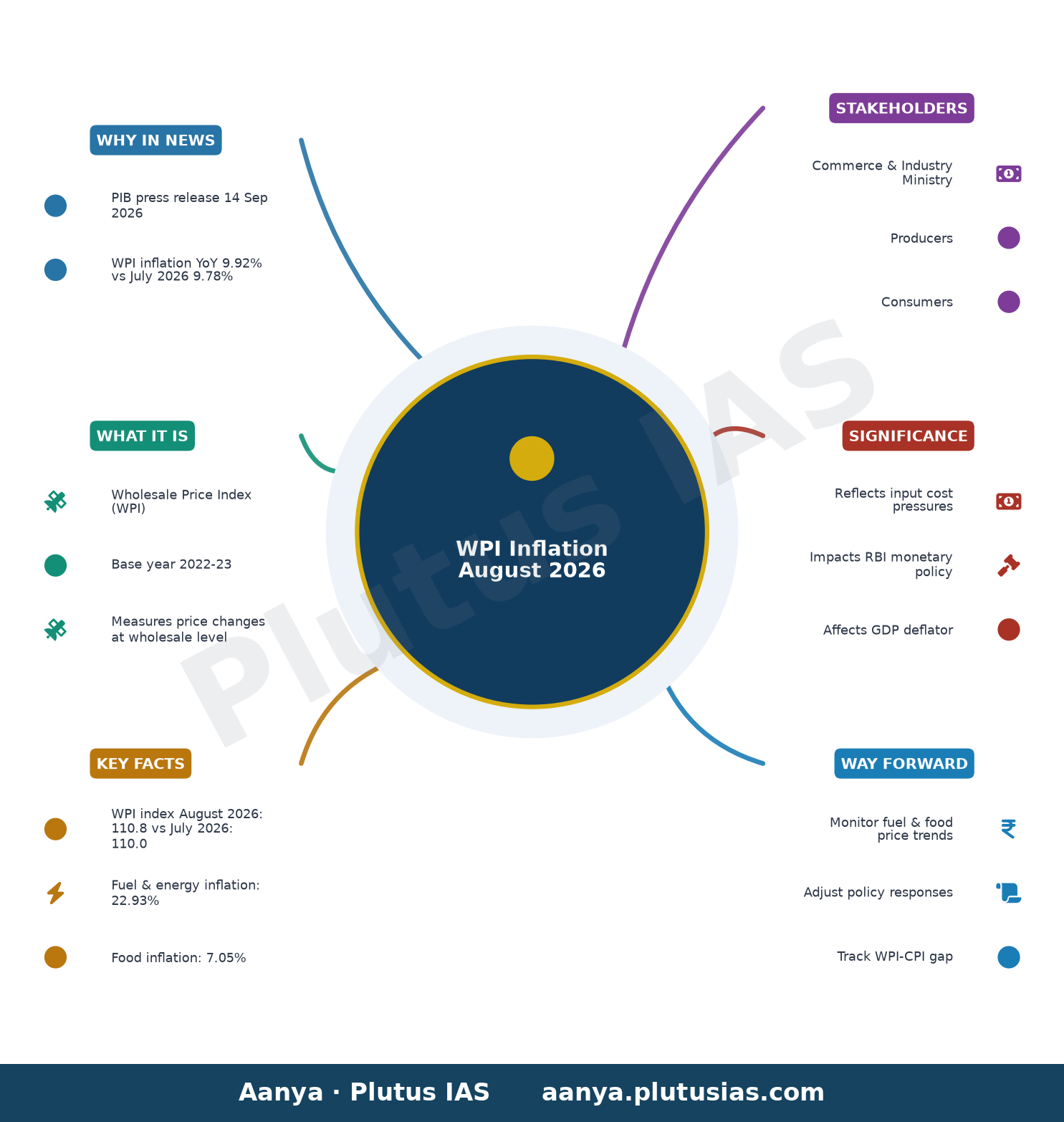
The Press Information Bureau (PIB) released the provisional Wholesale Price Index (WPI) for August 2026 with the base year 2022-23, revealing a year-on-year inflation rate of 9.92%, up from 9.78% in July 2026. The all-commodity index stood at 110.8, compared to 110.0 in the previous month. Primary articles saw a WPI inflation of 7.76%, fuel and power at 22.93%, and manufactured products at 8.37%, indicating rising costs across key sectors. Notably, mineral oils (including petroleum products), food items, and basic metals were major contributors to inflation, reflecting supply-side pressures and volatile commodity prices. The provisional data, collected at an 84.4% weighted response rate, suggests persistent inflationary trends, which could influence monetary policy decisions, including interest rate adjustments by the Reserve Bank of India (RBI).
For banking and SSC aspirants, understanding WPI trends is crucial as it impacts loan pricing, deposit rates, and overall economic policy frameworks. RBI Grade B candidates must grasp how WPI-driven inflation feeds into monetary policy, liquidity management, and inflation targeting. The data also highlights sectoral disparities, such as the sharp rise in fuel prices (22.93%), which could affect transportation costs and consumer prices, a key consideration for financial institutions and government policies. Aspirants should correlate WPI movements with GDP growth, fiscal deficits, and RBI’s stance on inflation to answer questions in exams like SBI PO, IBPS Clerk, or SSC CGL.
Source: PIB (Press Information Bureau)
Generated by AanyaAi for educational purpose.

1 comment on “WPI Inflation August 2026: Key Highlights for Banking & SSC Exams”