
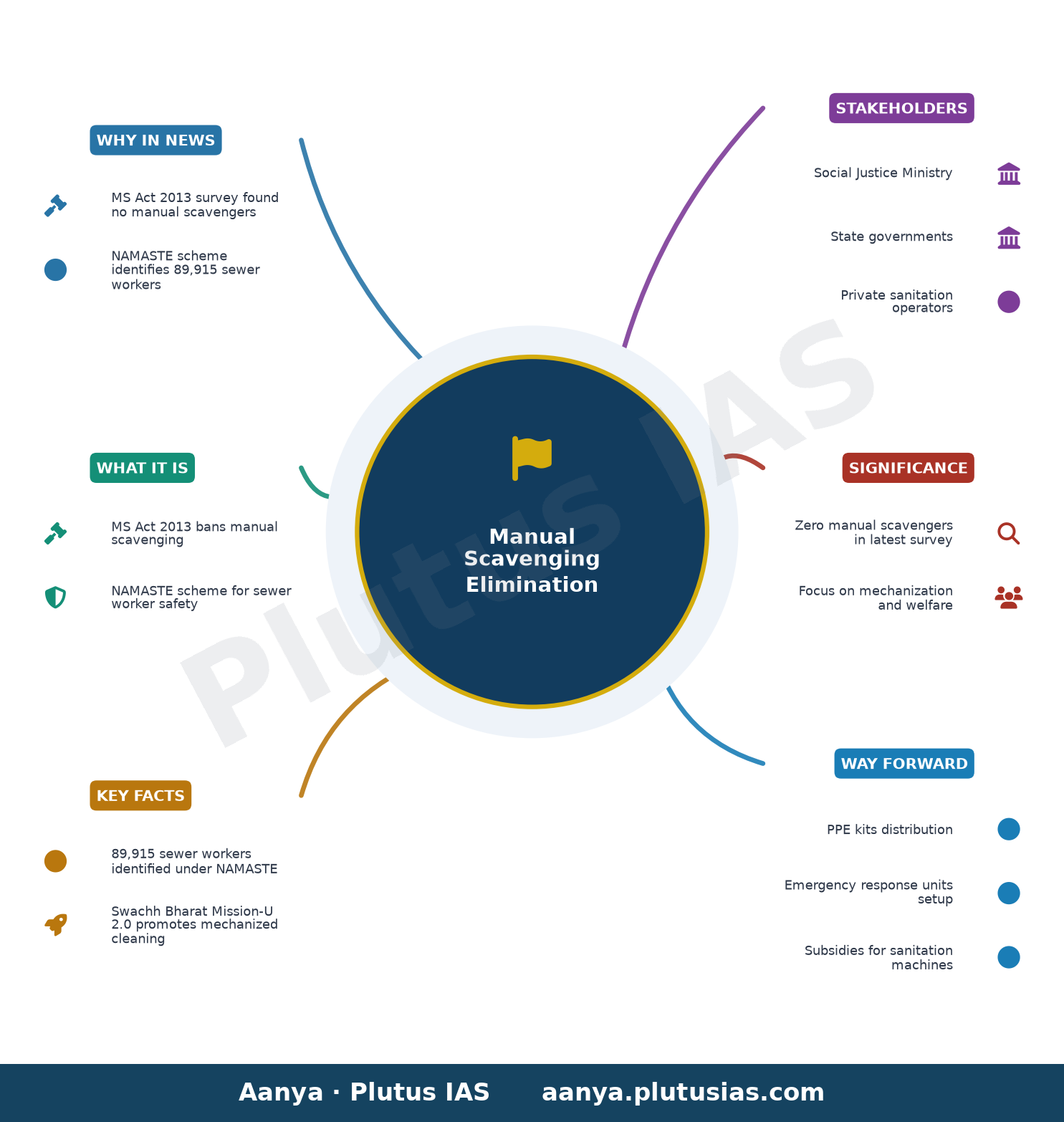
✎ MS Act 2013 and NAMASTE scheme aim to eliminate manual scavenging through mechanization and welfare measures.
Relevance for Banking, SSC & RBI Grade B exams: Economy/Governance
The government has reiterated its commitment to eliminating manual scavenging and ensuring the safety and dignity of sanitation workers through legal measures and welfare schemes under the *Prohibition of Employment as Manual Scavengers and their Rehabilitation (MS) Act, 2013*. A recent nationwide survey conducted under this Act found no manual scavengers, highlighting the progress made in eradicating the practice. The *National Action for Mechanised Sanitation Ecosystem (NAMASTE)* scheme, launched in 2023-24, has identified 89,915 sewer and septic tank workers across India, with state-wise data shared in Parliament. The scheme focuses on mechanization, safety training, provision of PPE kits, health insurance, and capital subsidies for sanitation machinery to improve working conditions and prevent hazardous manual cleaning.
For banking and SSC aspirants, this development underscores the government’s focus on inclusive governance and social welfare, which often features in exams. The MS Act’s enforcement and NAMASTE’s welfare measures reflect policy priorities that candidates should understand for governance-related questions. RBI Grade B candidates, in particular, may link such initiatives to broader themes like public health, labor reforms, and sustainable urban development, as these impact economic policies and financial inclusion. The emphasis on mechanization and safety also aligns with India’s broader goals of improving infrastructure and reducing occupational hazards, topics relevant for economic assessments.
Source: PIB (Press Information Bureau)
Generated by AanyaAi for educational purpose.
