
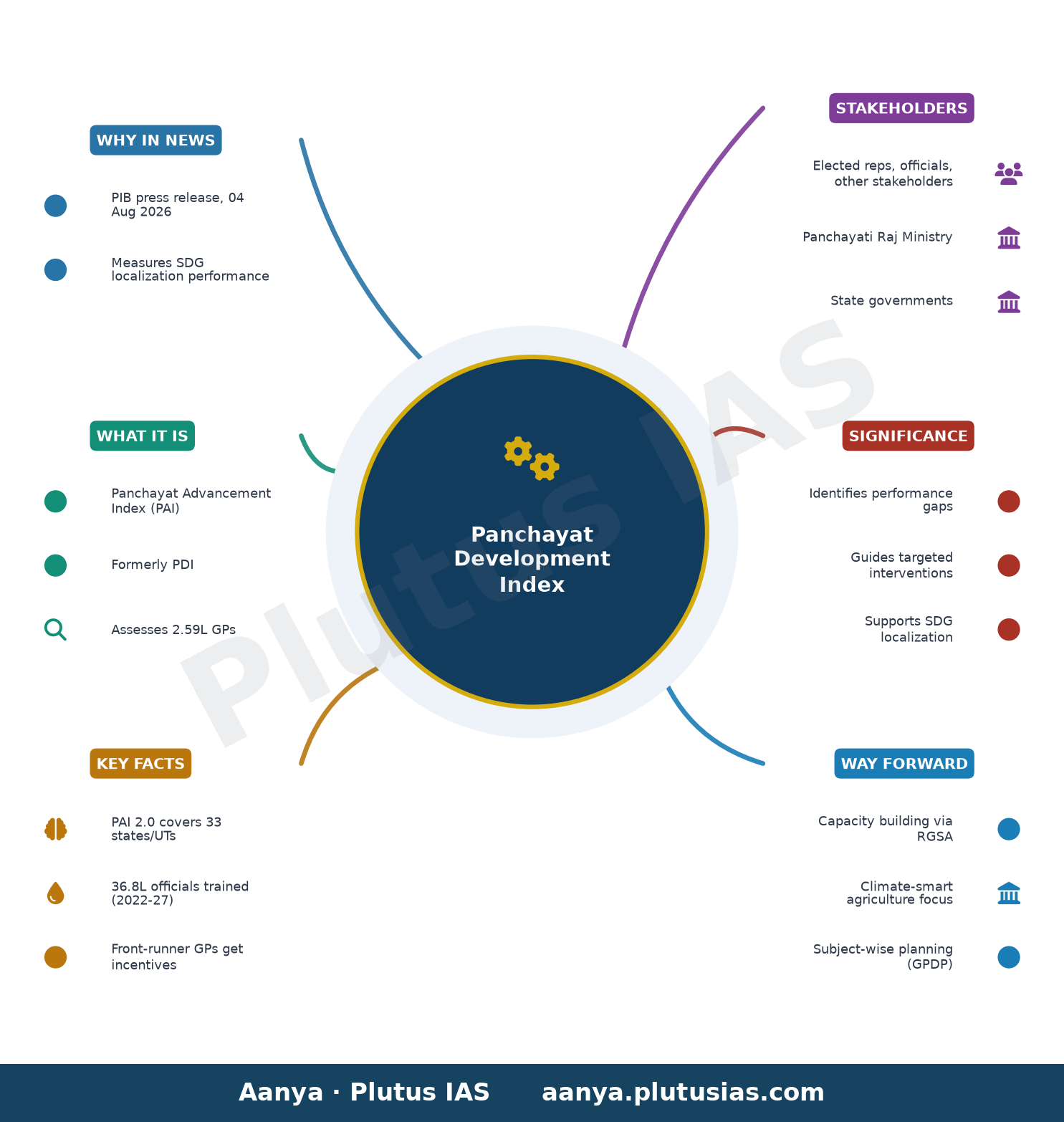
✎ PAI tracks SDG-localization progress in 2.59L panchayats via 36.8L trained officials under RGSA.
Relevance for Banking, SSC & RBI Grade B exams: Economy/Governance
The Panchayat Development Index (PDI), now called the Panchayat Advancement Index (PAI), is a comprehensive assessment framework developed by the Ministry of Panchayati Raj to measure the progressive performance of Gram Panchayats (GPs) in aligning with the Sustainable Development Goals (SDGs). Introduced as part of the localization of SDGs, the PAI provides granular scores and dashboards at both thematic and aggregate levels, enabling identification of performance gaps, strengths, and areas requiring focused interventions. For instance, in FY 2023-24, the PAI 2.0 evaluated over 2.59 lakh GPs across 33 states and Union Territories, categorizing them into grades (A+, A, B, C, D) based on their overall PAI scores. This data-driven approach not only enhances transparency in rural governance but also aligns with the RBI Grade B’s emphasis on inclusive growth and data-driven policy formulation. For banking and SSC aspirants, understanding the PAI’s role in decentralized planning and SDG localization is crucial, as it reflects the government’s commitment to grassroots development—a theme often tested in exams like SBI PO and SSC CGL through questions on governance and rural economy.
The PAI framework is closely linked to the Revised National Gram Swaraj Abhiyan (RNGSA), a centrally sponsored scheme aimed at capacity-building for elected representatives and officials in Panchayati Raj institutions. Under RNGSA, over 36.8 lakh stakeholders have been trained in SDG localization themes like “Child-Friendly Village” and “Water-Sufficient Panchayat” from FY 2022-23 to 2026-27. Such initiatives underscore the government’s push for sustainable and climate-resilient rural development, a key area of interest for RBI Grade B’s economic and social development sections. For banking aspirants, the PAI’s focus on thematic planning—such as efficient water management and sustainable agriculture—highlights the intersection of rural development with financial inclusion and credit flow to agriculture, a recurring topic in exams like IBPS PO. Similarly, SSC aspirants may encounter questions on the role of Panchayats in achieving SDGs, making the PAI a relevant case study for governance and economic planning.
Source: PIB (Press Information Bureau)
Generated by AanyaAi for educational purpose.
