
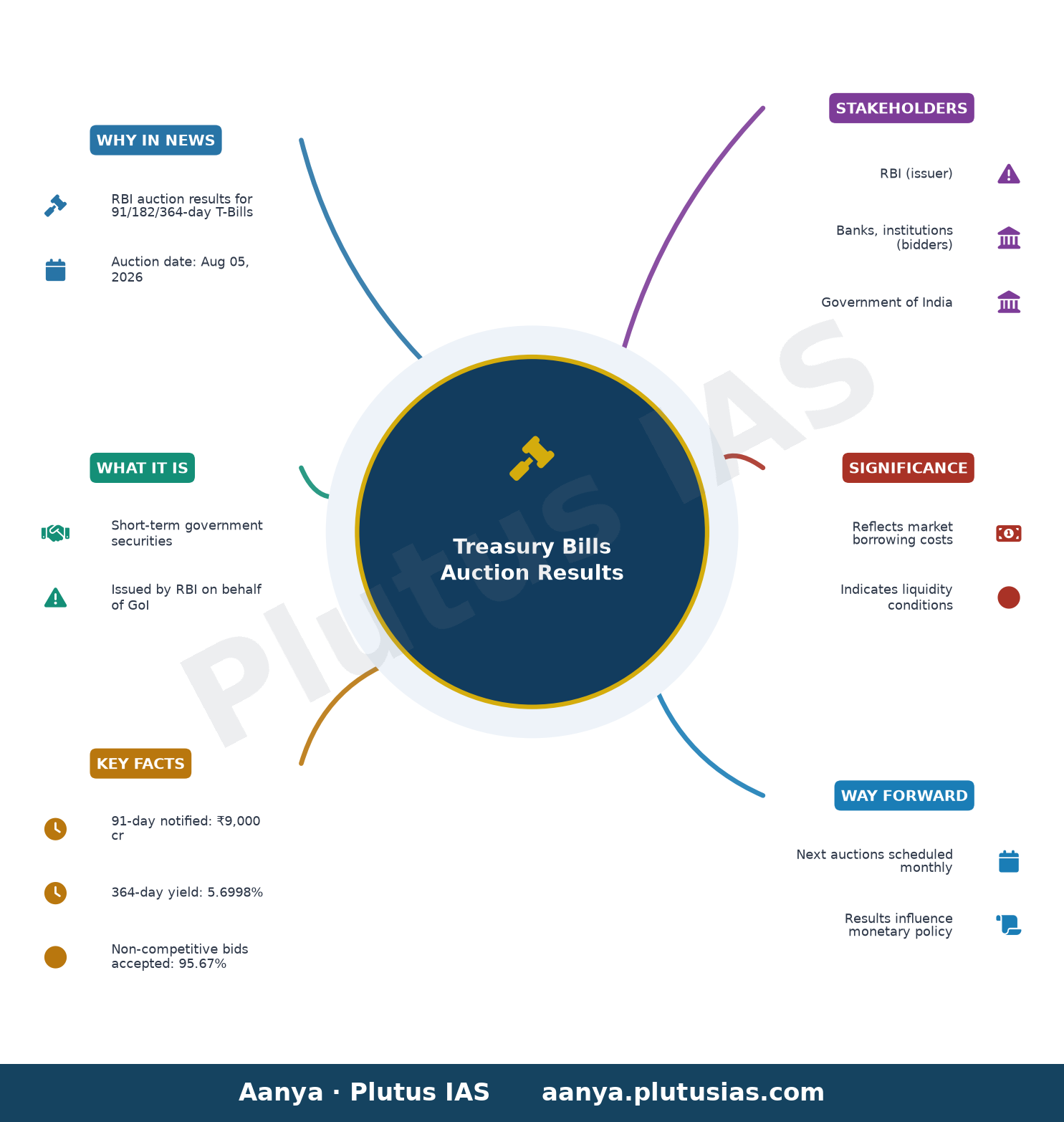
✎ T-Bills auction results show notified vs accepted amounts, yields, and bid trends for 91/182/364-day securities.
Relevance for Banking, SSC & RBI Grade B exams: Polity
The Reserve Bank of India (RBI) recently released the auction results for Treasury Bills (T-Bills) of 91-day, 182-day, and 364-day maturities, providing key insights into India’s short-term debt market. The notified amounts for the auctions were ₹9,000 crore, ₹8,000 crore, and ₹7,000 crore respectively, with competitive bids significantly exceeding the notified amounts—₹22,102.225 crore for 91-day, ₹19,947.250 crore for 182-day, and ₹14,560 crore for 364-day T-Bills. The cut-off yields, which reflect market sentiment, were 5.2780% for 91-day, 5.5501% for 182-day, and 5.6998% for 364-day T-Bills, indicating rising interest rates in the short-term segment. Non-competitive bids, primarily from small investors and institutions, also saw substantial participation, with amounts accepted at ₹27,222.290 crore, ₹2,100 crore, and ₹350 crore for the respective tenors.
For banking and financial services aspirants preparing for exams like Bank PO, IBPS, SBI, or RBI Grade B, understanding T-Bill auctions is crucial as they serve as benchmarks for short-term interest rates and liquidity conditions in the economy. The yield trends in these auctions influence lending rates, deposit pricing, and monetary policy decisions, making them a key indicator for financial stability. For SSC aspirants, especially in the General Studies section, questions on government securities and RBI’s role in managing public debt are common, and this data helps in grasping fiscal policy tools. The RBI’s auction mechanism also reflects its liquidity management strategies, which are frequently tested in RBI Grade B examinations, where candidates are expected to analyze market dynamics and their macroeconomic implications.
Source: RBI
Generated by AanyaAi for educational purpose.
