
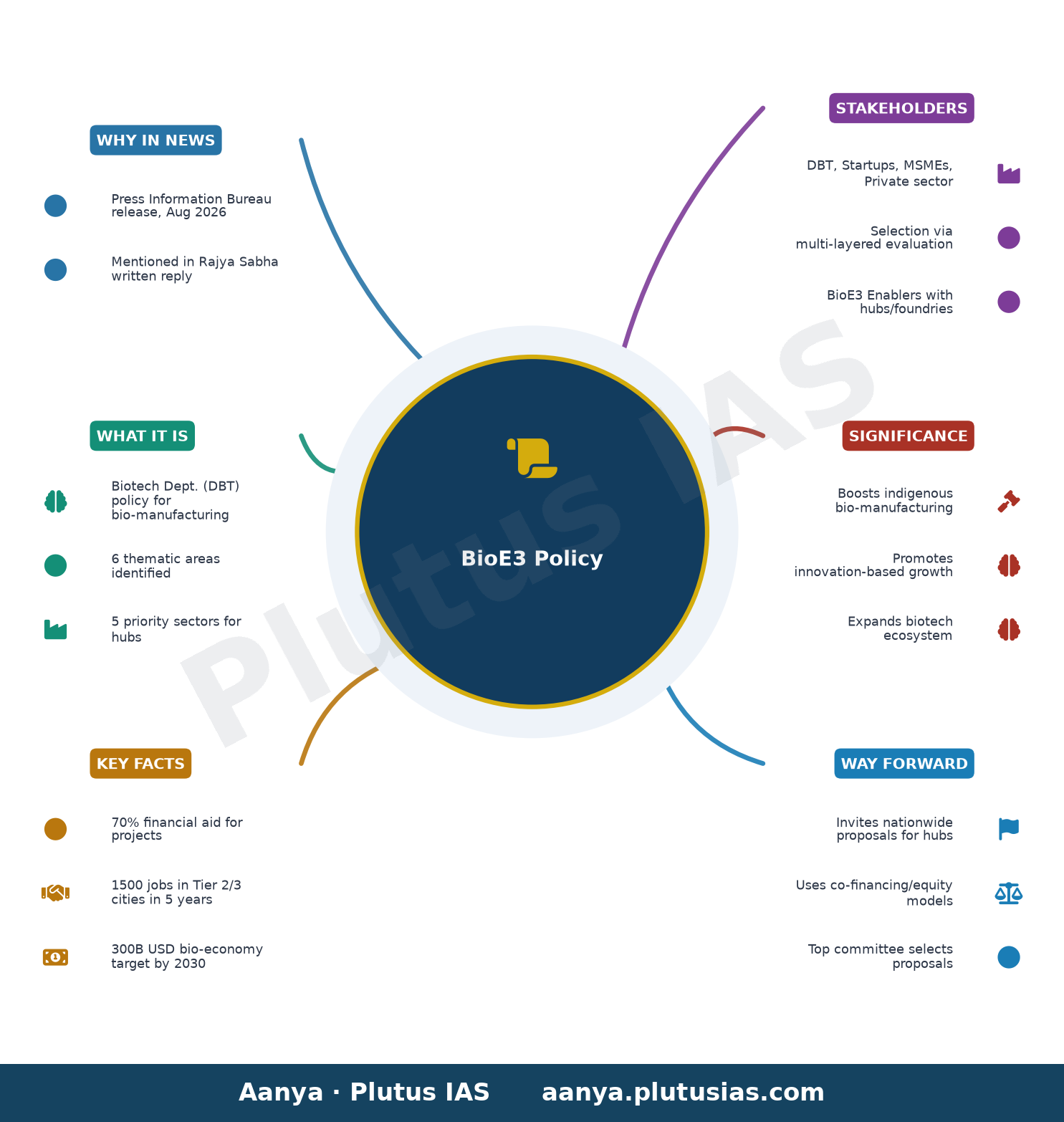
✎ BioE3 policy aims to strengthen India's bio-manufacturing, create jobs, and achieve a $300B bio-economy by 2030 through financial aid, hubs, and stakeholder collaboration.
Relevance for Banking, SSC & RBI Grade B exams: Polity & Governance
The **BioE3 Policy**, launched by the Department of Biotechnology (DBT), aims to boost high-potential bio-manufacturing in India by fostering innovation, sustainability, and employment. Under this policy, six thematic areas—including bio-based chemicals, bioplastics, active pharmaceutical ingredients, functional foods, precision biomedicine, climate-resilient agriculture, biofuels, and marine/space biotechnology—have been identified to strengthen indigenous capabilities. The policy also prioritizes five key sectors: Ayurveda, genomic diagnostics, synthetic biology, biomolecular design, and bio-AI hubs. By establishing **bio-manufacturing hubs, biofoundries, and bio-AI centers**, the initiative invites proposals through a rigorous multi-level evaluation process, ensuring technical and financial feasibility. This aligns with India’s goal of achieving a **$300 billion bio-economy by 2030**, while creating around **1,500 direct and indirect jobs** in tier-II and tier-III cities over the next five years. The policy’s emphasis on **public-private partnerships**, with up to **70% financial support** for projects, encourages startups, MSMEs, and industries to participate actively, driving self-reliance in biotechnology.
For **Banking, SSC, and RBI Grade B aspirants**, the BioE3 Policy holds significant relevance in governance, economy, and employment sectors. The policy’s focus on **bio-manufacturing and innovation** reflects India’s push toward **Make in India**, which can influence financial sector policies, including credit allocation for green industries and startups. For **SSC aspirants**, understanding such policies helps in **general awareness** sections, particularly in topics like employment generation, government schemes, and economic reforms. Meanwhile, **RBI Grade B candidates** may analyze its impact on **monetary policy, inflation control through sustainable practices, and sectoral credit growth** in bio-economy-driven industries. The policy also underscores **public-private partnerships (PPP)**, a key concept in banking and financial governance, making it a potential question in **descriptive exams** on economic policies.
Source: PIB (Press Information Bureau)
Generated by AanyaAi for educational purpose.
