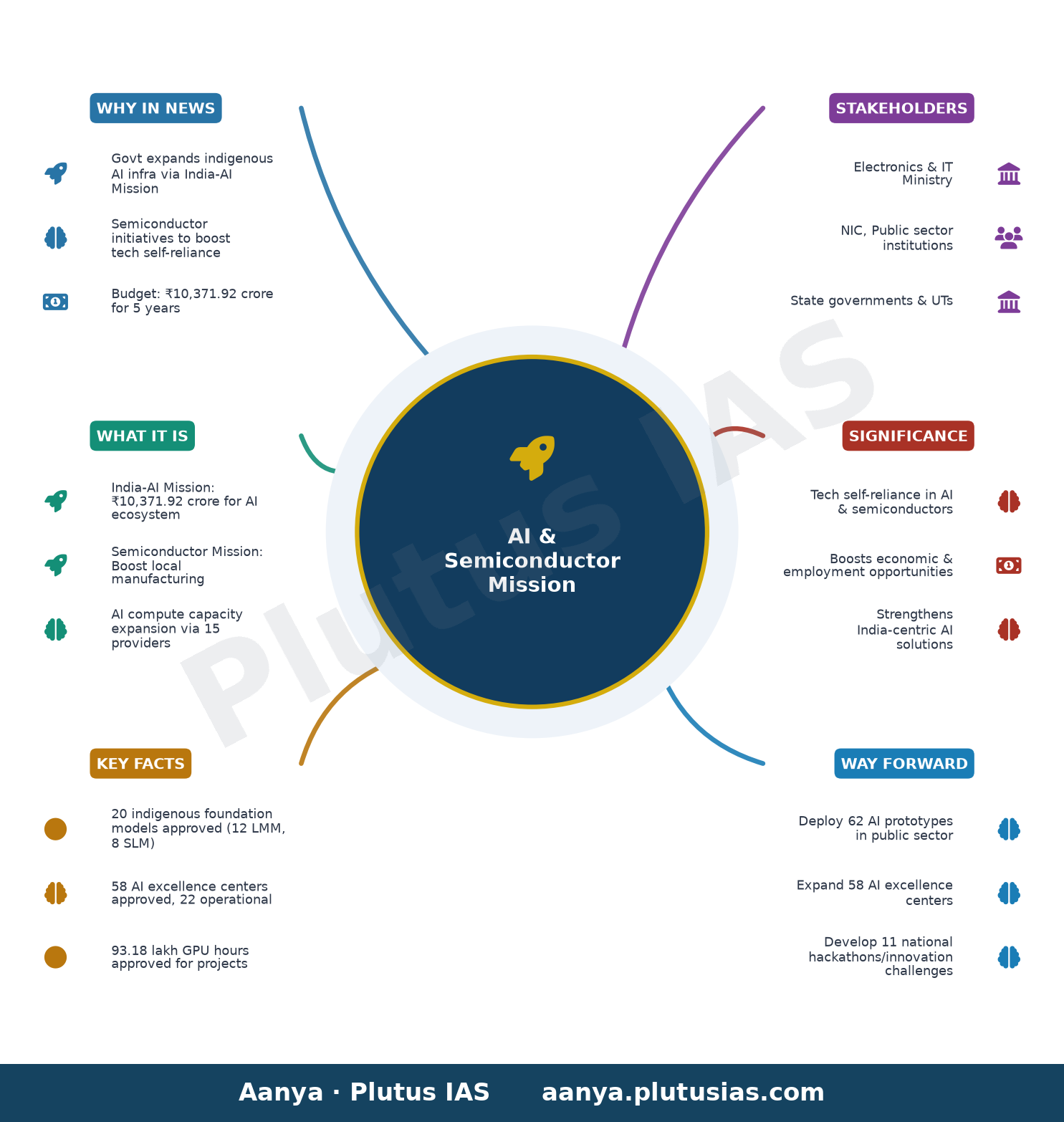
✎ India’s AI & semiconductor missions aim for tech self-reliance with ₹10,371.92 crore investment, 20 indigenous models, and 58 AI centers.
Relevance for Banking, SSC & RBI Grade B exams: Polity & Governance
The government has expanded indigenous AI infrastructure through initiatives like the ‘India-AI Mission’ and semiconductor projects, aiming to strengthen self-reliance in technology. The ‘India-AI Mission,’ approved in March 2024 with a ₹10,371.92 crore budget, focuses on developing homegrown AI models, including 20 indigenous foundational models—12 large multimodal and 8 small language models—with intellectual property rights retained by applicants. Additionally, the mission has approved 237 projects for subsidized AI computing support, deployed 20 AI solutions in public institutions, and established 58 AI excellence centers across states, fostering innovation and skill development. These efforts align with the government’s vision to make AI accessible, address India-specific challenges, and create economic and employment opportunities while reducing reliance on foreign AI hardware.
The semiconductor initiatives, including the ‘Semicon India Programme’ (₹1.64 lakh crore investments) and the recently launched ‘Semicon 2.0’ (₹1,27,500 crore budget), aim to boost domestic chip manufacturing, design, and advanced packaging. These projects are critical for sectors like defense, telecom, and automotive, enhancing India’s technological sovereignty. The government’s focus on AI and semiconductor self-sufficiency is reflected in India’s rising global AI competitiveness, as per the Stanford Global AI Vibrancy Report 2025, where India ranks third in AI ecosystem vitality. For banking, SSC, and RBI Grade B aspirants, these developments highlight the importance of India’s push toward digital self-reliance, which impacts financial inclusion, cybersecurity, and economic policies—key areas for exam preparation.
Source: PIB (Press Information Bureau)
Generated by AanyaAi for educational purpose.
