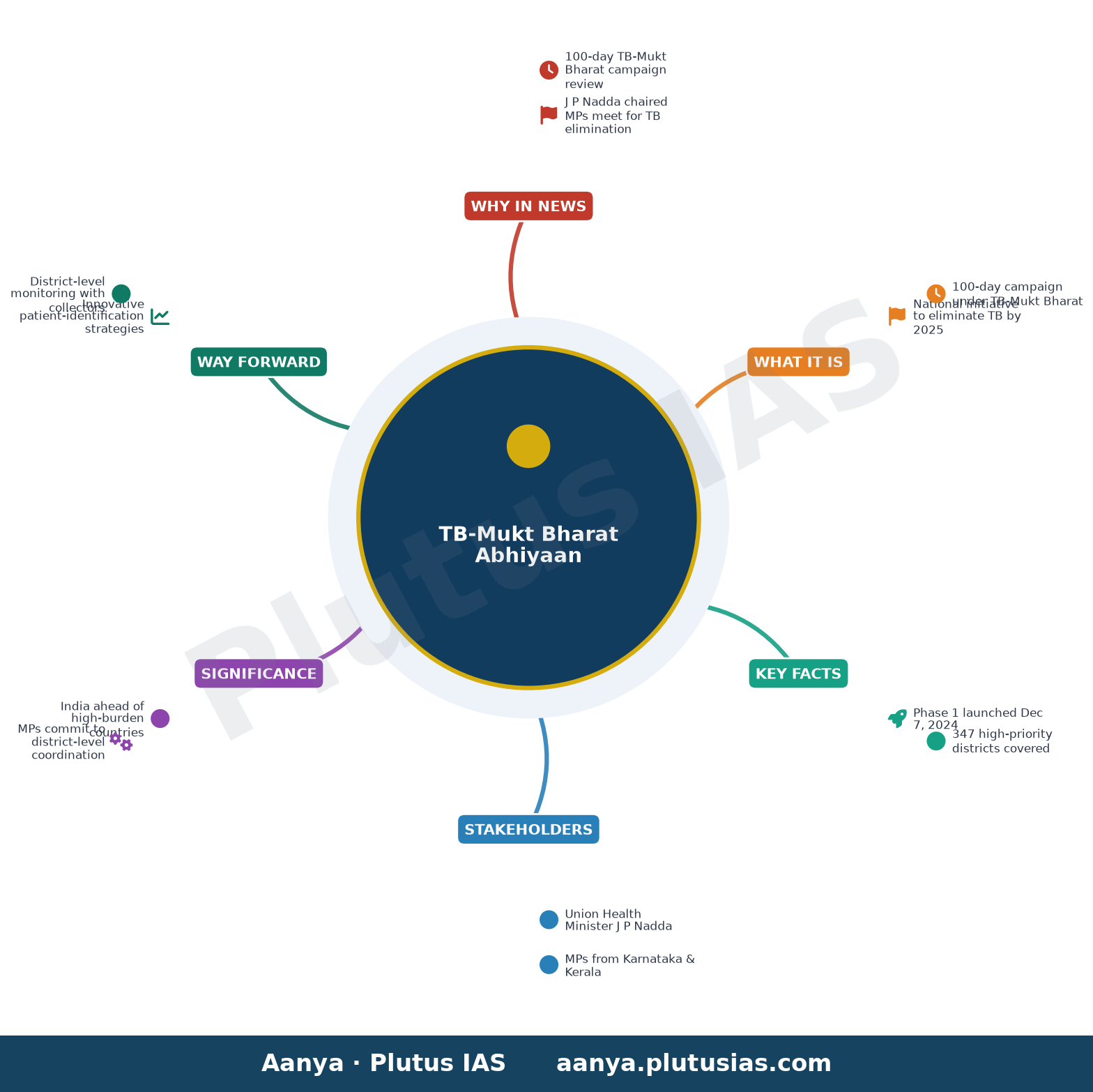
✎ TB-Mukt Bharat Abhiyaan aims for 2025 elimination with 100-day campaign, MP-led district coordination, and patient-centric strategies.
Relevance for Banking, SSC & RBI Grade B exams: Polity & Governance
The recent meeting chaired by Union Health Minister Jagat Prakash Nadda with MPs from Karnataka and Kerala highlights the government’s intensified efforts under the *TB-Mukt Bharat Abhiyaan* to eliminate tuberculosis by 2025. The discussion underscored the critical role of political leadership in accelerating TB eradication through district-level coordination, innovative patient-identification strategies, and community-driven awareness campaigns. The 100-day campaign, which concluded in July 2026, screened over 2.02 crore high-risk individuals, detected 7 lakh new TB cases—including 1.97 lakh asymptomatic ones—and achieved a 92% treatment coverage rate, surpassing global averages. This aligns with governance themes relevant to banking and SSC exams, where questions on government schemes, public health policies, and inter-departmental coordination often appear.
For RBI Grade B aspirants, the focus on *TB-Mukt Bharat* reflects broader themes of public health governance, data-driven policymaking, and multi-stakeholder collaboration—key areas in the exam’s *Economic and Social Issues* syllabus. The campaign’s success hinges on technological innovations like AI-enabled portable X-rays and molecular testing, which tie into India’s push for digital public health infrastructure. SSC aspirants may encounter questions on the campaign’s outreach mechanisms or its impact on socio-economic indicators, while banking exams could test awareness of government-funded health initiatives as part of financial inclusion policies. The meeting also emphasized the role of MPs in grassroots monitoring, a governance model that could be linked to questions on decentralized administration or flagship schemes in competitive exams.
Source: PIB (Press Information Bureau)
Generated by AanyaAi for educational purpose.
