
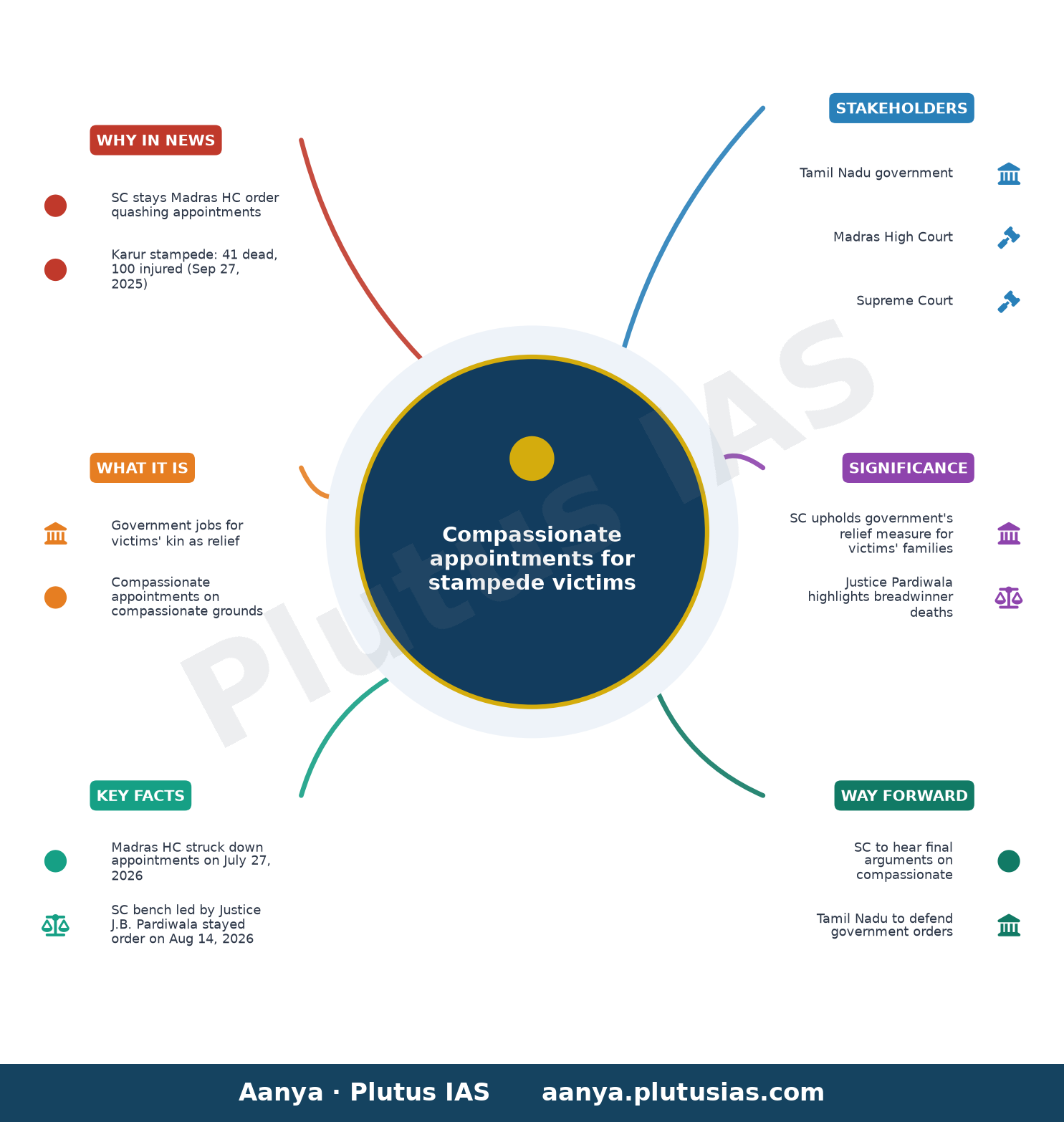
✎ SC stays Madras HC order, upholding compassionate appointments for stampede victims' kin as relief measure.
Relevance for Banking, SSC & RBI Grade B exams: Polity
The Supreme Court’s interim stay on the Madras High Court’s order quashing compassionate appointments for the kin of Karur stampede victims holds significant relevance for banking, SSC, and RBI Grade B exam aspirants, particularly in polity and governance sections. The case underscores constitutional principles like Article 14 (equality) and Article 21 (due process), which are frequently tested in competitive exams. The Supreme Court’s observation on the state’s executive authority under Article 162 and the balance between humanitarian relief and legal compliance reflects the judicial scrutiny of administrative actions—a key topic in public administration and constitutional law. For banking and SSC aspirants, understanding such judicial interventions in government policies is crucial, as questions often probe the interplay between constitutional provisions and executive decisions, especially in welfare schemes or disaster management contexts.
The ruling also highlights the debate over compassionate appointments, a recurring theme in governance and ethics-related questions. The Madras High Court’s caution about potential misuse of such appointments and the Supreme Court’s emphasis on humane considerations provide insights into judicial restraint and activism, topics relevant for RBI Grade B exams focusing on economic governance and policy implementation. Aspirants should note how the judiciary interprets constitutional limits on executive power, a concept tested in mains examinations. The case exemplifies how courts balance individual rights with state obligations, a theme that aligns with syllabus topics like judicial review, fundamental rights, and administrative law—areas where competitive exams often frame analytical questions.
Source: The Hindu
Generated by AanyaAi for educational purpose.
