
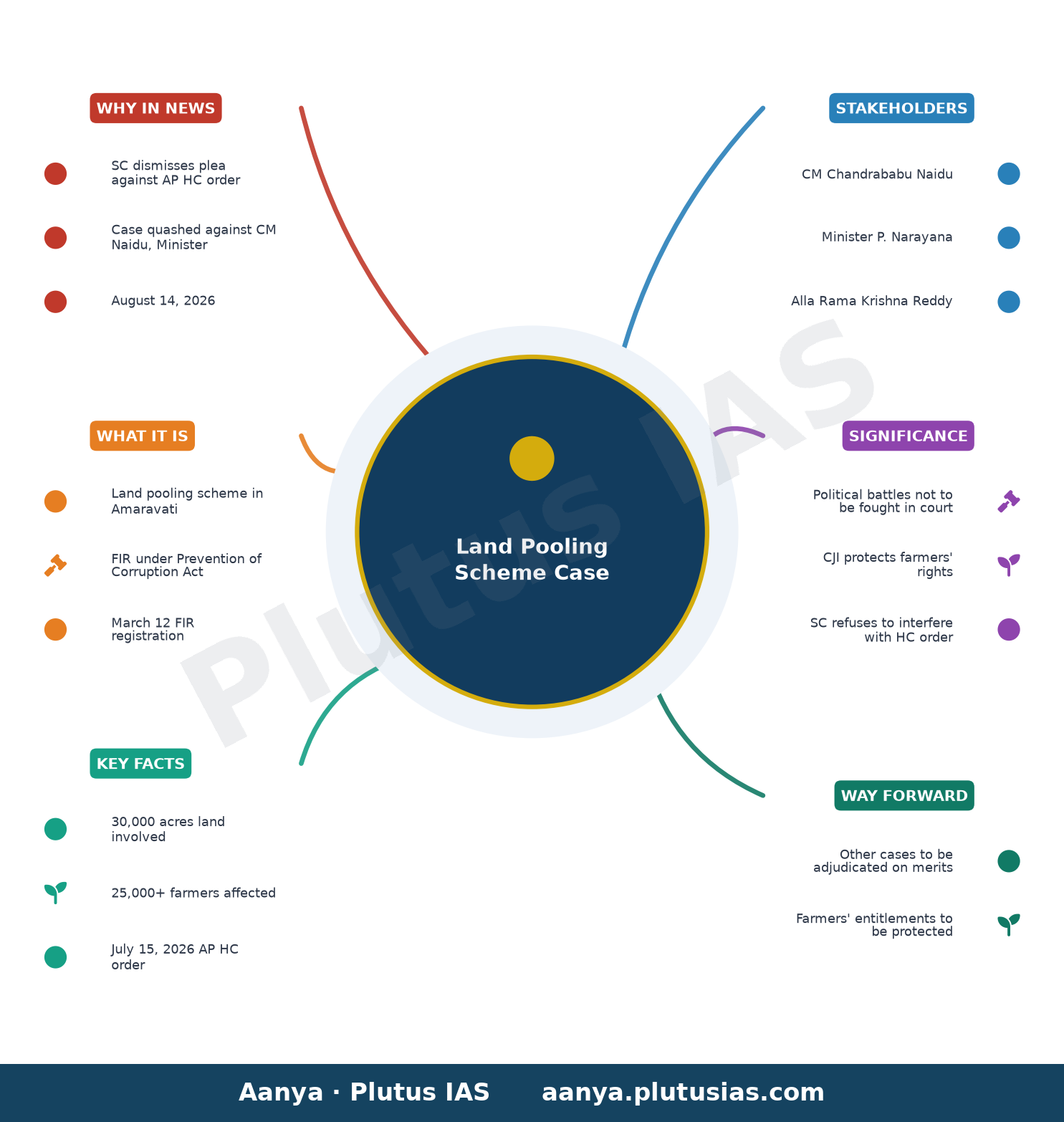
✎ SC upheld AP HC order quashing land pooling case against CM Naidu, emphasizing political disputes should not be fought in courts.
Relevance for Banking, SSC & RBI Grade B exams: Polity & Governance
The Supreme Court’s dismissal of a plea challenging the Andhra Pradesh High Court’s order quashing a case against Chief Minister N. Chandrababu Naidu and Minister P. Narayana in the Amaravati land pooling scheme case underscores the judiciary’s stance on avoiding political battles in courts. The apex court, led by Chief Justice Surya Kant, refused to interfere with the High Court’s July 15, 2026, order, emphasizing that the outcome of this petition would not impact other cases, which must be decided on their own merits. The CJI’s observation that “political battles should not be fought in court” highlights the judiciary’s role in preventing misuse of legal processes for political gains, a principle relevant for governance and legal frameworks in competitive exams like IBPS, SBI, and RBI Grade B, where questions on judicial activism and separation of powers often appear.
For banking and SSC aspirants, this case is significant as it touches upon land acquisition policies, judicial review of executive actions, and the balance of power between the judiciary and legislature. Questions in these exams may probe the legal provisions under the Prevention of Corruption Act, IPC, and SC/ST Act cited in the case, as well as the functioning of the Andhra Pradesh Capital Region Development Authority (APCRDA). The land pooling scheme’s structure—where farmers received developed plots in exchange for pooled agricultural land—also reflects economic policies and rural development initiatives, which are key topics in banking awareness and general studies sections of exams like RBI Grade B and SSC CGL.
Source: The Hindu
Generated by AanyaAi for educational purpose.
