
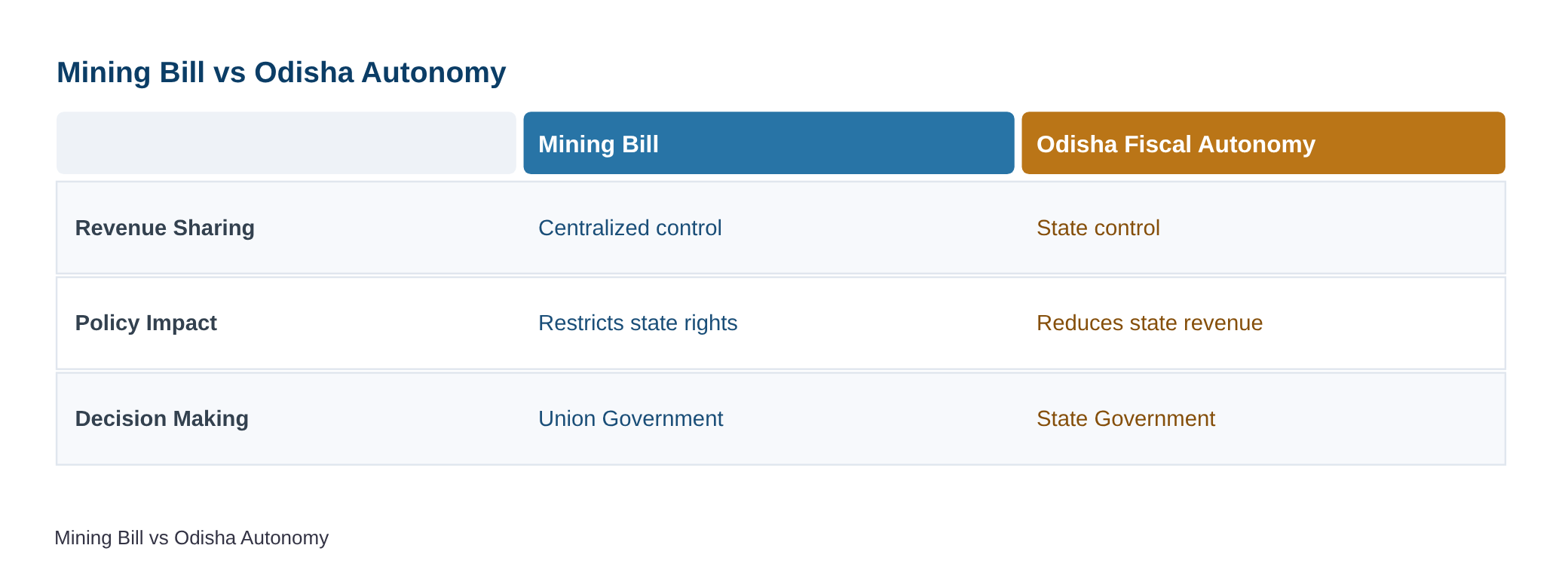
✎ MMDR Amendment Bill 2026 risks fiscal autonomy of mineral-rich states like Odisha by centralizing mineral governance.
Relevance for Banking, SSC & RBI Grade B exams: Polity
The recent controversy surrounding the *Mines and Minerals (Development and Regulation) Amendment Bill, 2026* has sparked a debate on federalism and fiscal autonomy, particularly for mineral-rich states like Odisha. BJD president Naveen Patnaik has criticized the Bill, arguing that it centralizes control over mineral resources, thereby undermining the state’s constitutional rights and revenue-generating capacity. His demand for an all-party meeting reflects broader concerns about the Bill’s potential to erode State-level decision-making, which could have implications for resource-rich regions’ ability to fund welfare schemes and infrastructure development. For banking and SSC aspirants, this issue highlights the importance of understanding intergovernmental fiscal relations, a topic often tested in exams like RBI Grade B and UPSC CSE, where federalism and resource allocation are key themes.
The Bill’s passage in Parliament has also drawn criticism from other state leaders, such as Jharkhand’s Hemant Soren, who termed it a “black Bill,” signaling potential nationwide opposition. For banking and SSC aspirants, this scenario underscores the significance of constitutional provisions related to federalism, taxation powers, and resource governance—areas frequently examined in exams like IBPS PO and SBI Clerk. Understanding such legislative developments is crucial for aspirants preparing for economic and governance-related questions, as it reflects real-time challenges to fiscal federalism in India.
Source: The Hindu
Generated by AanyaAi for educational purpose.
