
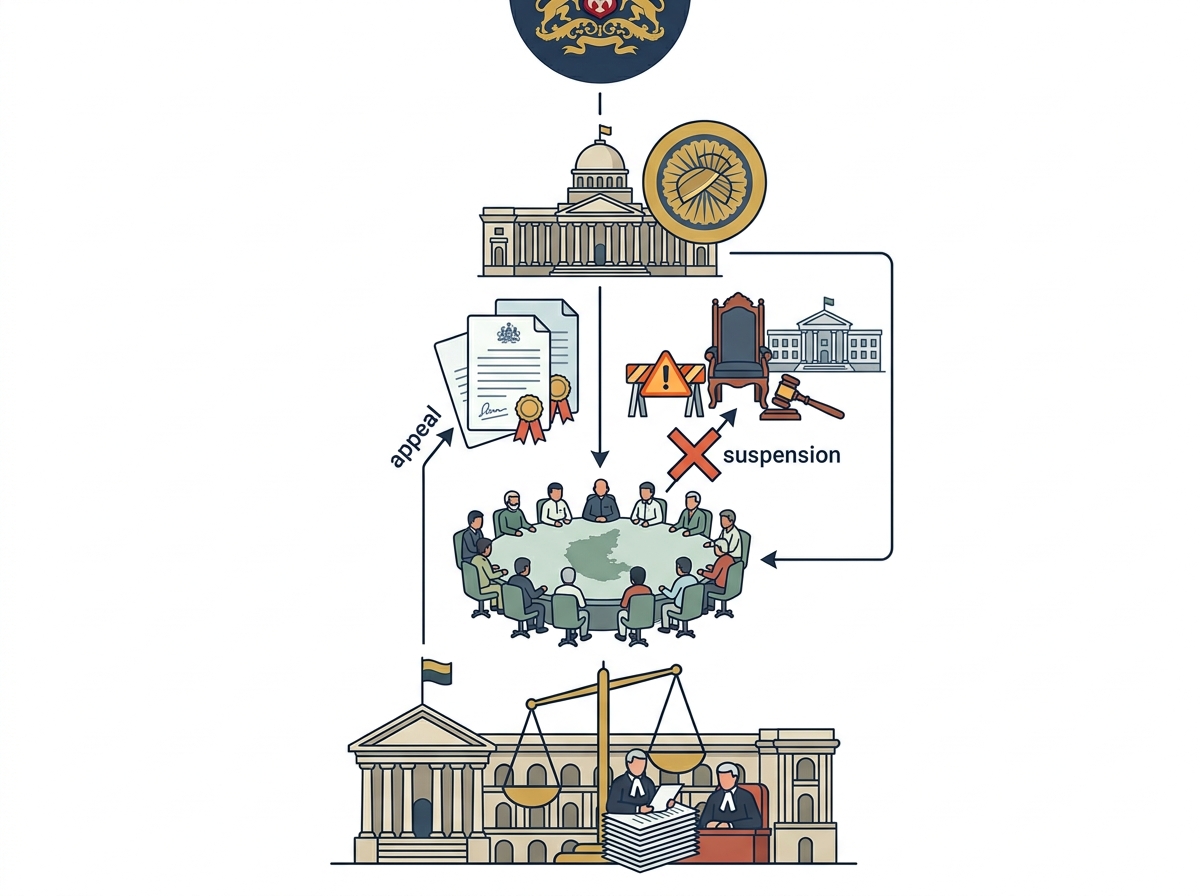
✎ Governor's power to suspend KPSC chairperson without prior Cabinet advice is under judicial review, testing constitutional doctrines and executive-judicial balance.
Relevance for Banking, SSC & RBI Grade B exams: Polity
The Karnataka High Court will examine the Governor’s appeal challenging a single judge’s ruling that the Governor cannot suspend the KPSC chairperson without the Cabinet’s prior advice, even in urgent circumstances. The Division Bench, led by Chief Justice Vibhu Bakhru and Justice K.S. Hemalekah, has adjourned the hearing till December 2, 2026. The Governor’s appeal argues that the July 10 suspension was justified due to public outrage over alleged misconduct, including the chairperson’s failure to disclose his daughters’ participation in KPSC recruitments, and that the Council of Ministers’ post facto approval on July 19 validated the action under the doctrine of ratification. The appellant cited the Supreme Court’s ruling in *P.P. Singh* to assert that subsequent approval cures procedural flaws, emphasizing the Governor’s constitutional power under Article 317(2) to act decisively when an institution’s integrity is at stake.
This case holds significant relevance for banking, SSC, and RBI Grade B exams as it tests candidates’ understanding of constitutional provisions, particularly the Governor’s discretionary powers and the role of the Council of Ministers. Questions may arise on the separation of powers, the doctrine of ratification, and the interpretation of Article 317(2), which deals with the suspension of State Public Service Commission members. Aspirants should also note the interplay between judicial review and executive actions, as the High Court’s decision could set a precedent for similar constitutional disputes across states.
Source: The Hindu
Generated by AanyaAi for educational purpose.
