✎ Swachhta Udyami Yojana empowers waste collectors with financial aid to improve livelihoods.
Relevance for Banking, SSC & RBI Grade B exams: Security
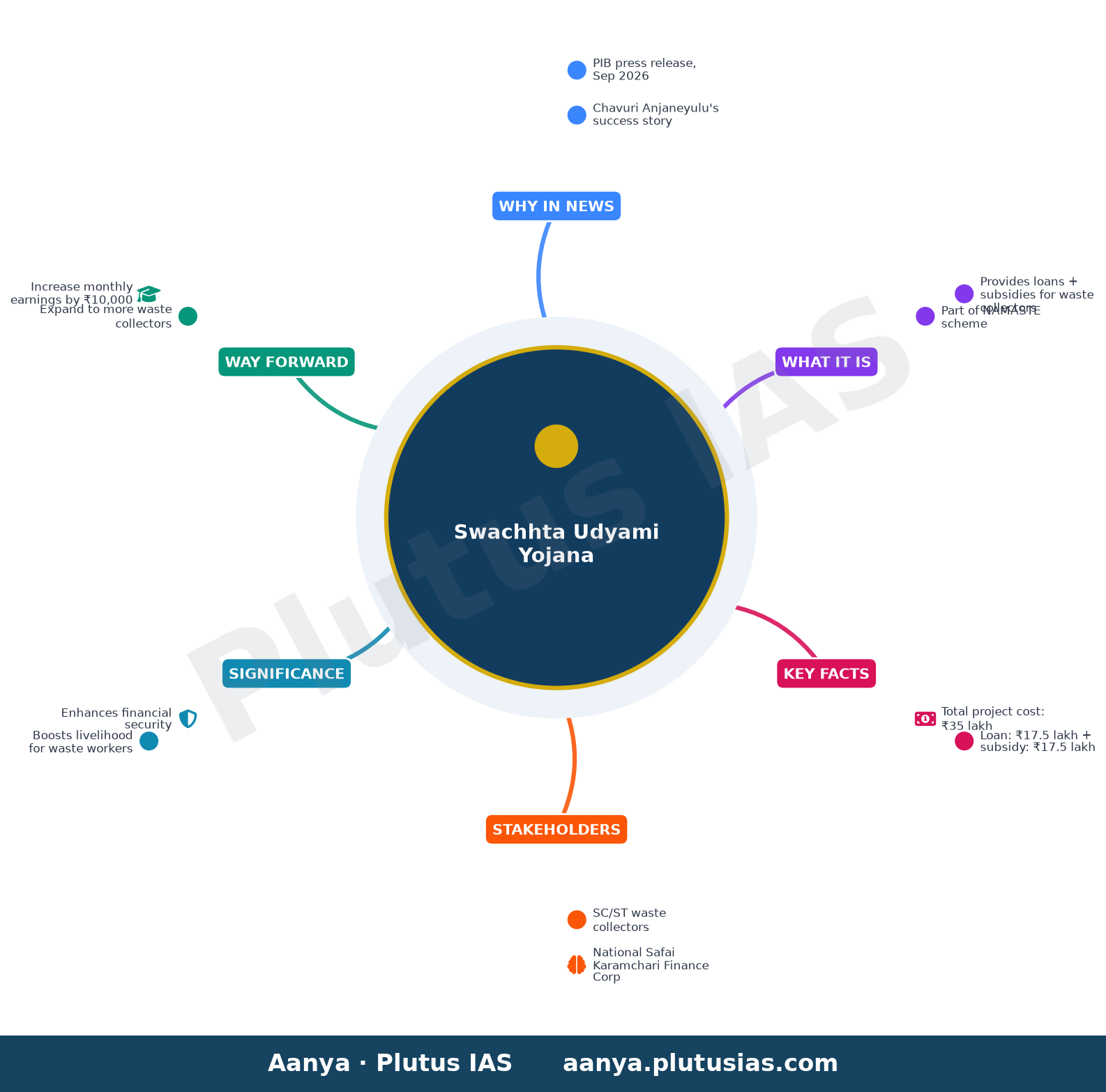
The story of Chavuri Anjaneyulu, a waste collector from Andhra Pradesh’s Guntur district, highlights how targeted government schemes like the *Swachhta Udyami Yojana (SUY)* under the *NAMASTE* initiative can transform livelihoods and enhance financial security. By providing a ₹35 lakh grant—comprising ₹17.5 lakh in loans and ₹17.5 lakh in capital subsidies—the scheme enabled Anjaneyulu to scale his income from waste collection to an additional ₹10,000 monthly. This financial boost allowed him to enroll his children in private English-medium schools and secure their future, breaking the cycle of poverty and social exclusion he faced due to his community’s marginalized status. The initiative underscores the role of structured financial support in fostering upward mobility, a theme that resonates with banking and finance exams, where questions on government welfare schemes, financial inclusion, and poverty alleviation are common. For SSC aspirants, the case study serves as a real-world example of how socio-economic policies impact vulnerable sections, aligning with topics like social justice and economic empowerment.
For RBI Grade B and banking exams, Anjaneyulu’s transformation reflects broader themes of financial inclusion, rural development, and the impact of credit subsidies on informal sector workers. The SUY scheme, implemented through the *National Safai Karamchari Finance and Development Corporation (NSKFDC)*, exemplifies how targeted credit and skill development can integrate marginalized communities into the formal economy. This aligns with RBI’s focus on inclusive growth and the banking sector’s role in extending financial services to underserved groups. For SSC exams, the narrative ties into questions on government schemes, constitutional provisions for scheduled tribes, and the socio-economic challenges of manual scavengers—key areas in the General Studies syllabus. The case also illustrates the interplay between social welfare and economic policies, a critical perspective for aspirants preparing for policy-based questions in competitive exams.
Source: PIB (Press Information Bureau)
Generated by AanyaAi for educational purpose.

1 comment on “How Swachhta Udyami Yojana Transformed a Waste Picker’s Financial Security”