
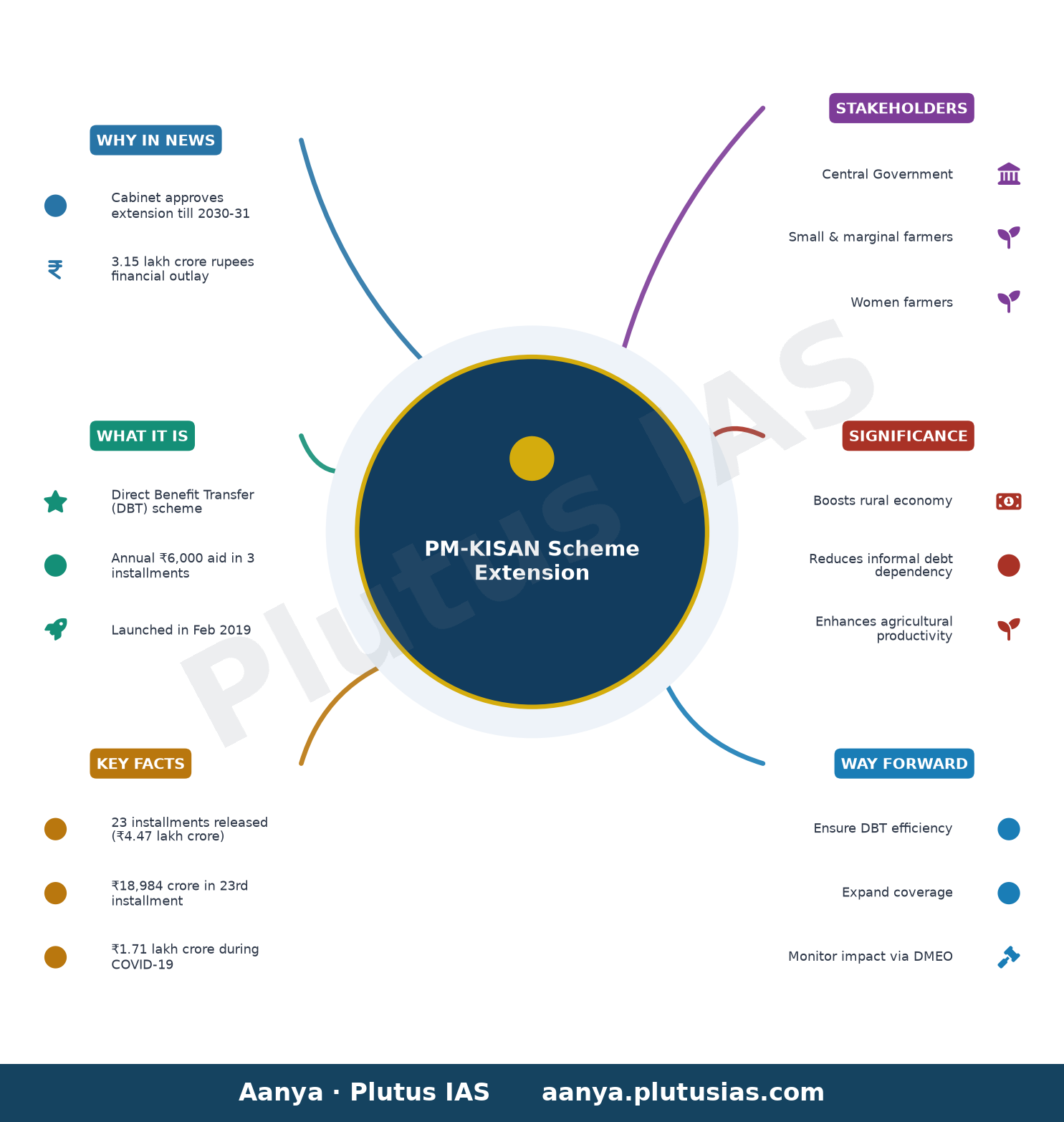
✎ PM-KISAN provides ₹6,000/year to farmers via DBT, extended till 2030-31 with ₹3.15 lakh crore budget.
Relevance for Banking, SSC & RBI Grade B exams: Polity & Governance
The Union Cabinet, chaired by Prime Minister Narendra Modi, has approved the continuation of the Pradhan Mantri-Kisan Samman Nidhi (PM-KISAN) scheme for the period 2026-27 to 2030-31 with a financial outlay of ₹3.15 lakh crore. Launched in February 2019, PM-KISAN provides direct income support of ₹6,000 annually to eligible landholding farmer families in three equal installments through Direct Benefit Transfer (DBT), ensuring timely and transparent financial assistance. The scheme leverages digital tools like Aadhaar-based authentication and robust DBT systems to enhance transparency, efficiency, and accountability, benefiting over 9.49 crore farmers in its 23rd installment alone, with cumulative transfers exceeding ₹4.47 lakh crore. Notably, women farmers constitute nearly one-fourth of the beneficiaries, receiving over ₹1.06 lakh crore, while the scheme played a crucial role during the COVID-19 pandemic by disbursing over ₹1.71 lakh crore to support agricultural activities.
This decision holds significant relevance for banking, SSC, and RBI Grade B examinations as it underscores key governance and welfare initiatives in India. For banking aspirants, understanding PM-KISAN highlights the role of DBT in financial inclusion and direct benefit schemes, a topic often tested in exams like IBPS and SBI PO. SSC candidates may encounter questions on government welfare schemes, digital governance, and their socio-economic impact, while RBI Grade B exams may focus on the scheme’s role in rural economy strengthening, agricultural productivity, and its alignment with self-reliant India goals. The scheme’s success in leveraging technology for transparency also reflects broader themes of digital public infrastructure, making it a critical case study for governance-related questions.
Source: PIB (Press Information Bureau)
Generated by AanyaAi for educational purpose.
