
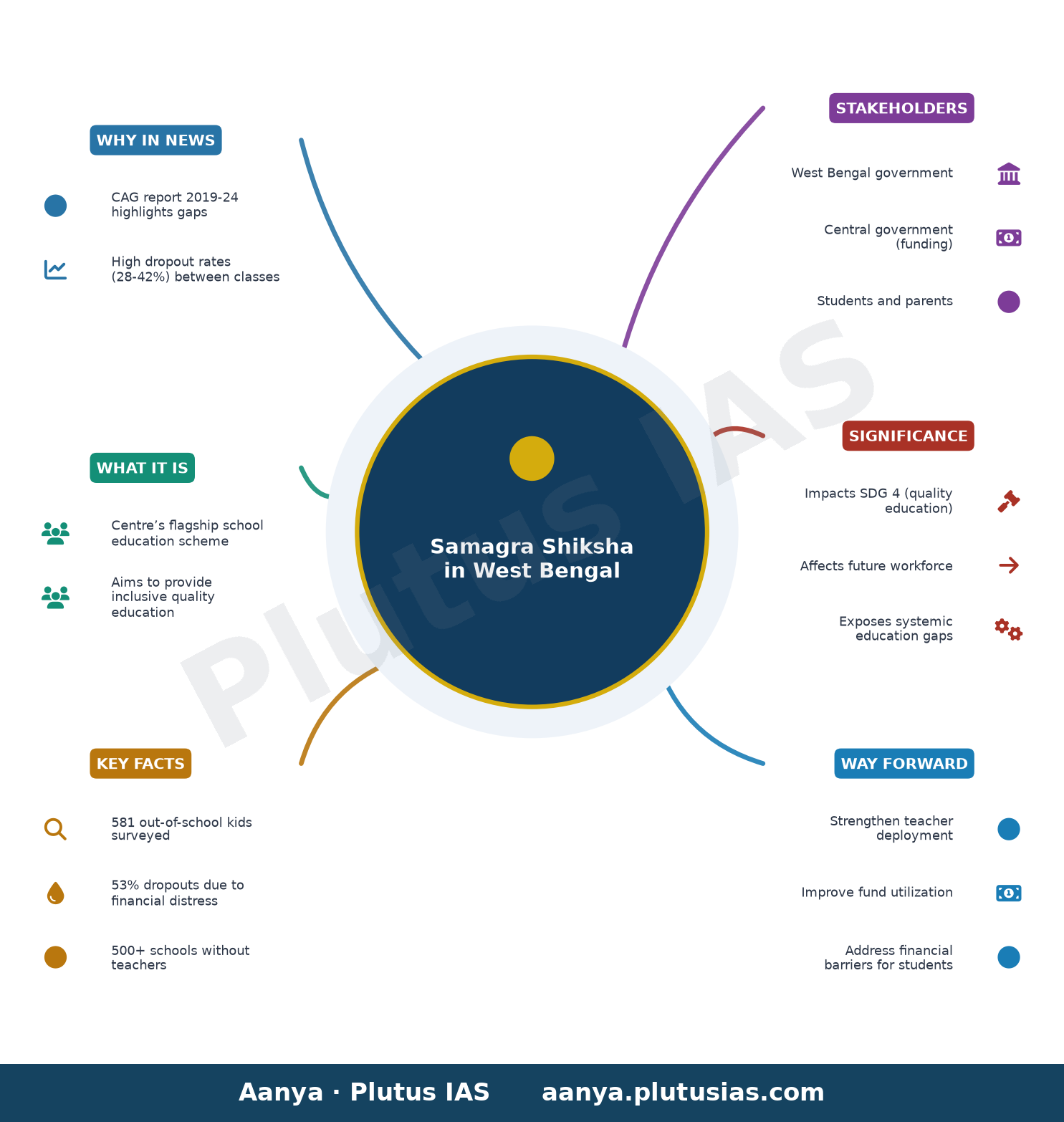
✎ Samagra Shiksha in West Bengal faces dropout, teacher shortage, and fund gaps, threatening inclusive education as per CAG audit.
Relevance for Banking, SSC & RBI Grade B exams: Economy/Governance
A recent Comptroller and Auditor General (CAG) report has exposed critical gaps in West Bengal’s implementation of the Samagra Shiksha scheme, a centrally sponsored initiative aimed at universalizing quality education. The audit, covering 2019-20 to 2023-24, revealed alarming dropout rates (28-42% between upper primary and higher secondary levels), severe teacher shortages, and underutilization of funds. Over 500 schools operated without any teachers, while 5,152 schools had just one teacher, impacting nearly 1.8 lakh students. Financial constraints, early marriage, and migration for work were cited as major reasons for dropouts, with 53% of surveyed parents citing poverty as the primary factor. Fund utilization remained dismally low (46-65%), with delays in central and state fund releases and unexecuted sanctioned works leading to a surrender of ₹395 crore and a shortfall of ₹2,428 crore in central funding, further crippling the scheme’s reach.
For banking and SSC aspirants, this report underscores the importance of public finance management and governance challenges, directly relevant to RBI Grade B’s economic and social issues sections. The inefficiencies in fund utilization and teacher deployment highlight systemic issues in India’s education sector, a key topic in banking exams like SBI PO and IBPS, where questions often probe the impact of government schemes on socio-economic development. SSC aspirants preparing for the General Studies paper will find this case study useful in understanding the role of audits (like CAG) in governance and the challenges in implementing flagship programs, a recurring theme in competitive exams.
Source: The Hindu
Generated by AanyaAi for educational purpose.
