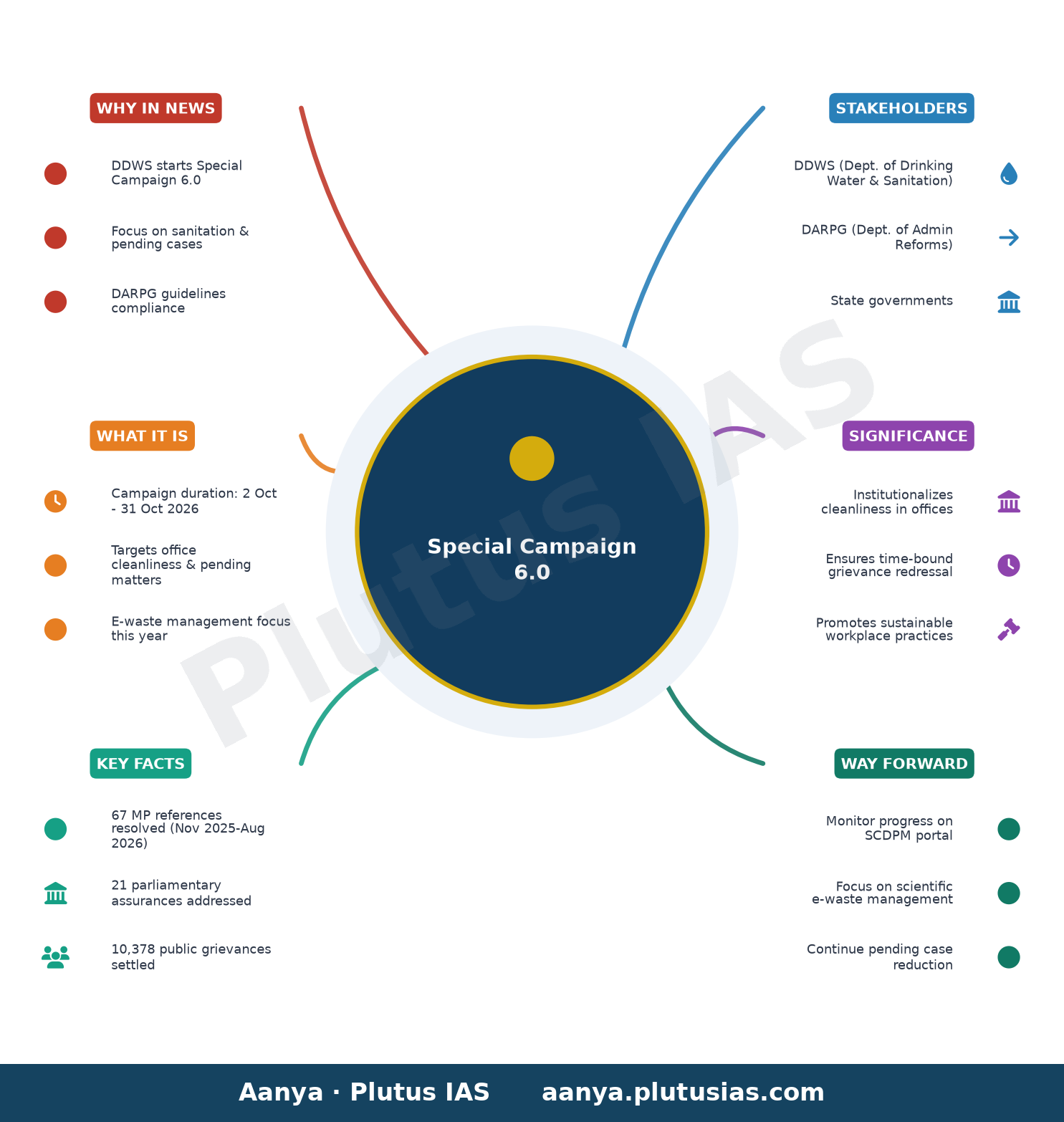
✎ Special Campaign 6.0 aims to institutionalize cleanliness, ensure time-bound grievance redressal, and promote sustainable practices in DDWS offices.
Relevance for Banking, SSC & RBI Grade B exams: Polity & Governance
The Department of Drinking Water and Sanitation (DDWS) under the Ministry of Jal Shakti has initiated preparations for *Special Campaign 6.0*, to be implemented from 2 October to 31 October 2026 across its secretariat and regional offices. Aligned with the Department of Administrative Reforms and Public Grievances (DARPG) guidelines, the campaign prioritizes institutionalizing cleanliness practices, improving space management, and ensuring time-bound disposal of pending matters. Notably, it builds on the previous campaign’s achievements, including the resolution of 67 parliamentary references, 21 assurances, 3 cabinet proposals, 13 state government references, 11 PMO references, 10,378 public grievances, and 2,346 grievance appeals between November 2025 and August 2026. For banking and SSC aspirants, this reflects the government’s emphasis on efficiency, transparency, and citizen-centric governance—key themes often tested in exams like IBPS PO, SBI Clerk, and SSC CGL, where questions on administrative reforms and public service delivery are common.
The campaign’s focus on scientific e-waste management underscores the growing importance of sustainable practices in governance, a topic increasingly relevant for RBI Grade B and SSC exams. By integrating environmental responsibility into office operations, DDWS aims to promote eco-friendly workplace practices, aligning with national sustainability goals. For aspirants, this highlights the intersection of governance with environmental and technological policies, a critical area for static GK and current affairs sections. Understanding such initiatives helps candidates grasp broader policy frameworks, which are frequently assessed in descriptive papers and interviews for competitive exams.
Source: PIB (Press Information Bureau)
Generated by AanyaAi for educational purpose.
