
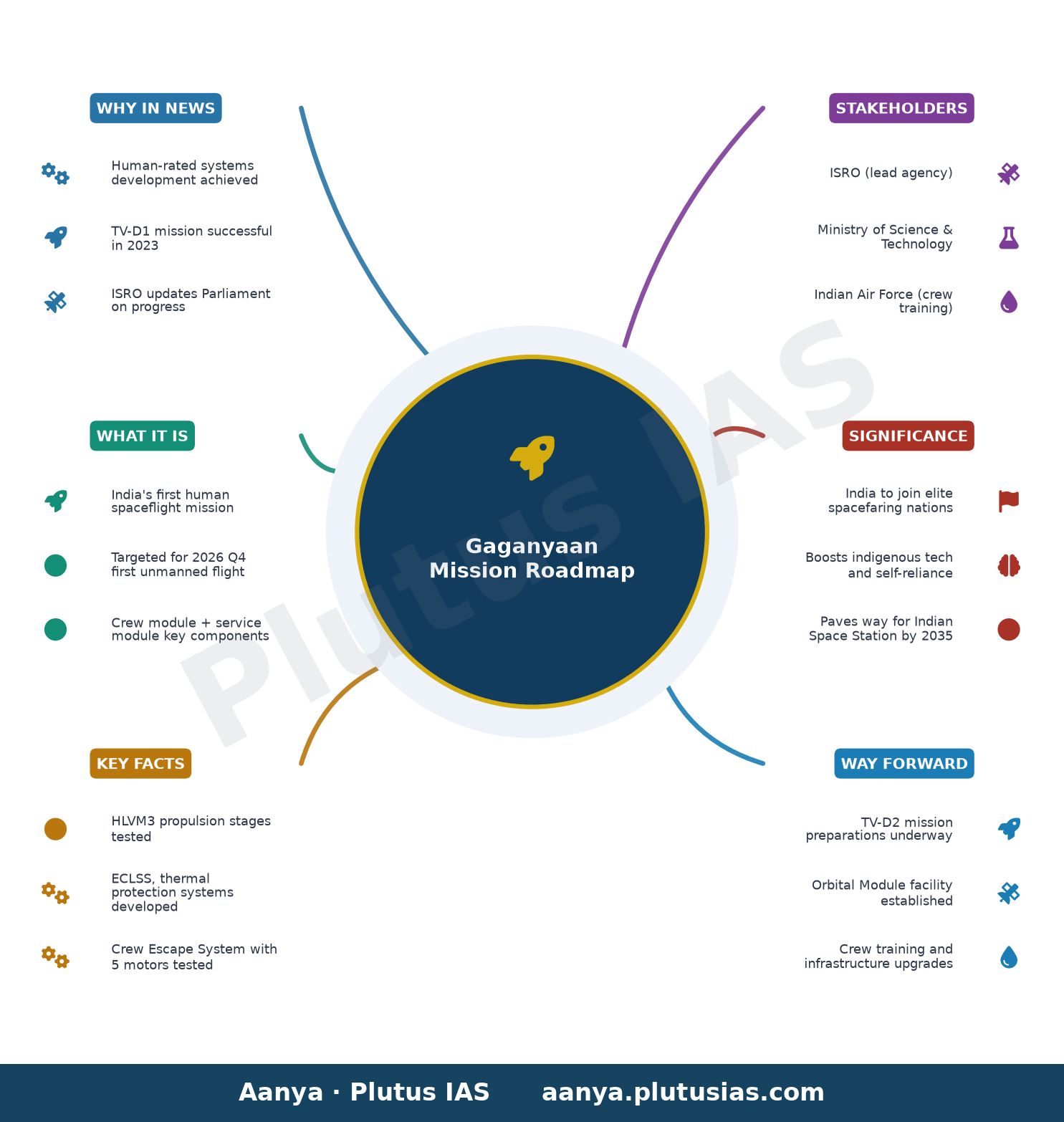
✎ Gaganyaan mission marks India's leap in human spaceflight with indigenous tech and 2026 unmanned flight target.
Relevance for Banking, SSC & RBI Grade B exams: Polity & Governance
Dr. Jitendra Singh, Union Minister of State (Independent Charge) for Science & Technology, Earth Sciences, and Space, recently informed the Rajya Sabha about the significant progress of India’s maiden human spaceflight mission, *Gaganyaan*, and the country’s broader roadmap for human space exploration. The mission has achieved critical human-rating milestones, including the development and certification of the human-rated launch vehicle (HLVM3), crew and service module propulsion systems, environmental control and life support systems (ECLSS), thermal protection systems, and crew escape mechanisms. Key tests, such as the TV-D1 mission validating the crew escape system and integrated air-drop tests for deceleration systems, have been successfully completed, with further preparations underway for TV-D2. The government has also established critical mission infrastructure, including orbital module preparation facilities and ground communication networks, in collaboration with international agencies like ESA, ASI, CNES, and Roscosmos. The first uncrewed *Gaganyaan* mission carrying *Vyommitra*, a half-humanoid, is targeted for the fourth quarter of 2026, followed by two additional uncrewed missions before the first crewed orbital flight in 2027. Long-term plans include establishing the *Bharatiya Antariksha Station* (BAS) by 2035, with the first module, BAS-01, already approved for development.
This development holds strong relevance for Banking, SSC, and RBI Grade B exam aspirants, particularly in the Polity & Governance and Science & Technology segments. For Banking exams like IBPS PO and SBI Clerk, questions may focus on the government’s role in funding such high-cost missions—highlighting budgetary allocations (₹20,193 crore) and inter-ministerial coordination under the Department of Space. SSC aspirants may encounter questions linking *Gaganyaan* to India’s technological self-reliance (*Atmanirbhar Bharat*), international collaborations, or constitutional provisions related to space research (Entry 71, Union List). RBI Grade B candidates preparing for Economic & Social Issues (ESI) sections might analyze the mission’s macroeconomic implications, such as job creation in aerospace, R&D investments, and India’s position in the global space economy. The mission also underscores India’s strategic autonomy in space, a recurring theme in governance-related current affairs.
Source: PIB (Press Information Bureau)
Generated by AanyaAi for educational purpose.
